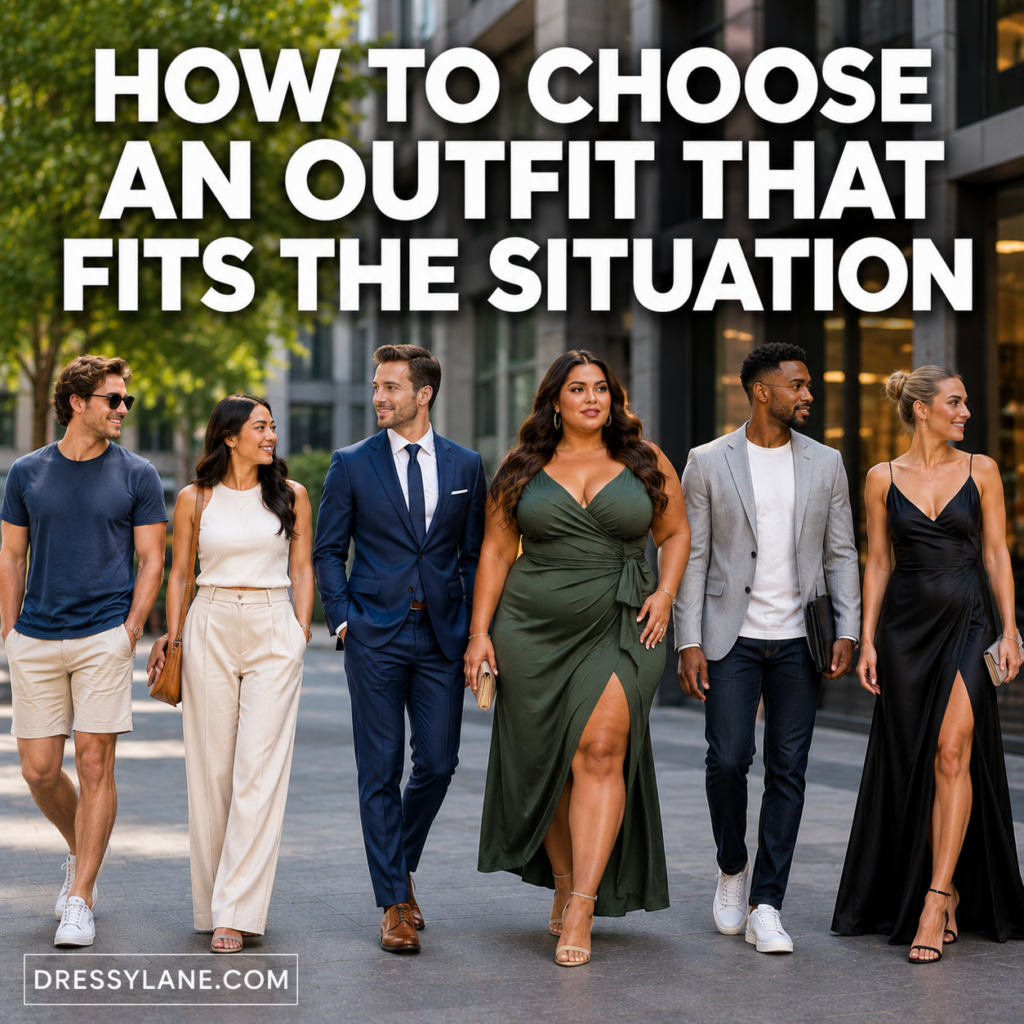
Choosing the right outfit is less about memorizing fashion rules and more about reading the situation correctly.
A summer wedding, job interview, dinner with friends, long flight, and memorial service might all require you to look “put together,” but what that means changes dramatically from one setting to another.
A useful outfit has to balance several things at once: the occasion, dress code, location, weather, practical demands, and your own comfort. Get those pieces right and choosing what to wear becomes much easier.
This guide explains a practical system you can use for almost any situation, whether you’re dressing for work, travel, a party, a formal event, or an occasion where the expectations aren’t completely clear.
How to Choose the Right Outfit: The Quick Method
Before opening your closet, answer these six questions:
- Where am I going?
- Why am I going there?
- How formal is it?
- What will I actually be doing?
- What will the weather and environment be like?
- Is there anything specific the host, employer, venue, or invitation expects?
These questions are more useful than starting with a particular shirt, dress, or pair of shoes.
For example, “dinner” alone doesn’t tell you enough.
Dinner could mean jeans and a knit top at a neighborhood restaurant, a midi dress at an anniversary dinner, or tailored trousers and a blazer for dinner at an upscale hotel.
The situation provides the context.
Start With the Setting
First, identify where the outfit will actually be worn.
Think about the physical environment as well as the type of event.
A few common settings include:
- Office
- Restaurant
- Hotel
- Wedding venue
- Religious building
- Conference center
- Outdoor garden
- Beach
- Private home
- Cocktail bar
- Airplane
- Funeral home
Location often gives you your first clue about formality.
A birthday party held around someone’s backyard pool requires a different outfit from a birthday dinner at an upscale restaurant, even though both events are technically birthday celebrations.
Similarly, an interview at a traditional financial firm may call for more conservative tailoring than an interview at a small creative agency.
For specific situations, see our guides to what to wear to a summer wedding as a guest, what to wear to a job interview, and what to wear to a dinner party.
Determine the Level of Formality
Once you know the setting, determine roughly where the occasion sits on the casual-to-formal spectrum.
You don’t have to identify the dress code with perfect precision. You simply need enough information to eliminate clothing that is obviously too casual or too formal.
Casual
Casual clothing works for everyday situations such as running errands, relaxed lunches, casual gatherings, sightseeing, or spending time with friends.
Examples include:
- Straight-leg jeans with a cotton T-shirt and clean sneakers
- Chinos with a polo or casual button-down shirt
- Linen trousers with a tank or simple blouse
- Casual cotton or jersey dresses
- Sweaters with jeans and loafers
Casual does not have to mean careless. Fit, condition, and coordination still matter.
Smart Casual
Smart casual sits between relaxed everyday clothing and traditional business attire.
Think:
- Dark jeans with a blouse and loafers
- Chinos with an Oxford shirt and leather sneakers
- Tailored trousers with a fine-gauge knit
- Midi dress with flats or low heels
- Unstructured blazer over a simple shirt
Smart casual is especially useful for restaurants, dates, informal work events, nicer social gatherings, and occasions where you know you should look polished but a suit would feel excessive.
Our guide to what smart casual style means explains this dress code in more detail.
Business Casual
Business casual is more workplace-oriented.
Common pieces include:
- Tailored trousers
- Knee-length or midi skirts
- Button-down shirts
- Blouses
- Knit polos
- Cardigans
- Loafers
- Simple dresses
- Blazers
Dark, non-distressed jeans may work in some offices, while others expect trousers or skirts.
Because workplace standards vary considerably, look at how established employees dress whenever possible.
See our complete guide to business casual style for more examples.
Formal
Formal situations require greater attention to fabric, construction, footwear, and finishing details.
Depending on the event, appropriate choices might include:
- A dark suit with a dress shirt
- A cocktail or midi dress
- A formal jumpsuit
- A floor-length gown
- A tuxedo
- Polished leather dress shoes
- Refined heels, flats, or dressy sandals
Always follow an explicitly stated dress code—particularly for weddings, galas, ceremonies, and formal dinners.
What to Do When the Dress Code Is Vague
Some of the hardest occasions are the ones where nobody tells you what to wear.
An invitation might simply say “dinner,” “celebration,” or “join us for drinks.”
Start looking for contextual clues.
Consider the venue, time of day, host, event type, invitation design, and anything you know about the other guests.
A Saturday afternoon barbecue at someone’s home points toward casual clothing. Drinks at 8 p.m. in an upscale hotel lounge suggest something more polished.
When the clues conflict, choose an outfit near the middle of the likely range.
Dark trousers, a neat shirt, simple leather shoes, an understated dress, a skirt with a polished knit, or a blazer that can be removed all give you room to adjust.
For more difficult invitations, see how to dress when the invitation is vague.
When You Don’t Want to Overdress
Being significantly overdressed can feel just as uncomfortable as being underdressed.
The solution isn’t automatically to dress down. Instead, choose clothing that is polished without looking ceremonial.
For example, instead of a full suit for an uncertain smart-casual dinner, try tailored trousers, a button-down shirt, and loafers. Instead of a cocktail dress, consider a simple midi dress with understated jewelry and flats.
You can also control formality through individual pieces.
A blazer makes an outfit more polished but can be removed. Leather loafers generally look dressier than athletic sneakers. Silk, satin, velvet, and highly structured tailoring tend to read more formally than cotton, denim, jersey, or linen.
Our guide to what to wear when you don’t want to overdress explores this middle ground in more detail.
Think About What You’ll Actually Be Doing
An outfit can be technically appropriate and still be completely impractical.
Before choosing it, imagine yourself several hours into the event.
Will you be:
- Walking several blocks?
- Sitting through a long dinner?
- Standing at a networking event?
- Dancing?
- Carrying luggage?
- Moving between air conditioning and outdoor heat?
- Sitting on grass?
- Taking public transportation?
These details matter.
Four-inch heels may look appropriate for a cocktail event but become frustrating if you have a 15-minute walk from the parking area. A heavy wool blazer might look excellent for a summer conference but become uncomfortable if you’ll be moving between buildings.
Function should influence your fabrics, layers, footwear, bag, and outerwear.
Dress for the Weather, Not Just the Calendar
“Summer clothes” and “winter clothes” are only starting points.
Check the actual conditions.
Hot Weather
In high temperatures, prioritize breathable fabrics such as:
- Linen
- Cotton
- Seersucker
- Chambray
- Lightweight tropical wool
Loose silhouettes can also improve airflow.
A linen shirt with chinos, for example, can look significantly more polished than a heavy T-shirt while remaining comfortable.
For very hot conditions, see what to wear during a heatwave and our broader guide to what to wear in summer.
Cold Weather
Instead of relying on one extremely heavy garment, build layers.
For example:
Base layer + knit + coat
or:
Shirt + cardigan + wool overcoat
Useful cold-weather materials include merino wool, cashmere, fleece, wool blends, and down or synthetic insulation when appropriate.
Our winter dressing guide covers this in more detail.
Rain and Unpredictable Weather
Consider the entire outfit, including footwear.
A beautiful suede shoe isn’t especially useful if you’re walking through heavy rain. Leather boots, water-resistant outerwear, and an umbrella may matter more than adding another accessory.
Choose Clothes That Let You Feel Comfortable in Your Body
Appropriate clothing shouldn’t require spending the entire event adjusting your waistband, pulling down a hem, or worrying about how your body looks from every angle.
Fit matters more than the number printed on a clothing label.
Look for clothes that allow you to sit, walk, reach, and move comfortably.
That might mean choosing:
- A straight-leg trouser instead of a very slim cut
- A wrap dress that allows adjustable shaping
- A structured jacket over a softer base layer
- A higher-rise trouser if it feels more secure
- A relaxed linen shirt instead of a fitted button-down
Before wearing something to an important event, perform a simple movement test: sit down, walk, bend, reach forward, and raise your arms.
If you’re already adjusting the garment at home, you’ll probably be adjusting it all evening.
For a deeper discussion of this approach, read how to dress to feel comfortable in your body.
Match Your Outfit to the Occasion
The occasion itself provides another layer of information.
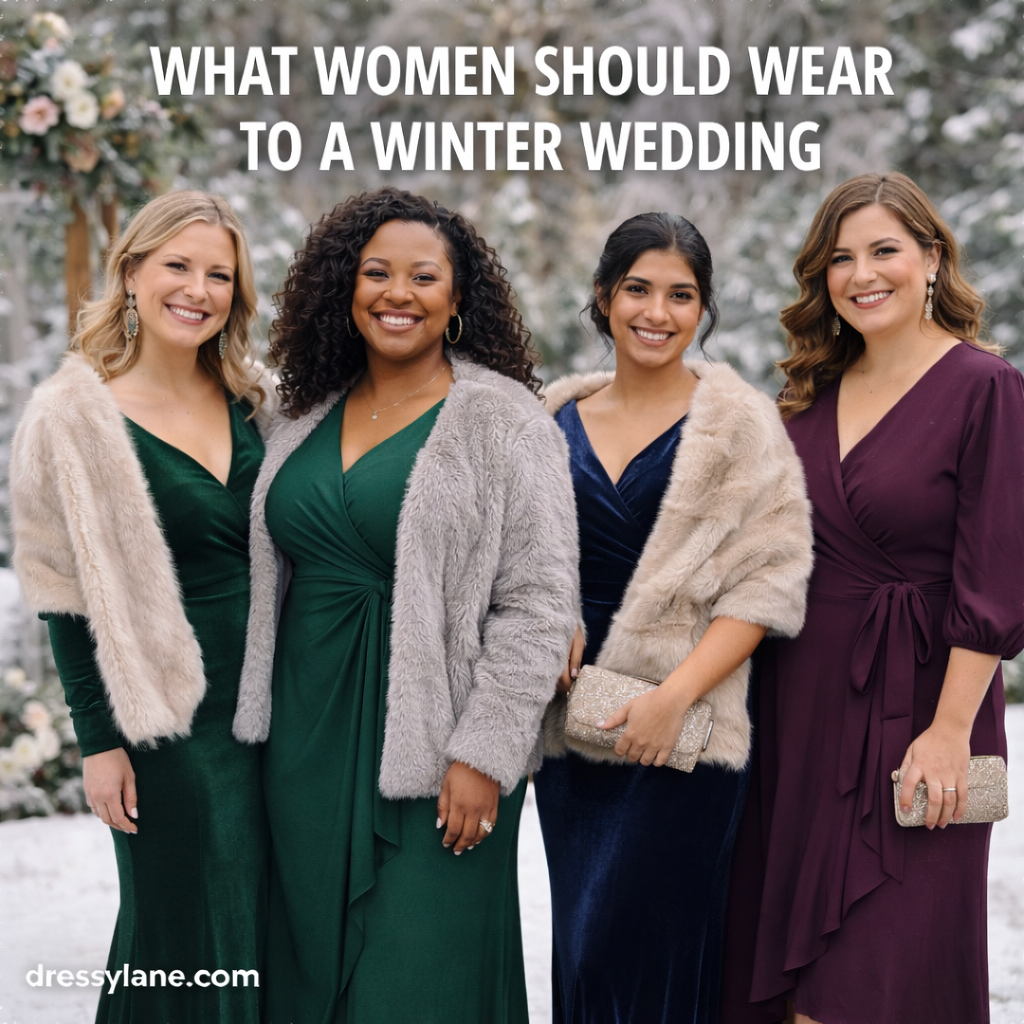
Weddings
Start with the invitation’s stated dress code.
If there isn’t one, consider the venue, time, season, and style of wedding.
A daytime garden wedding might suit a floral midi dress, lightweight suit, linen-blend tailoring, or dressy separates. An evening ballroom wedding generally calls for more formal fabrics and silhouettes.
Avoid wearing something so casual that it resembles ordinary weekend clothing.
For warm-weather ceremonies, see what to wear to a summer wedding as a guest.
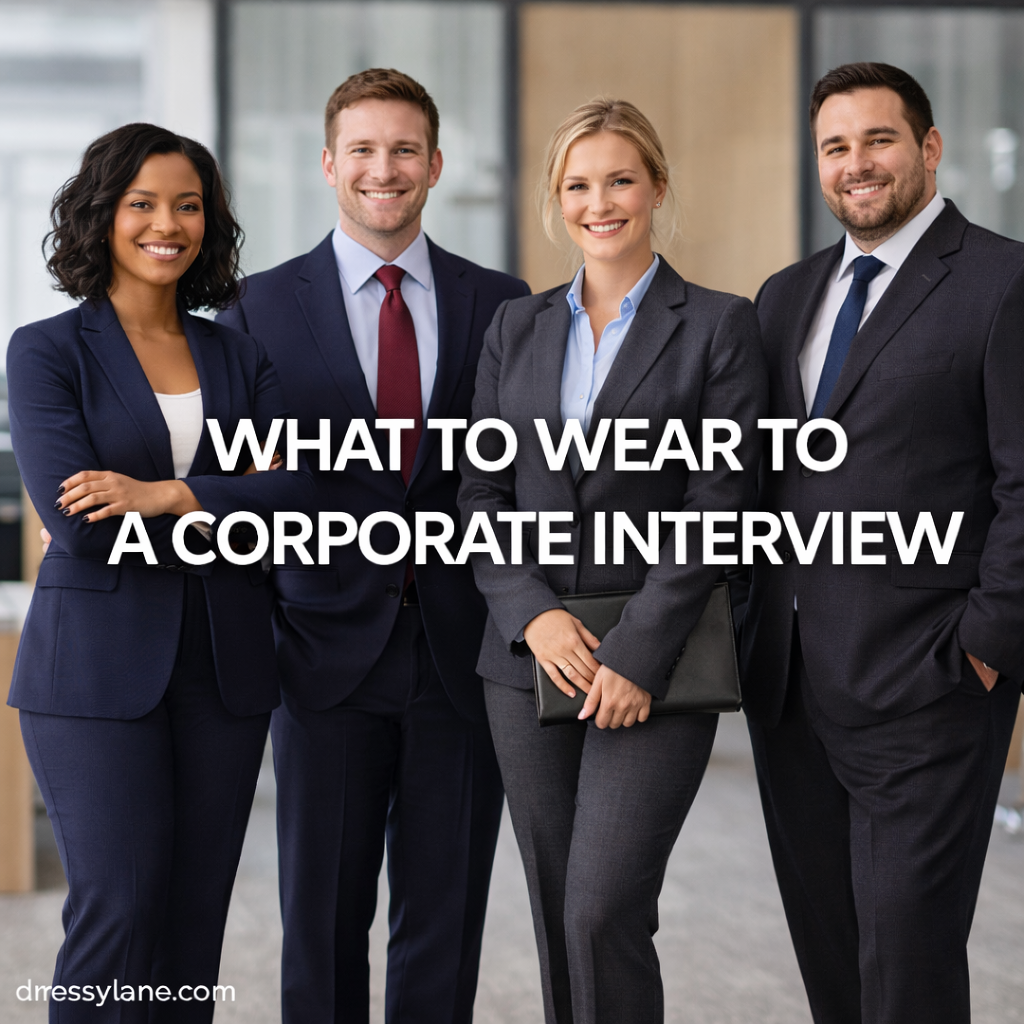
Job Interviews
Interview clothing should make it easy for the interviewer to focus on you rather than your outfit.
For many professional environments, that could mean:
- Navy or charcoal trousers
- A blazer
- White or pale-blue shirt
- Simple blouse
- Knee-length or midi dress
- Loafers, pumps, flats, or polished dress shoes
Creative and casual industries may allow greater flexibility, but neatness and intentionality still matter.
Start with what to wear to a job interview. If you’re interviewing in a more traditional professional environment, see what to wear to a corporate interview.
Birthday Parties
Birthday parties can range from backyard gatherings to formal dinners.
For casual celebrations, jeans, trousers, casual dresses, polos, shirts, and clean sneakers may be completely appropriate.
For an evening restaurant or cocktail-bar celebration, move toward tailored trousers, dresses, skirts, collared shirts, loafers, heels, or refined flats.
See what to wear to a birthday party for more situation-specific ideas.
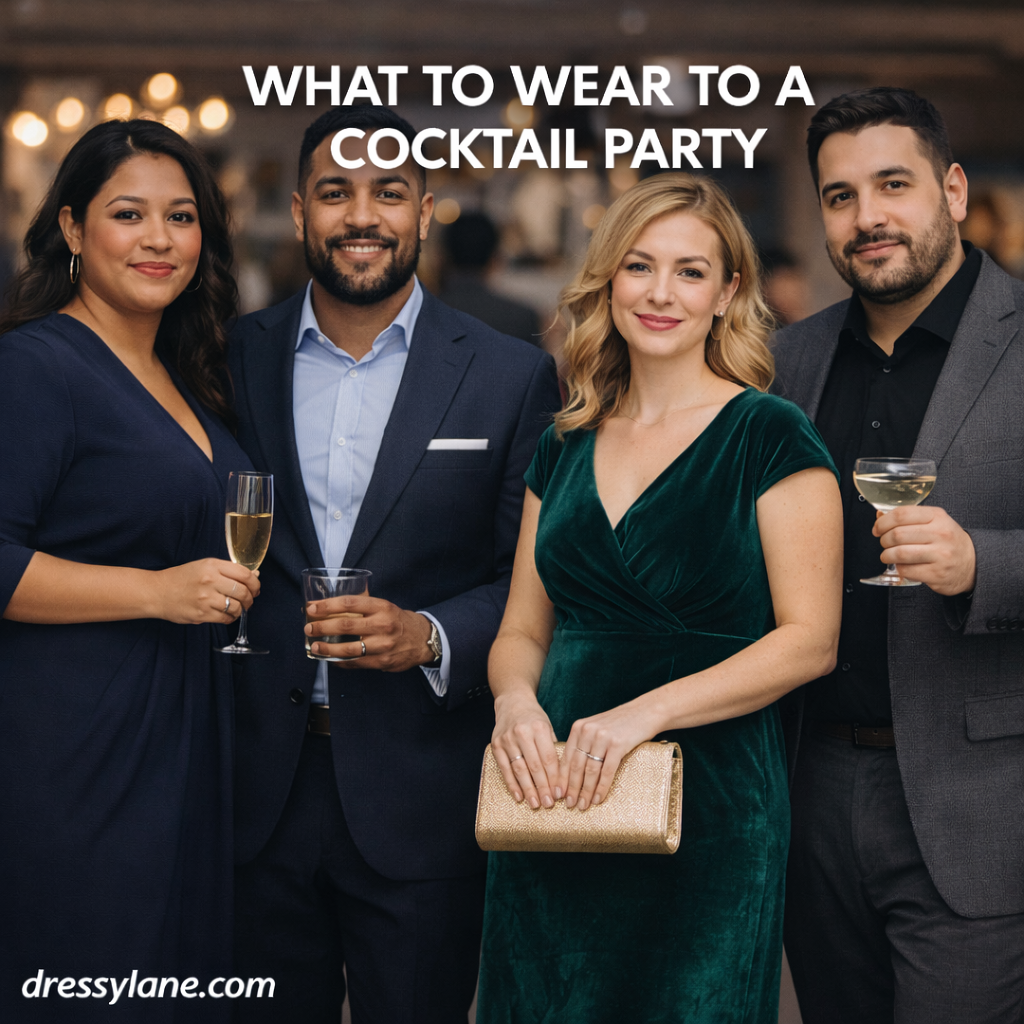
Cocktail Parties
Cocktail attire should feel noticeably dressier than ordinary evening clothing without necessarily reaching black-tie formality.
Options include:
- Cocktail dresses
- Elegant midi dresses
- Tailored jumpsuits
- Dark suits
- Dress trousers with a blazer
- Dress shirts with polished leather shoes
Fabrics such as crepe, silk, satin, velvet, fine wool, and structured blends can help create a more elevated appearance.
See our guide to what to wear to a cocktail party.
Dinner Parties
For a dinner at someone’s home, consider what you know about the host.
Dark jeans with a blouse or Oxford shirt might work beautifully for a relaxed dinner. A more elaborate celebration could call for a dress, tailored trousers, or a jacket.
You generally want to look as though you made an effort without dressing as though you’re attending an entirely different event.
See what to wear to a dinner party for examples.
Hotel Dining
Hotel restaurants can be difficult because standards vary enormously.
A casual resort restaurant and the signature dining room of a luxury hotel aren’t comparable.
Check whether the restaurant publishes a dress code. When it doesn’t, the restaurant’s atmosphere and price level can provide clues.
For an upscale hotel dinner, smart-casual pieces are often a useful starting point: tailored trousers, a midi dress, a blouse and skirt, a collared shirt, loafers, or a lightweight blazer.
See how to dress for hotel dining for a more detailed breakdown.
Dressing for Work and Professional Situations
Professional clothing should reflect both your workplace and what you’re doing that day.
A normal office day may require nothing more than business-casual separates. A presentation to senior leadership or meeting with a client may justify adding a blazer, more structured footwear, or a more conservative color palette.
The useful question is:
What level of attention should my clothing attract in this situation?
In many professional environments, the answer is very little.
Navy, charcoal, black, cream, camel, white, pale blue, and other easy-to-coordinate colors make professional wardrobes especially flexible.
You can then add personality through texture, jewelry, ties, scarves, shoes, or one stronger color.
Dressing for Travel
Travel clothing needs to solve a different problem: prolonged comfort without looking like you dressed exclusively for your sofa.
Useful travel pieces include:
- Stretch trousers
- Straight-leg jeans
- Breathable T-shirts
- Knit tops
- Overshirts
- Cardigans
- Lightweight jackets
- Comfortable sneakers
- Loafers
- Easy layers
Wrinkle resistance is particularly useful.
Merino wool, quality jersey, ponte knit, and certain technical blends often handle long travel days better than easily creased fabrics.
For broader travel situations, see what to wear while traveling.
What to Wear on a Plane
Airplane cabins introduce another problem: changing temperatures.
A lightweight base layer with a cardigan, overshirt, sweatshirt, or jacket lets you adjust without carrying a completely separate outfit.
Choose footwear that remains comfortable if your feet swell slightly during a long flight.
See our complete guide to what to wear on a plane.
Dressing for Funerals, Memorial Services, and Serious Occasions
Some situations require your clothing to communicate respect rather than personality.
Funerals and memorial services are good examples.
Unless cultural or religious traditions indicate otherwise, choose subdued, conservative clothing.
Appropriate pieces might include:
- Dark trousers
- Simple dresses
- Knee-length or midi skirts
- Collared shirts
- Sweaters
- Blazers
- Dark suits
- Closed-toe or understated footwear
Black is traditional in many settings but isn’t universally required. Navy, charcoal, dark brown, and other muted colors may also be appropriate.
Avoid distracting slogans, highly distressed clothing, very revealing cuts, or anything obviously intended to attract attention.
Our guides to what to wear to a funeral cover these situations more carefully.
For religious services, also consider traditions specific to the place of worship, including expectations around shoulders, head coverings, footwear, or hem length.
Use Simple Outfit Formulas
You don’t need to invent an outfit from scratch every morning.
A few dependable formulas can cover an enormous number of situations.
For example:
Casual:
Jeans + T-shirt + overshirt + sneakers
Smart casual:
Tailored trousers + knit top + loafers
Business casual:
Trousers + button-down shirt + blazer + leather shoes
Relaxed summer:
Linen trousers + cotton top + sandals
Polished social outfit:
Midi dress + simple jewelry + flats or heels
Once you understand the required formality, you can select the appropriate formula and change the individual pieces.
Our guide to how to build simple outfits that always work goes deeper into creating these combinations.
Pay Attention to Color Without Overcomplicating It
Color coordination is one of the easiest ways to make basic clothing look intentional.
If you’re unsure, start with two or three colors.
For example:
- Navy + white + tan
- Black + gray + burgundy
- Olive + cream + brown
- Denim blue + white + camel
- Charcoal + pale blue + black
Neutral colors are useful because they make individual pieces easier to combine.
You don’t need every item to match exactly. They simply need to look intentional together.
See how to match colors in an outfit for a fuller explanation.
Simple Clothes Can Still Look Well Dressed
A plain outfit isn’t automatically boring.
A white cotton shirt, navy trousers, brown loafers, and a leather belt contain almost no unusual elements, but the combination can look excellent when everything fits properly and is in good condition.
Prioritize:
- Proper fit
- Clean shoes
- Unwrinkled clothing
- Coordinated colors
- Appropriate proportions
- Fabrics suited to the season
- A small number of intentional accessories
For more examples, see how to dress well with simple clothes.
Minimalist dressers can take the same principle further by building outfits around restrained colors, clean silhouettes, and versatile pieces. See how to dress for minimalist style.
What If You Don’t Really Care About Fashion?
You don’t have to love fashion to dress appropriately.
In fact, a small collection of dependable clothes can make the process easier.
A practical wardrobe might include several neutral tops, dark jeans, chinos or tailored trousers, a sweater, one blazer or jacket, comfortable sneakers, and one pair of slightly dressier shoes.
The goal isn’t to follow every trend. It’s to have enough appropriate clothing that getting dressed doesn’t become a problem whenever something appears on your calendar.
Our guide to how to dress when you don’t like fashion takes this low-maintenance approach.
A Practical Styling Tip: Build the Outfit Around the Hardest Requirement
When I’m trying to make an outfit work for a complicated situation, I don’t start with the most exciting piece. I start with the thing I can’t easily change.
If I’m going to walk for 30 minutes, that’s probably the shoes. If it’s 95°F outside, it’s the fabric. If the invitation specifies cocktail attire, it’s the level of formality. If I’ll be outside after sunset, it’s the layer I need to bring.
Once that non-negotiable is handled, everything else becomes much easier.
This also prevents a common mistake: putting together a great-looking outfit and then discovering that the shoes hurt, the jacket is too hot, or the whole thing is wrong for the venue.
The Final Outfit Check
Before leaving, evaluate the entire outfit rather than individual pieces.
Ask yourself:
- Does this match the formality of the event?
- Does anything look noticeably too casual or too formal?
- Can I comfortably sit, walk, and move?
- Are my shoes suitable for what I’ll actually be doing?
- Am I prepared for the weather?
- Are my clothes clean and reasonably wrinkle-free?
- Do the colors work together?
- Will I still feel comfortable wearing this several hours from now?
If the answers are mostly yes, stop adjusting.
There is a point where continuing to change accessories or swap shirts stops improving the outfit and simply creates uncertainty.
If You’re Still Unsure, Choose the More Adaptable Outfit
When two outfits both seem reasonable, choose the one you can adjust.
A blazer can come off.
A scarf can be removed.
Sleeves can often be rolled.
A cardigan can go into a bag.
An understated outfit can be elevated with jewelry or a more polished shoe.
This flexibility is particularly valuable when you don’t know exactly what other people will be wearing.
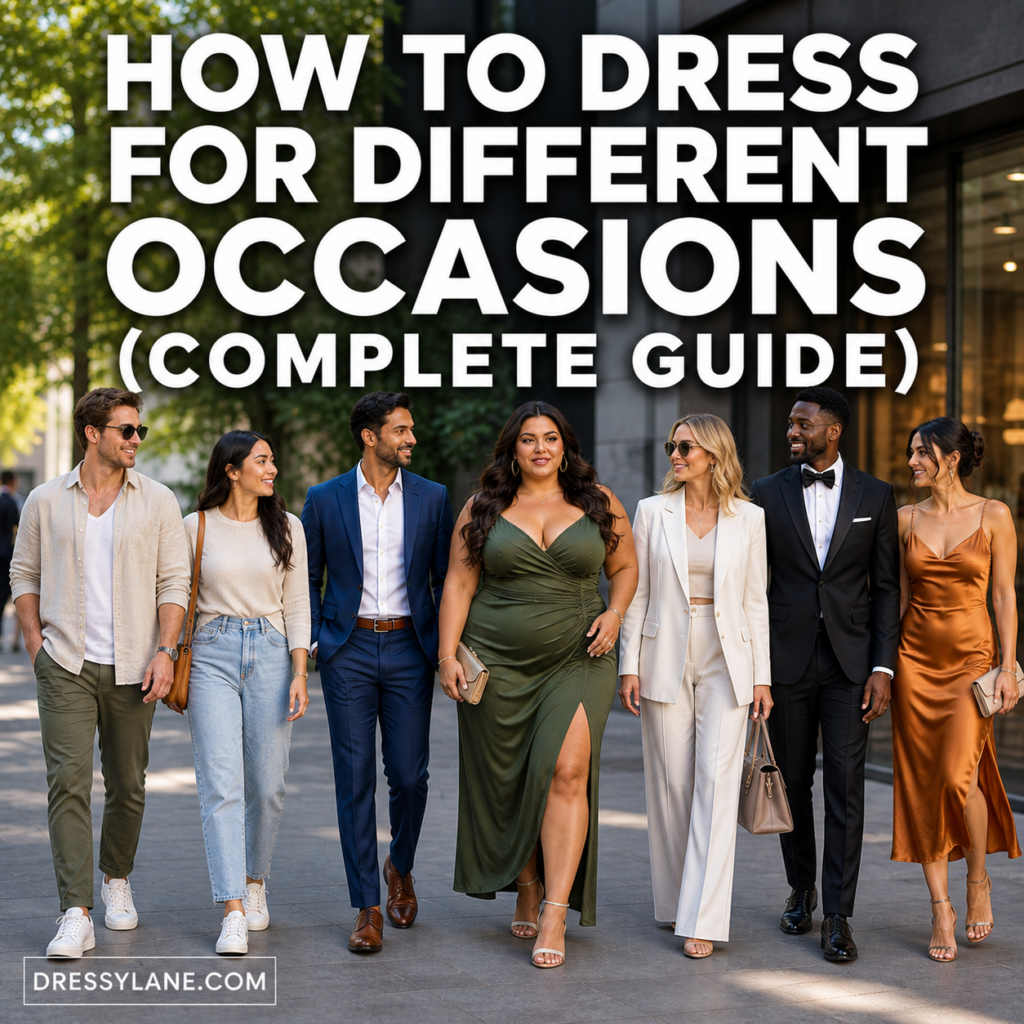
For an even broader look at matching clothing to specific events, see our complete guide to dressing for different occasions.
Frequently Asked Questions
How do I know if an outfit is appropriate for an occasion?
Consider the venue, purpose of the event, time of day, dress code, weather, and what you’ll be doing. An appropriate outfit satisfies those practical requirements without being dramatically more casual or formal than the setting calls for.
What should I wear when an invitation doesn’t include a dress code?
Use the venue, time, host, and type of event as clues. If you’re still unsure, choose polished clothing from the middle of the likely formality range. A flexible layer such as a blazer or cardigan makes it easier to adjust.
See how to dress when the invitation is vague for more guidance.
Is it better to be overdressed or underdressed?
Being slightly more polished than necessary is usually easier to manage than being significantly underdressed, but extremes in either direction can feel awkward. Aim for the expected level of formality and use removable layers when you’re uncertain.
How can I look polished without looking overdressed?
Choose simple pieces with good fit rather than obviously formal pieces. Tailored trousers, dark jeans, fine-gauge knits, simple dresses, loafers, clean leather sneakers, and unstructured jackets are useful because they sit between casual and formal.
What should I wear if I don’t like fashion?
Build a small wardrobe of neutral, interchangeable basics rather than worrying about trends. A handful of reliable outfit formulas can cover work, casual activities, dinners, travel, and many social occasions.
How can I make a simple outfit look better?
Start with fit and condition. Make sure clothing isn’t excessively wrinkled, faded, stretched, or poorly proportioned. Coordinate two or three colors, choose appropriate footwear, and add one intentional finishing element such as a watch, belt, scarf, jewelry, or jacket.
Should comfort or appearance come first?
You usually don’t have to choose one.
The best outfit is both appropriate and wearable. Instead of tolerating painful shoes or restrictive clothing, look for alternatives that provide the same level of formality in a more comfortable construction or fabric.
What should I wear to an upscale hotel restaurant?
Check whether the restaurant publishes a dress code first. If not, smart casual is often a practical starting point for upscale hotel dining: tailored trousers, a collared shirt, blouse, midi dress, skirt, loafers, dress shoes, or refined flats.
How do I dress appropriately in very hot weather?
Choose breathable fabrics such as linen, cotton, seersucker, or lightweight wool and favor less restrictive silhouettes. You can still dress formally in warm weather by using lighter fabrics rather than simply removing structure from the outfit.
What should I wear if I don’t want to stand out?
Choose simple silhouettes, familiar colors, and clothing near the expected formality level of the event. Navy, charcoal, black, cream, white, tan, olive, and denim are easy to combine without making the outfit feel attention-seeking.
Final Thoughts
Choosing an outfit that fits the situation becomes much easier once you stop asking, “What should I wear?” and start asking, “What does this particular situation require?”
Look at the setting. Determine the formality. Check the weather. Think about what you’ll actually be doing. Respect any cultural or event-specific expectations. Then choose clothing that allows you to meet those requirements comfortably.
You don’t need a huge wardrobe or an encyclopedic knowledge of fashion.
A well-fitting pair of trousers, clean shoes, a few reliable tops, useful layers, and an understanding of when to dress them up or down can take you surprisingly far.
The goal isn’t to create the most fashionable outfit in the room.
It’s to wear something that makes sense for where you are, what you’re doing, and how you want to feel while you’re there.