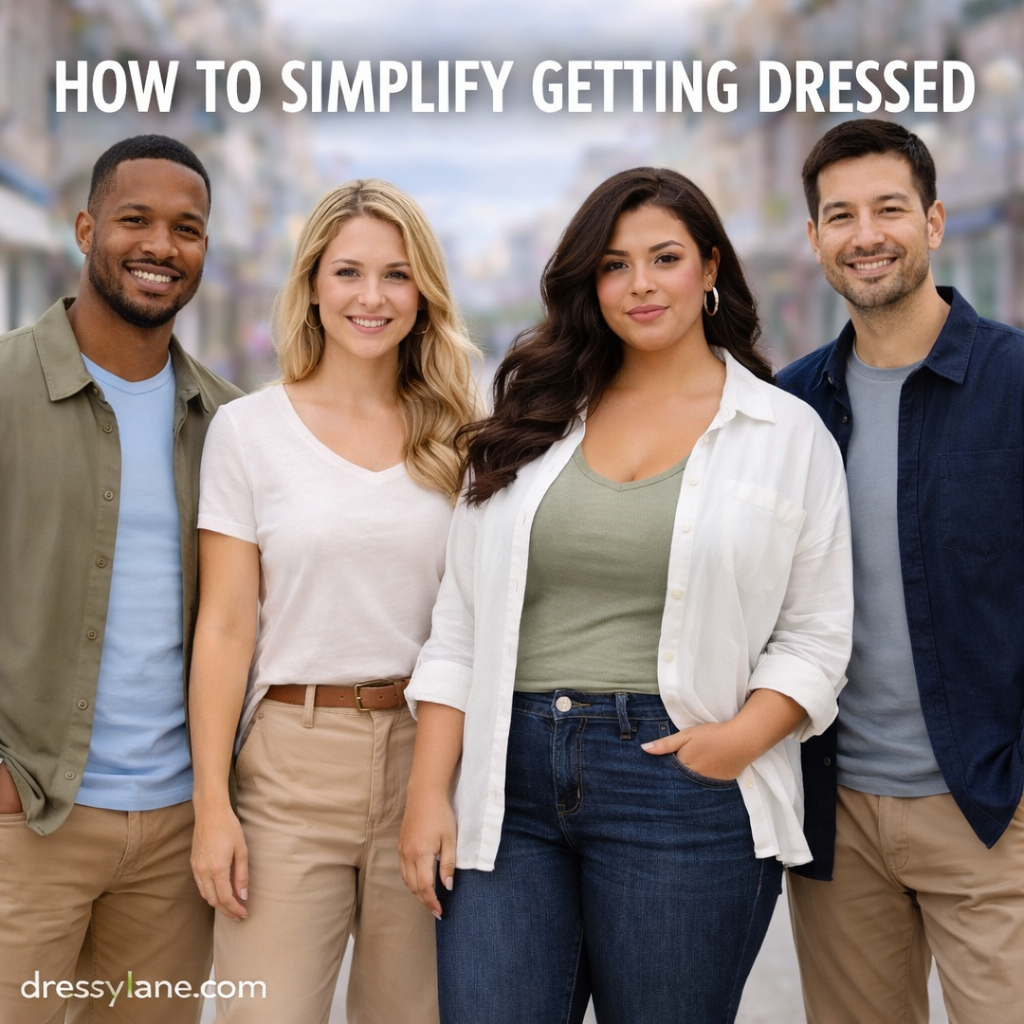
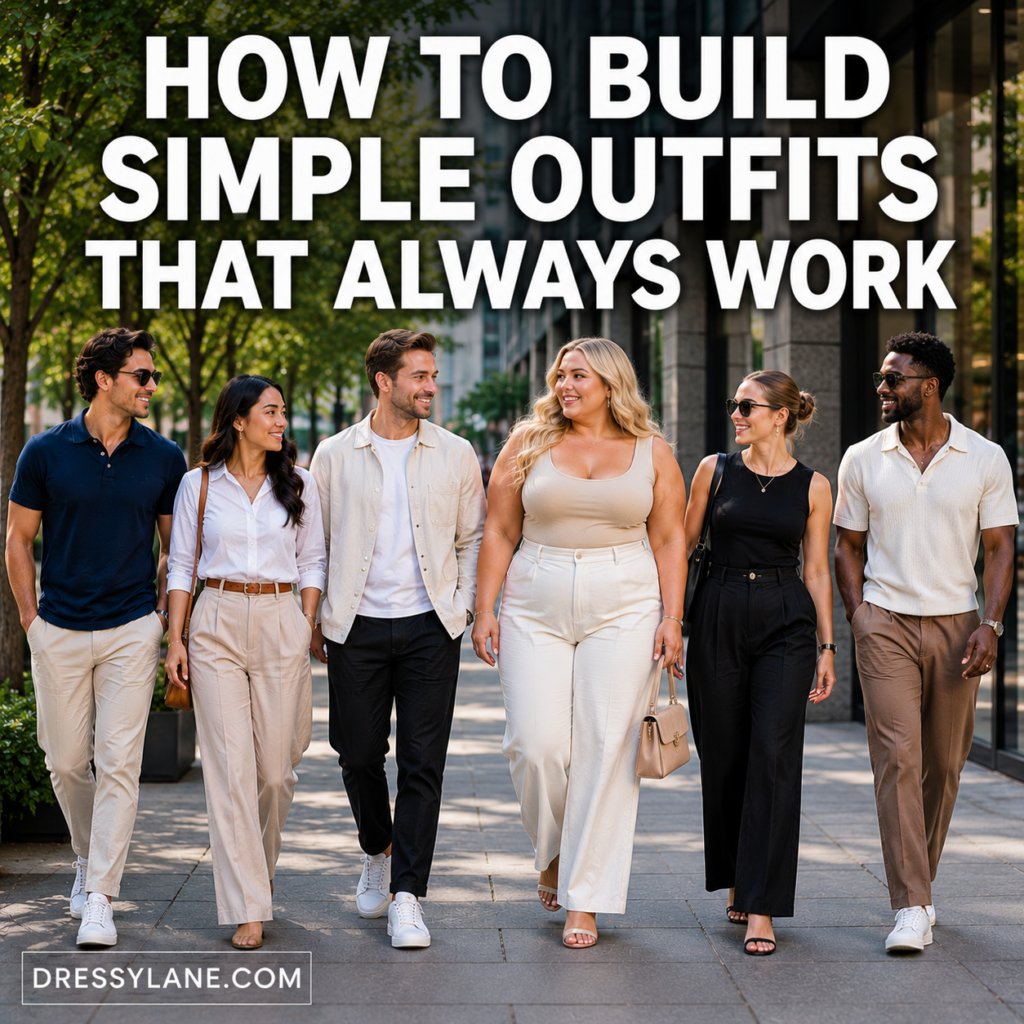
Putting together a good outfit does not have to mean following trends, owning a huge wardrobe, or spending twenty minutes deciding which shirt works with which pants.
Some of the most dependable outfits are simple: a few well-chosen pieces, colors that work together, comfortable proportions, and clothing that makes sense for where you are going.
The key is not finding one magical outfit that literally works everywhere. A T-shirt and jeans will not replace a suit at a formal wedding, and office clothes may feel unnecessarily stiff on vacation. Instead, the goal is to develop a simple outfit system you can adjust for different situations.
Once you know which basics, colors, fits, layers, and shoes work for you, getting dressed becomes much easier.
This guide explains how to build that system for both women and men.
The Simple Outfit Formula
Most reliable everyday outfits can be reduced to four parts:
- A base — shirt, blouse, sweater, polo, knit top, or dress
- A bottom — jeans, chinos, trousers, skirt, or shorts
- Shoes — sneakers, loafers, boots, flats, sandals, or dress shoes
- An optional finishing layer — cardigan, overshirt, blazer, jacket, or coat
For example:
Women:
White cotton T-shirt + straight-leg jeans + leather sneakers + lightweight trench coat
Men:
Oxford shirt + chinos + loafers + unstructured jacket
Neither outfit is complicated. More importantly, almost every piece can be swapped without rebuilding the entire look.
That is what makes a simple wardrobe useful.
Start With Versatile Basics
A dependable outfit starts with clothing that is easy to combine.
You do not need everything to be neutral or minimalist, but having a core group of versatile pieces gives you something reliable to build around.
Useful basics for women
Depending on your lifestyle, these might include:
- White, black, navy, gray, or cream T-shirts
- Cotton or linen button-front shirts
- Fine-knit sweaters
- Straight-leg or relaxed jeans
- Black or navy trousers
- A simple midi skirt
- A casual midi or knee-length dress
- A cardigan
- A denim, leather, utility, or lightweight wool jacket
- Clean sneakers
- Flats, loafers, ankle boots, or simple sandals
Useful basics for men
A practical foundation might include:
- Solid cotton T-shirts
- Oxford cloth button-down shirts
- Polos
- Merino wool or cotton sweaters
- Dark or medium-wash jeans
- Navy, charcoal, khaki, or olive chinos
- Wool or wool-blend trousers
- An overshirt
- An unstructured blazer
- Clean leather or canvas sneakers
- Loafers or simple leather shoes
- Casual boots
The exact list matters less than compatibility. If nearly every top works with several bottoms and several pairs of shoes, you have far more outfit possibilities than the size of your wardrobe suggests.
For more on making ordinary wardrobe pieces look intentional, see How to Dress Well With Simple Clothes.
Use a Base + Layer + Shoe Formula
When you do not know what to wear, avoid trying to imagine an entire outfit at once.
Start with the base.
Choose something such as:
- T-shirt and jeans
- Sweater and trousers
- Blouse and skirt
- Oxford shirt and chinos
- Simple dress
Then decide whether the outfit needs a layer.
A layer can change the character of otherwise basic clothing surprisingly quickly.
For example:
T-shirt + jeans + sneakers = relaxed casual
T-shirt + jeans + blazer + loafers = polished casual
T-shirt + jeans + cardigan + ankle boots = comfortable smart casual
The clothes underneath barely changed.
This is one reason jackets, cardigans, overshirts, and blazers are especially useful in a simple wardrobe: they allow you to adjust the formality of an outfit without starting over.
Keep Your Color Palette Easy to Combine
Color becomes much easier when you stop treating every outfit as a new puzzle.
Begin with a few dependable neutrals.
Useful options include:
- Black
- White
- Cream
- Navy
- Gray
- Camel
- Beige
- Brown
- Olive
- Denim
Then add colors you genuinely enjoy wearing.
You might build around navy, cream, denim, and burgundy, for example. Someone else may prefer black, charcoal, white, and forest green.
Easy color combinations
Reliable pairings include:
- White + navy
- Cream + camel
- Black + gray
- Denim + white
- Navy + tan
- Olive + cream
- Charcoal + burgundy
- Brown + light blue
- Black + camel
You do not need every item to match exactly. You simply want most pieces to coexist without fighting for attention.
For a more detailed approach, read How to Match Colors in an Outfit.
Pay More Attention to Fit Than Complexity
Simple clothing exposes fit more than elaborate clothing does.
A plain white shirt that fits beautifully can look sharper than an expensive shirt with distracting details that pulls across the shoulders or hangs awkwardly.
Look at a few practical areas.
Shoulders
Shirts, jackets, and blazers generally look cleaner when the shoulder seams sit reasonably close to your natural shoulder line unless the garment is deliberately oversized.
Waist
Clothes do not have to be tight, but they should usually give you enough shape or structure that they do not look accidentally oversized.
Trouser length
Excess fabric pooling heavily around the ankles can make otherwise polished trousers look untidy.
Movement
Sit down. Raise your arms. Walk around.
An outfit that looks good only when you stand perfectly still is not a very useful outfit.
This is especially important when choosing clothes for long workdays, travel, dinners, weddings, or events where you will spend several hours sitting and standing.
Balance Your Proportions
You do not need complicated fashion rules to create visual balance.
One of the easiest approaches is to avoid having every piece compete in volume.
For example:
- Relaxed trousers + more streamlined top
- Oversized sweater + straight or tapered pants
- Wide-leg pants + tucked or shorter top
- Full skirt + fitted knit
- Relaxed shirt + structured jeans or trousers
This is not an absolute rule. Oversized-on-oversized outfits can work, as can fitted outfits. But when something feels visually “off,” adjusting proportions is often more effective than adding accessories.
A partial tuck, rolled sleeve, different trouser rise, or shorter jacket can sometimes fix an outfit without changing a single item.
Choose Fabrics That Match the Situation
Fabric affects both comfort and how formal an outfit appears.
For warm weather, consider:
- Linen
- Cotton poplin
- Seersucker
- Chambray
- Lightweight cotton jersey
For cooler conditions:
- Merino wool
- Lambswool
- Corduroy
- Denim
- Flannel
- Wool blends
For dressier outfits:
- Wool
- Crepe
- Silk
- Satin
- Fine-gauge knitwear
- Structured cotton
A linen shirt and a crisp cotton poplin shirt may have almost identical shapes, yet the linen version generally feels more relaxed. The same principle applies to footwear and outerwear.
Understanding these small distinctions lets you build simple outfits without making them boring.
Build the Outfit Around the Occasion
Before choosing clothes, ask one question:
What am I actually dressing for?
Consider:
- Location
- Time of day
- Weather
- Expected formality
- How long you will be there
- Whether you will walk or stand extensively
- Who else will be there
A restaurant dinner, backyard birthday party, office meeting, airport day, and wedding reception all require different levels of polish.
Our guide to choosing an outfit that fits the situation goes deeper into evaluating those details.
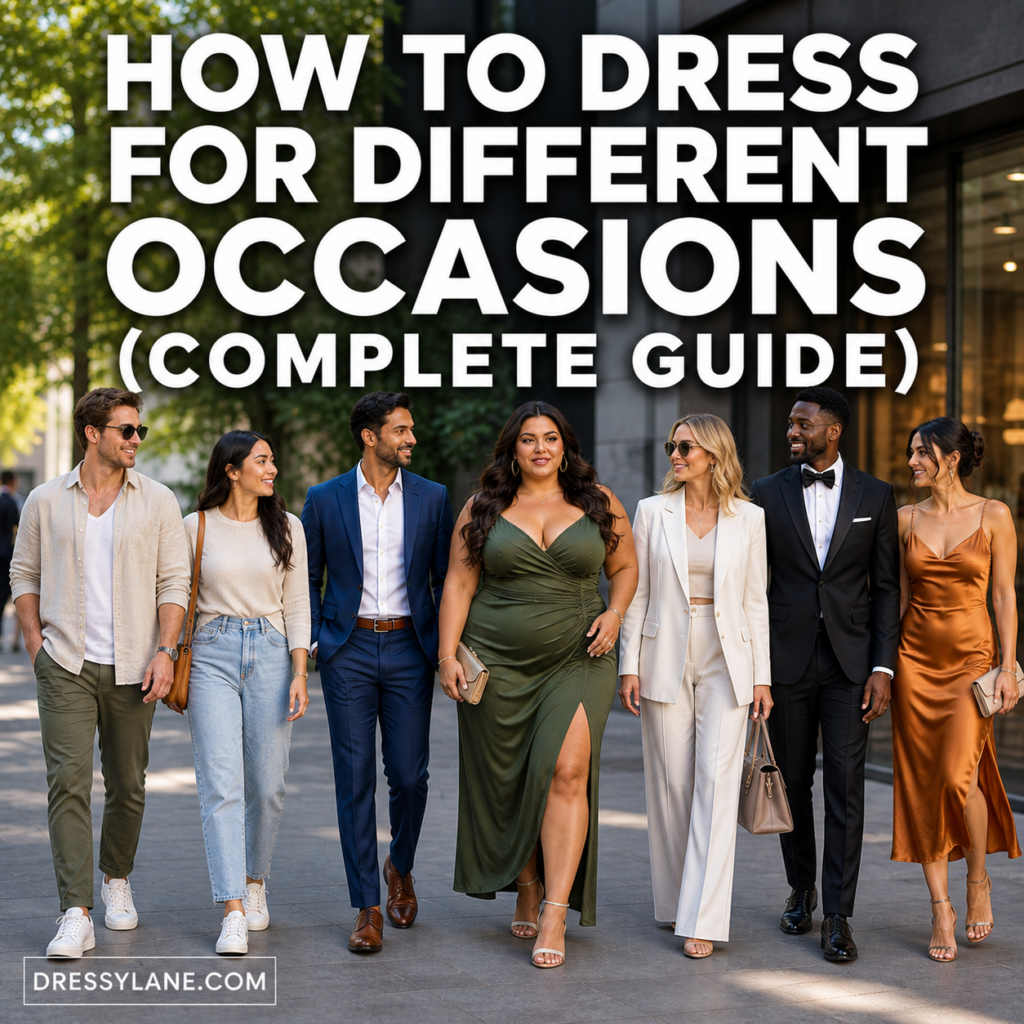
For a broader reference covering many dress codes and events, see How to Dress for Different Occasions: Complete Guide.
What to Wear When the Invitation Is Vague
“Come by for drinks.”
“Dinner at 7.”
“Birthday celebration.”
An invitation like this may tell you almost nothing about what everyone will be wearing.
Instead of guessing, look for contextual clues:
Check the venue
A neighborhood restaurant and an upscale rooftop restaurant imply different levels of dress.
Consider the time
Evening events often lean slightly dressier than comparable daytime events.
Consider the host
If you know how the host normally dresses or entertains, that can provide useful context.
Choose an adjustable outfit
When uncertainty remains, wear something that can move slightly up or down in formality.
For example:
Women: dark jeans or trousers + simple blouse or knit + loafers or ankle boots + blazer
Men: dark jeans or chinos + Oxford shirt or fine knit + loafers or clean leather sneakers + casual jacket
You can remove the jacket if everyone is dressed casually without looking dramatically overdressed.
See How to Dress When the Invitation Is Vague for more examples.
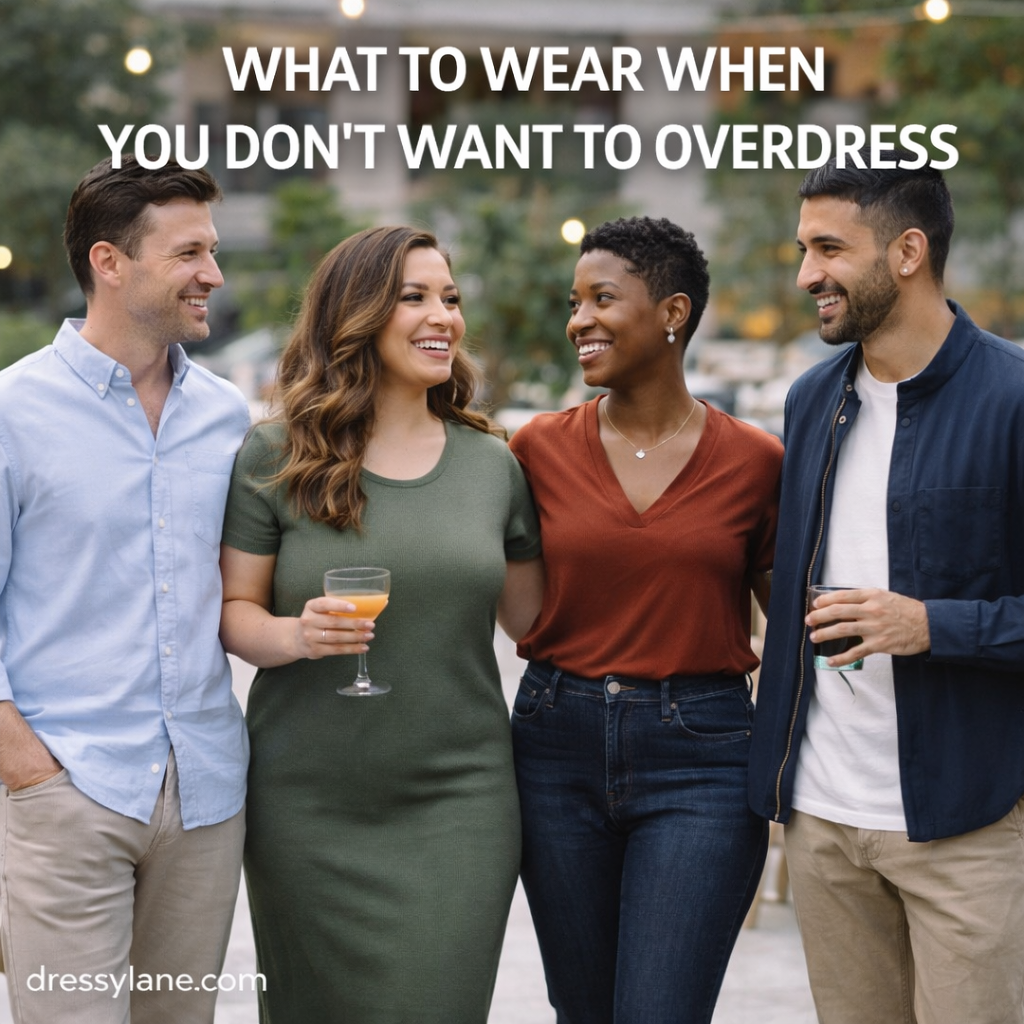
What to Wear When You Don’t Want to Overdress
Being slightly polished is usually manageable. Feeling conspicuously formal can be uncomfortable.
When you suspect an occasion is casual, use one polished element rather than an entirely formal outfit.
For example:
- Blazer + T-shirt + jeans instead of a full suit
- Midi dress + flats instead of cocktail dress + heels
- Oxford shirt + chinos instead of dress shirt + tailored suit trousers
- Blouse + dark jeans instead of blouse + formal skirt + pumps
Shoes are particularly useful for controlling formality.
Clean sneakers or flat sandals can relax an outfit, while loafers, boots, heels, or polished leather shoes can move it upward.
For more examples, see What to Wear When You Don’t Want to Overdress.
Simple Outfits for Hotel Dining
Hotel restaurants can be confusing because the atmosphere varies enormously.
A casual hotel café may be perfectly suitable for jeans and sneakers, while a luxury property’s signature restaurant may expect smart-casual or formal clothing.
For an unfamiliar hotel restaurant, a polished middle ground is useful.
Women
Try:
- Midi dress + flats or low heels
- Tailored trousers + blouse + loafers
- Dark jeans + fine knit + blazer + ankle boots
Men
Try:
- Chinos + Oxford shirt + loafers
- Dark jeans + knit polo + casual blazer
- Tailored trousers + fine sweater + leather shoes
Avoid assuming that staying at the hotel means anything you would wear around the property is appropriate for its restaurant. Poolwear, gym clothes, slippers, and very casual resort clothing may not fit the dining room.
If you are visiting a particular property, check its restaurant’s stated dress code.
Our guide to dressing for hotel dining covers the situation in more detail.
Use Layers to Make Simple Outfits More Flexible
Layers solve several problems at once.
They help with temperature changes, but they can also alter an outfit’s structure and formality.
Useful layers include:
- Denim jackets
- Cardigans
- Blazers
- Overshirts
- Lightweight field jackets
- Trench coats
- Wool coats
- Leather jackets
Imagine a basic combination of a white T-shirt, dark jeans, and sneakers.
Add a denim jacket and it remains casual.
Add a blazer and loafers and it becomes more polished.
Add a cardigan and boots and it becomes a practical cool-weather outfit.
Seasonal conditions obviously matter as well. See What to Wear in Fall and What to Wear in Winter for more weather-specific ideas.
Let Shoes Set the Tone
If you want to change a simple outfit without replacing everything, change the shoes.
Consider jeans and a button-front shirt.
With running-style sneakers, the outfit feels very casual.
With clean leather sneakers, it becomes neater.
With loafers, it becomes smart casual.
With polished dress shoes or heels, it becomes noticeably dressier.
That makes footwear one of the most efficient parts of a small wardrobe.
Rather than owning numerous pairs that work with only one outfit, look for a few pairs that cover genuinely different situations.
Keep Accessories Intentional
Simple outfits benefit from accessories, but they rarely need many at once.
Depending on your style, one or two of these may be enough:
- Watch
- Belt
- Simple necklace
- Small earrings
- Scarf
- Structured handbag
- Leather tote
- Sunglasses
The point is not to follow a rule about how many accessories you are “allowed” to wear.
Ask whether each accessory improves the outfit.
If the answer is no, you probably do not need it.
How to Dress Simply If You Don’t Like Fashion
Not everyone wants clothing to be a hobby.
You may simply want to look appropriate, feel comfortable, and stop spending so much time deciding what to wear.
If that describes you, create a personal uniform.
Choose two or three combinations you know work.
For example:
Women
- Straight jeans + knit top + sneakers
- Trousers + blouse + loafers
- Midi dress + cardigan + flats
Men
- Chinos + Oxford shirt + sneakers
- Jeans + T-shirt + overshirt + boots
- Trousers + knit polo + loafers
Buy future clothes primarily when they fit into those formulas.
This reduces the number of decisions you need to make without requiring you to wear exactly the same clothes every day.
Read How to Dress When You Don’t Like Fashion for a more streamlined approach.
Simple Outfits and Minimalist Style Aren’t Exactly the Same
Simple dressing and minimalist fashion overlap, but they are not identical.
A simple outfit can include:
- Bright color
- Prints
- Statement shoes
- Jewelry
- Trend-driven pieces
Minimalist style generally places greater emphasis on restrained colors, clean silhouettes, limited decoration, and carefully selected pieces.
If you prefer that aesthetic, build around items such as:
- Straight trousers
- Crisp shirts
- Fine knits
- Simple dresses
- Structured outerwear
- Unembellished shoes
Then keep the color palette relatively cohesive.
See How to Dress for Minimalist Style if you want simplicity to become part of your overall aesthetic rather than merely a convenient way of getting dressed.
Build Outfits Around Physical Comfort Too
An outfit is not successful if you spend the entire day adjusting it.
Comfort does not have to mean sweatpants.
Look for:
- Waistbands that stay in place without digging
- Fabrics that feel good against your skin
- Shoes you can realistically walk in
- Tops that allow normal arm movement
- Jackets that fit over the layers underneath
- Pants that remain comfortable when sitting
- Underwear that works with the garment
Also consider which silhouettes make you feel at ease.
You do not have to wear a fitted waist, sleeveless top, skinny trousers, short skirt, tucked shirt, or any other styling convention simply because someone says it is “flattering.”
Clothing is more useful when you can stop thinking about it once you leave home.
For a more body-comfort-focused approach, read How to Dress to Feel Comfortable in Your Body.
Create a Few Reliable Outfit Templates
Instead of memorizing individual outfits, memorize formulas.
Casual everyday
Women:
T-shirt + straight jeans + sneakers + cardigan
Men:
T-shirt + jeans or chinos + sneakers + overshirt
Smart casual
Women:
Blouse or knit + tailored trousers + loafers + blazer
Men:
Oxford shirt or knit polo + chinos + loafers + unstructured jacket
Relaxed dinner
Women:
Midi dress + cardigan or jacket + flats or ankle boots
Men:
Dark jeans + fine knit + loafers or leather sneakers
Travel
Choose breathable layers, comfortable shoes, and fabrics that tolerate sitting.
A cotton T-shirt, knit layer, relaxed trousers, and sneakers are an easy starting point.
See What to Wear While Traveling for more travel-specific combinations.
Professional
Build around structured pieces such as trousers, button-front shirts, blouses, fine-gauge knitwear, blazers, loafers, and understated leather shoes.
For interviews specifically, see What to Wear to a Job Interview.
Adjust a Basic Outfit Instead of Replacing It
One of the most useful styling habits is learning to modify what you are already wearing.
Suppose your starting outfit is:
Dark jeans + white shirt + neutral shoes
To make it more casual:
- Roll the sleeves
- Wear sneakers
- Add a denim or utility jacket
To make it dressier:
- Tuck the shirt
- Add a belt
- Switch to loafers or dress shoes
- Add a blazer
To prepare for cold weather:
- Add a merino sweater
- Switch to boots
- Add a wool coat
You are not creating three unrelated outfits. You are modifying one dependable foundation.
That is much easier to manage.
Create a Small Outfit Rotation
Once you find combinations that work, save them.
You might keep five to ten dependable outfits for the situations you encounter most frequently.
For example:
- Everyday errands
- Casual lunch
- Work or professional setting
- Dinner
- Social event
- Travel
- Hot weather
- Cold weather
Take a quick mirror photo when an outfit works particularly well.
After a few months, you will have your own outfit reference library. This is often more useful than saving hundreds of inspiration photos featuring clothes you do not actually own.
A practical styling tip
One of the easiest mistakes is buying an item because you love it by itself.
Before buying something, mentally create at least three outfits using clothes you already own.
If you cannot, the item may be beautiful but not particularly useful in your wardrobe.
This one habit can make a small wardrobe much easier to dress from.
Common Mistakes That Make Simple Outfits Harder
Buying too many statement pieces
Interesting clothes are not bad, but a wardrobe filled with pieces that each demand their own special combination becomes difficult to use.
Ignoring shoes until the end
Shoes can determine whether an outfit feels casual, professional, dressy, sporty, or seasonally appropriate.
Buying the same function repeatedly
Five slightly different black tops may not help if what you actually need is a jacket that works with all five.
Keeping clothes that don’t fit comfortably
If you consistently avoid an item because it pulls, slips, scratches, pinches, or requires constant adjustment, it is not a dependable basic.
Copying outfits instead of learning formulas
You do not need the exact sweater, jeans, bag, and shoes from an inspiration photo.
Look at the structure instead:
Relaxed knit + straight pants + simple shoe + structured bag.
You can recreate the principle with your own clothes.
A 60-Second Method for Choosing an Outfit
When you are standing in front of your wardrobe and cannot decide what to wear, use this sequence:
1. Check the situation.
How formal is it?
2. Check the weather.
Will you need breathable fabrics, rain protection, or warm layers?
3. Choose one base.
Start with a dress, trousers, jeans, skirt, or shorts.
4. Add the easiest compatible top.
Do not search for the “perfect” combination.
5. Choose shoes based on comfort and formality.
6. Add one layer if necessary.
7. Stop.
That last step matters.
If the outfit fits, works for the occasion, and feels comfortable, adding more pieces simply because the outfit seems “too simple” can make it worse.
Frequently Asked Questions
How many colors should a simple outfit have?
There is no fixed limit, but two or three main colors are easy to coordinate. You can then introduce smaller amounts of color through accessories, patterns, or shoes.
Do simple outfits have to use neutral colors?
No. Neutrals simply make mixing easier. A simple outfit could be blue trousers, a striped shirt, and burgundy loafers if the pieces work together.
How do I make jeans and a T-shirt look more polished?
Start with fit and condition. Choose jeans without excessive distressing and a T-shirt that holds its shape. Then add a structured layer, belt, watch, simple jewelry, or polished shoes.
What should I wear when I don’t know the dress code?
Aim for the middle of the likely range and choose an outfit you can adjust. Dark jeans or trousers, a clean shirt or knit, smart shoes, and a removable blazer or jacket work for many ambiguous situations. For more detail, see How to Dress When the Invitation Is Vague.
How can I avoid looking overdressed?
Mix one polished piece with more relaxed pieces. A blazer with jeans, a dress with flats, or an Oxford shirt with chinos generally looks less formal than wearing dressy pieces from head to toe.
Can comfortable clothes still look put together?
Absolutely. Soft merino knits, cotton shirts, relaxed trousers, stretch wool, straight jeans, loafers, supportive sneakers, and simple dresses can all be comfortable. Fit, fabric, condition, and coordination matter more than whether clothing feels restrictive.
Is minimalist style the easiest way to dress simply?
It can be, but you do not have to become a minimalist. A wardrobe can be colorful, patterned, or eclectic while still relying on repeatable outfit formulas.
What is the easiest outfit formula for everyday wear?
For many people, it is:
Simple top + jeans or trousers + clean shoes + optional layer.
Change the materials, colors, and footwear according to the season and occasion.
Final Thoughts
Building simple outfits that consistently work is less about having exceptional fashion instincts and more about creating a dependable system.
Start with clothes that work together. Keep several easy color combinations in mind. Pay attention to fit and fabric. Use shoes and outer layers to adjust formality. Most importantly, dress for the situation you are actually entering rather than trying to make every outfit impressive.
Over time, you will identify combinations you naturally return to.
Keep them.
Those repeatable formulas are the foundation of an effective wardrobe. Once you have them, getting dressed becomes less about inventing an outfit every morning and more about choosing the right version of something you already know works.