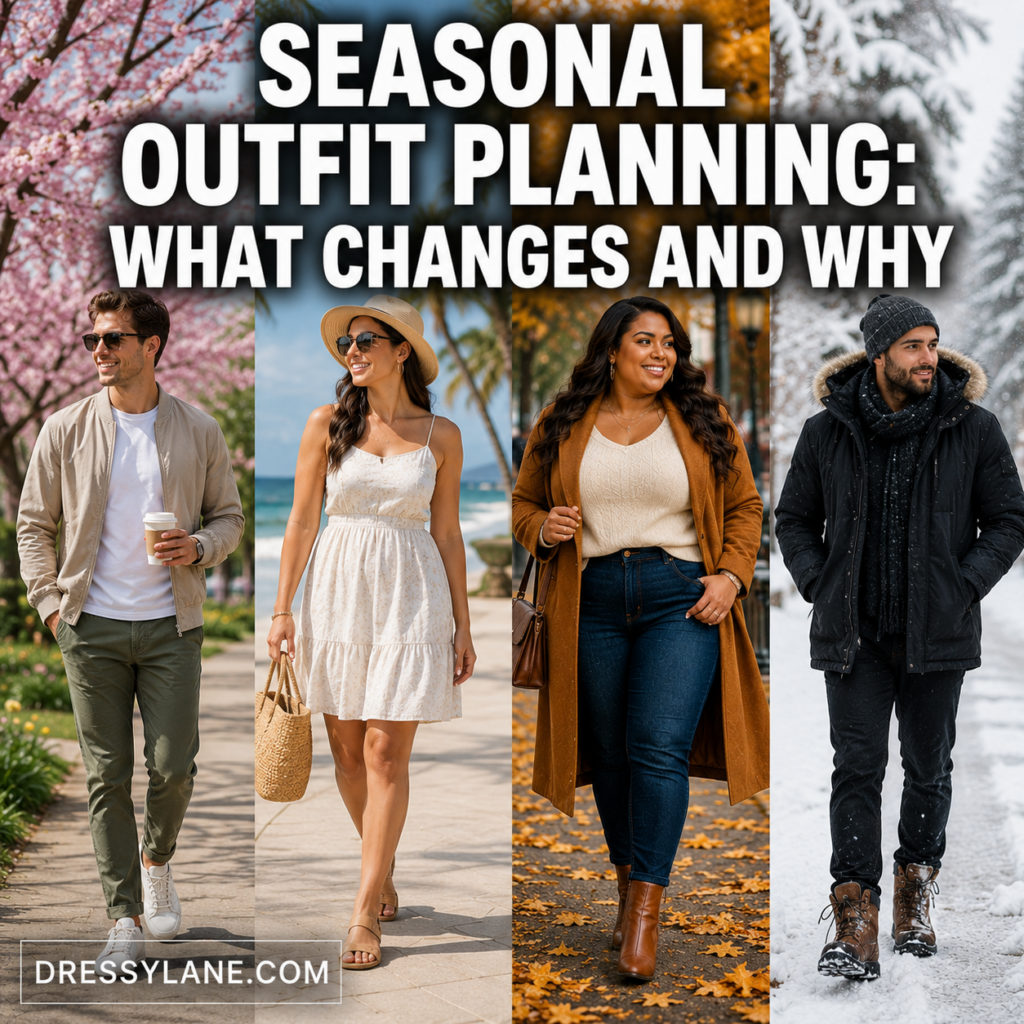
Getting dressed for the seasons involves more than pulling out shorts in summer and coats in winter. Temperature matters, but so do humidity, wind, rain, changing daylight, indoor heating and air conditioning, and how much the weather can change between morning and evening.
A good seasonal wardrobe responds to those conditions without requiring an entirely different closet every three months.
The key is understanding what actually needs to change: fabric weight, layering, footwear, outerwear, coverage, and sometimes color or texture. Once you understand those variables, seasonal outfit planning becomes much simpler.
This guide explains how to adjust your clothes throughout the year, what works during transitional weather, how to plan for specific conditions, and how to build outfits that remain practical without losing your personal style.
Table of Contents
- Why Seasonal Outfit Planning Matters
- The Five Things That Change With the Seasons
- How to Dress for Spring
- How to Dress for Summer
- How to Dress for Fall
- How to Dress for Winter
- How to Handle Transitional Weather
- Choosing Fabrics by Season
- Building a Practical Layering System
- Seasonal Footwear
- Dressing for Rain, Wind, Heat, and Unpredictable Weather
- How to Dress If You Overheat Easily
- Planning Seasonal Outfits for Different Occasions
- Dressing for Four Seasons With Fewer Clothes
- Seasonal Colors and Textures
- How to Transition Your Wardrobe Between Seasons
- Common Seasonal Dressing Mistakes
- Frequently Asked Questions
- Final Thoughts
Why Seasonal Outfit Planning Matters
Weather changes how clothing functions.
A thick wool sweater may be comfortable on a cold January morning but unbearable during a warm September afternoon. Linen trousers that feel excellent in July may provide little protection against cold wind in November.
Seasonal planning helps you balance three things:
- Temperature: Will the outfit keep you warm or cool enough?
- Conditions: Can it handle rain, wind, humidity, or changing temperatures?
- Context: Is it still appropriate for work, dinner, travel, errands, or another occasion?
This is why seasonal dressing shouldn’t be reduced to arbitrary fashion rules.
There is no date when you suddenly have to stop wearing one color or start wearing another. What matters more is adapting the function and construction of your outfit to the conditions around you.
For a broader approach to adapting clothing to changing conditions, see How to Dress for Different Weather Conditions Year-Round.
The Five Things That Change With the Seasons
Most seasonal wardrobe changes can be understood through five categories.
1. Fabric Weight
Warm conditions generally favor lighter materials, while cold conditions call for heavier or more insulating ones.
Examples include:
Warm weather:
- Linen
- Cotton poplin
- Seersucker
- Chambray
- Lightweight cotton jersey
- Lightweight rayon or viscose
Cold weather:
- Wool
- Merino wool
- Flannel
- Fleece
- Corduroy
- Heavyweight denim
- Cashmere
You don’t necessarily need completely different types of clothing. A lightweight cotton button-down and a brushed flannel shirt perform similar styling roles while serving very different temperatures.
2. Number of Layers
Summer may require only one or two clothing layers.
Winter could require a base layer, shirt or sweater, insulating layer, and coat.
Spring and fall fall somewhere between the two, which is why removable layers become particularly useful.
3. Coverage
Seasonal clothing changes how much skin is exposed.
Short sleeves, skirts, shorts, and open shoes can make hot weather more comfortable, while long sleeves, trousers, boots, scarves, and coats provide additional protection in cold conditions.
Coverage also matters for sun exposure and wind—not just temperature.
4. Footwear
Weather often determines which shoes are practical.
Suede loafers may work beautifully on a dry fall afternoon but poorly during heavy rain. Open sandals are comfortable in summer but inappropriate when sidewalks are cold or wet.
5. Outerwear
Outerwear becomes increasingly important as temperatures drop.
Depending on the climate, that might mean:
- Lightweight overshirts
- Denim jackets
- Trench coats
- Rain jackets
- Wool coats
- Parkas
- Insulated jackets
A good outer layer can also make fairly simple clothes underneath look much more intentional.
How to Dress for Each Season
Spring: Prepare for Changing Temperatures
Spring can be surprisingly difficult to dress for because conditions rarely stay consistent throughout the day.
A morning commute might be chilly, while the afternoon becomes warm enough for short sleeves.
Instead of wearing one heavy garment, build an outfit from removable layers.
Useful Spring Pieces
Consider:
- Cotton sweaters
- Cardigans
- Lightweight knitwear
- Denim jackets
- Chore jackets
- Trench coats
- Lightweight rain jackets
- Long-sleeve shirts
- Straight-leg jeans
- Chinos
- Midi skirts
- Loafers
- Sneakers
A simple women’s spring outfit might be straight-leg jeans, a cotton T-shirt, cardigan, trench coat, and loafers.
For men, chinos with an Oxford shirt, lightweight crewneck sweater, and casual jacket provide similar flexibility.
The important part is that the outfit still works when one or two layers come off.
Summer: Prioritize Breathability
Summer dressing is primarily about controlling heat and moisture.
Heavy fabrics, unnecessary layers, tight silhouettes, and poorly ventilated footwear can become uncomfortable quickly.
Choose clothes that allow heat to escape.
Useful Summer Fabrics
Look for:
- Linen
- Cotton
- Seersucker
- Chambray
- Lightweight jersey
- Lightweight blends designed for moisture management
Fabric construction matters too. A loosely woven cotton shirt may feel considerably cooler than a thick cotton sweatshirt even though both garments are technically cotton.
Summer Outfit Ideas for Women
Depending on the occasion:
- Linen trousers + sleeveless blouse + sandals
- Cotton midi dress + flat sandals
- Lightweight wide-leg trousers + fitted T-shirt + sneakers
- Tailored shorts + linen button-down + loafers
Summer Outfit Ideas for Men
Try combinations such as:
- Linen shirt + chino shorts + minimal sneakers
- Lightweight polo + cotton trousers + loafers
- Short-sleeve button-down + chinos
- Lightweight T-shirt + drawstring trousers + sneakers
Fit can make almost as much difference as fabric. Slightly relaxed clothing usually allows better air circulation than garments sitting tightly against the body.
What to Wear During Extremely Hot Weather
Ordinary summer clothing may not be enough during a heatwave.
When temperatures climb significantly, simplify your outfit further.
Prioritize:
- Loose-fitting clothing
- Breathable fabrics
- Minimal unnecessary layering
- Comfortable, ventilated footwear
- Sun protection when spending time outdoors
Lightweight long sleeves can sometimes be useful despite the heat because they provide sun coverage without requiring sunscreen on as much exposed skin. The important distinction is lightweight and breathable, rather than simply covering more of the body with heavy fabric.
Fall: Layer Without Dressing for Winter Too Early
Fall introduces cooler mornings, shorter days, and more opportunities for layering.
It’s also easy to overdress.
A thick winter coat may feel appropriate when leaving home early in the morning but become uncomfortable by afternoon.
Start with lighter layers and gradually increase insulation as temperatures fall.
Useful Fall Pieces
Consider:
- Oxford shirts
- Flannel shirts
- Lightweight sweaters
- Cardigans
- Denim jackets
- Suede or leather jackets
- Chore coats
- Lightweight wool jackets
- Jeans
- Chinos
- Corduroy trousers
- Ankle boots
- Loafers
For more specific combinations, see Fall Outfit Ideas for Women and Fall Outfit Ideas for Men.
A Simple Fall Layering Formula
Try:
base + mid-layer + light outerwear
For example:
T-shirt + cardigan + trench coat
or:
Oxford shirt + crewneck sweater + chore jacket
This gives you several ways to adjust the outfit without changing clothes entirely.
Winter: Build Warmth in Layers
Winter dressing is less about wearing the thickest possible garment and more about preventing heat loss.
A well-planned combination of layers can often feel warmer—and less bulky—than one enormous sweater underneath a coat.
A Practical Winter System
Think in three parts.
Base Layer
The layer closest to your skin helps regulate temperature.
Depending on the climate, this might be:
- Merino wool base layer
- Thermal top
- Lightweight long-sleeve shirt
Insulating Layer
The middle layer retains warmth.
Options include:
- Wool sweater
- Fleece
- Cardigan
- Lightweight insulated vest
Outer Layer
The final layer protects against wind, cold, or precipitation.
Examples:
- Wool overcoat
- Puffer jacket
- Parka
- Insulated raincoat
You don’t necessarily need all three layers every day. The system simply allows you to add or remove insulation according to conditions.
Winter Outfit Examples
For women:
Wool trousers + fine-knit sweater + long wool coat + ankle boots.
For men:
Flannel trousers + Oxford shirt + merino sweater + overcoat + leather boots.
Casual outfits can substitute jeans, sneakers, fleece, or insulated jackets depending on the weather.
Spring and Fall: Why Transitional Dressing Is Different
The hardest seasons to plan for are often spring and fall because temperatures can fluctuate significantly.
You might leave home at 50°F and return when it’s 70°F.
This is where layering becomes most valuable.
Instead of asking, “What should I wear at 8 a.m.?” think about the entire period you’ll be away from home.
Ask:
- What will the warmest temperature be?
- What will the coolest temperature be?
- Will I spend most of the day indoors or outside?
- Can I easily carry the layer I remove?
That last question matters more than it seems.
A giant coat that becomes unnecessary by noon is inconvenient. A lightweight jacket or cardigan can usually be folded, carried, or placed in a bag.
Choosing Fabrics by Season
Fabric is one of the biggest differences between a comfortable seasonal outfit and an uncomfortable one.
Spring
Look for moderate-weight materials such as:
- Cotton
- Denim
- Lightweight wool
- Cotton knitwear
- Twill
These materials provide enough structure for cooler weather without heavy insulation.
Summer
Choose breathable materials such as:
- Linen
- Cotton poplin
- Seersucker
- Chambray
- Lightweight cotton jersey
Linen wrinkles easily, but that’s part of its relaxed character. A linen shirt does not need to look perfectly pressed throughout a hot day.
Fall
Introduce more texture and slightly heavier fabrics:
- Corduroy
- Flannel
- Denim
- Merino wool
- Suede
- Medium-weight cotton
These add warmth without requiring full winter insulation.
Winter
Prioritize materials that retain heat:
- Wool
- Merino wool
- Cashmere
- Fleece
- Heavyweight cotton
- Down or synthetic insulation
Remember that fabric alone doesn’t determine warmth. Thickness, weave, construction, and layering all affect performance.
Building a Practical Layering System
Layering is one of the most useful skills in seasonal dressing.
The goal isn’t to wear as many garments as possible. It’s to create an outfit that can be adjusted.
Start With a Comfortable Base
Your base should work reasonably well by itself.
Examples:
- T-shirt
- Tank top
- Oxford shirt
- Blouse
- Long-sleeve tee
- Fine-knit top
Add a Removable Mid-Layer
This provides additional warmth.
Examples:
- Cardigan
- Crewneck sweater
- Overshirt
- Lightweight fleece
- Knit vest
Finish With Weather Protection
Outerwear handles the conditions your indoor clothing cannot.
Examples:
- Rain jacket for precipitation
- Windbreaker for strong wind
- Trench coat for mild wet weather
- Wool coat for cold dry conditions
- Insulated waterproof coat for cold rain or snow
One practical styling lesson: make sure the outfit still looks complete when you remove a layer.
If your entire outfit only works while the jacket is on, you may feel awkward once you enter a heated restaurant or office and take it off.
Seasonal Footwear: What Actually Changes?
Footwear has to deal directly with the ground, making it one of the most weather-dependent parts of your wardrobe.
Spring
Useful options include:
- Leather sneakers
- Loafers
- Ankle boots
- Water-resistant casual shoes
Summer
Consider:
- Sandals
- Canvas sneakers
- Lightweight sneakers
- Loafers
- Espadrilles
Fall
This is a good season for:
- Leather sneakers
- Loafers
- Chelsea boots
- Casual lace-up boots
- Ankle boots
Winter
Depending on your climate:
- Waterproof boots
- Insulated boots
- Leather boots with suitable soles
- Weather-resistant sneakers for milder climates
If you want to keep your shoe collection small, focus on versatile options that can cross multiple seasons. See Best Shoes for All-Season Wear for a more focused guide.
Dressing for Rain, Wind, Heat, and Unpredictable Weather
Seasons provide a useful framework, but the actual forecast should make the final decision.
A rainy summer day requires different clothing from a dry summer day. A windy 55°F afternoon can feel much colder than a calm one.
Rain
Prioritize:
- Water-resistant outerwear
- Shoes that tolerate moisture
- Quick-drying or practical trouser hems
- An umbrella when appropriate
Be especially careful with delicate suede shoes, long hems, and fabrics that become uncomfortable when wet.
Wind
Wind can change both comfort and practicality.
Flowing skirts, very loose shirts, wide hats, and lightweight scarves can become frustrating in strong gusts.
A wind-resistant jacket, secure layers, trousers, and practical footwear may make more sense.
If wind is the main concern rather than temperature alone, see What to Wear in Windy Weather.
Humidity
Humidity can make moderate temperatures feel much warmer.
Favor:
- Breathable fabrics
- Looser silhouettes
- Fewer layers
- Shoes that don’t trap excessive heat
Be cautious with thick denim, heavy polyester garments, and tightly fitted layers when you’ll be outdoors for extended periods.
How to Dress When You Overheat Easily
Not everyone experiences temperature the same way.
If you tend to feel warm while everyone else is reaching for a sweater, generic seasonal advice can lead you to overdress.
Instead, make your wardrobe easier to regulate.
Choose:
- Lightweight base layers
- Cardigans instead of pullover sweaters
- Jackets that are easy to remove
- Breathable natural fibers
- Unlined or lightly lined outerwear when appropriate
- Shoes and socks that don’t trap unnecessary heat
A button-front cardigan, zip jacket, or open overshirt gives you more temperature control than a thick sweater that has to be pulled over your head.
For more strategies, read How to Dress When You Overheat Easily.
A practical styling tip: when I’m planning an outfit for a day with uncertain temperatures, I would rather carry one light layer I don’t need than spend hours trapped in a heavy outfit I can’t adjust. Removability is often more useful than maximum warmth.
Planning Seasonal Outfits for Different Occasions
Weather doesn’t replace the dress code.
You still need to consider where you’re going.
Work
Seasonal office outfits might shift from:
Summer: lightweight trousers + blouse or polo + loafers
to:
Winter: wool trousers + knitwear + boots + structured coat.
Indoor temperature matters too. Air-conditioned offices can make a summer cardigan surprisingly useful.
Weddings and Celebrations
A summer outdoor wedding might call for linen blends, lightweight tailoring, breathable dresses, or dressy sandals.
A winter celebration may make heavier suiting, velvet accents, long sleeves, closed-toe shoes, or formal coats more practical.
Casual Weekends
Casual clothing gives you more freedom to respond directly to the weather.
Jeans, chinos, shorts, T-shirts, knitwear, sneakers, boots, and casual jackets can be mixed according to conditions.
Dinners and Evening Events
Remember that temperatures often fall after sunset.
Even when a summer afternoon is hot, an outdoor dinner near the coast or in a breezy location may justify bringing a light layer.
For more guidance on balancing clothing with the event itself, see How to Dress for Different Occasions: Complete Guide.
How to Dress for All Four Seasons With Fewer Clothes
Seasonal dressing doesn’t require four completely separate wardrobes.
Many garments can work across two, three, or even four seasons.
The trick is choosing adaptable pieces.
High-Use Cross-Season Pieces
Examples include:
- White or neutral T-shirts
- Oxford shirts
- Lightweight button-downs
- Straight-leg jeans
- Chinos
- Neutral trousers
- Cardigans
- Lightweight sweaters
- Denim jackets
- Trench coats
- Leather sneakers
- Loafers
- Ankle boots
A white Oxford shirt, for example, can be worn alone in spring, with rolled sleeves in summer, underneath knitwear in fall, and as part of a layered outfit in winter.
The garment hasn’t changed. Its role in the outfit has.
This approach can reduce unnecessary seasonal shopping considerably. For a more detailed wardrobe strategy, see How to Dress for All Four Seasons With Fewer Clothes.
Seasonal Colors and Textures
Seasonal color traditions can be useful inspiration, but they aren’t rules.
Spring wardrobes often feature:
- Soft neutrals
- Pale blue
- Light green
- Blush
- Cream
Summer often brings:
- White
- Light blue
- Beige
- Brighter accent colors
- Washed or faded shades
Fall commonly introduces:
- Olive
- Camel
- Burgundy
- Chocolate brown
- Rust
- Navy
Winter often works well with:
- Charcoal
- Black
- Navy
- Deep green
- Burgundy
- Cream
You can ignore these conventions if they don’t suit you.
Texture often creates a stronger seasonal effect than color anyway.
A cream linen shirt reads as summery because of its texture and construction. A cream cable-knit wool sweater reads as wintry despite being almost the same color.
How to Transition Your Wardrobe Between Seasons
You don’t need to replace your closet the moment the calendar changes.
Transition gradually.
Summer to Fall
Keep wearing:
- T-shirts
- Lightweight shirts
- Jeans
- Trousers
- Sneakers
Then add:
- Cardigans
- Overshirts
- Lightweight jackets
- Boots
Fall to Winter
Retain your fall basics and increase insulation with:
- Heavier knitwear
- Thermal layers
- Wool coats
- Insulated jackets
- Scarves
- Gloves
- Weather-resistant footwear
Winter to Spring
Start removing the heaviest layers.
Swap:
- Heavy coat → trench or lightweight jacket
- Thick wool sweater → cotton sweater or cardigan
- Insulated boots → loafers or sneakers
Spring to Summer
Reduce layers further.
Move toward:
- Short sleeves
- Linen
- Lightweight cotton
- Sandals
- Shorts where appropriate
- Lighter trousers
This gradual approach prevents the common problem of dressing according to the calendar rather than the actual weather.
Common Seasonal Dressing Mistakes
Dressing for the Season Instead of the Forecast
“Fall” doesn’t automatically mean sweater weather.
A warm October afternoon may still require lightweight clothing.
Check the day’s actual temperature and conditions.
Ignoring the Temperature Range
A forecast of 72°F doesn’t tell the whole story if the morning starts at 48°F.
Look at both the daily low and high.
Wearing Too Many Heavy Layers
Multiple lightweight layers often provide more flexibility than one extremely heavy garment.
Forgetting Indoor Temperatures
Heating and air conditioning can make indoor conditions very different from outside.
A removable layer helps bridge the difference.
Choosing the Wrong Shoes
An otherwise excellent outfit can become miserable if your shoes aren’t suited to rain, snow, heat, or extended walking.
Buying Too Many Season-Specific Clothes
Before buying something new, ask whether you can wear it during another season by changing the layers around it.
The more garments that work across seasons, the easier your wardrobe becomes to manage.
A Simple Seasonal Outfit Planning Formula
When you’re unsure what to wear, consider these questions in order:
- What is the temperature range today?
- Will it rain, snow, or be windy?
- How much time will I spend outside?
- Where am I going, and what level of dress is appropriate?
- Which layers can I remove if I become warm?
- Are my shoes appropriate for the conditions?
Then build the outfit around the least flexible part of your day.
For example, if you’re commuting in rain but spending eight hours in a warm office, you probably need weather-resistant outerwear—not an excessively warm indoor outfit.
This method is more reliable than simply thinking, “It’s winter, so I need a sweater.”
Frequently Asked Questions
Do I need a completely different wardrobe for every season?
No. A well-planned wardrobe should contain pieces that overlap between seasons. Jeans, chinos, shirts, T-shirts, cardigans, lightweight sweaters, sneakers, and some jackets can be used for much of the year by changing how they’re layered.
What is the hardest season to dress for?
Spring and fall can be challenging because temperatures often change substantially during the day. Removable layers are especially useful during these transitional periods.
What should I wear when the morning is cold but the afternoon is warm?
Start with a lightweight base outfit that works during the warmer part of the day, then add a cardigan, overshirt, or jacket for the morning. Avoid relying on one extremely heavy piece that will be difficult to carry later.
What fabrics are best for hot weather?
Linen, cotton poplin, seersucker, chambray, and lightweight cotton are useful choices. Fabric weight, weave, fit, and ventilation matter in addition to fiber content.
What fabrics work best in cold weather?
Wool, merino wool, fleece, cashmere, flannel, and insulated materials can help retain warmth. Layering several appropriate fabrics is often more versatile than relying on one very thick garment.
How should I dress if I overheat easily?
Wear breathable base layers and use removable pieces such as cardigans, overshirts, or lightweight jackets. Avoid building outfits around thick garments that cannot easily be removed.
What should I wear in windy weather?
Choose secure, relatively streamlined layers and a wind-resistant outer garment when needed. Avoid clothing and accessories that become difficult to manage in strong gusts.
What shoes can I wear through multiple seasons?
Leather sneakers, loafers, ankle boots, and simple casual boots can work across several seasons depending on climate and precipitation. No single shoe is ideal for every weather condition, however.
Do seasonal colors really matter?
They’re optional. Colors such as rust and olive may be associated with fall while lighter shades are common in spring and summer, but comfort, fabric, fit, and personal preference matter more.
How can I own fewer clothes without getting bored with seasonal outfits?
Focus on versatile base pieces and change the layers, footwear, accessories, and textures around them. A simple pair of trousers can look completely different with a linen shirt in summer, a cardigan in fall, and wool knitwear in winter.
Final Thoughts
Seasonal outfit planning becomes much easier when you stop thinking of each season as requiring an entirely separate wardrobe.
Instead, think about what the weather is asking your clothing to do.
Summer emphasizes ventilation and breathability. Winter requires insulation and protection. Spring and fall demand flexibility. Rain, wind, humidity, and unusual temperature changes add another layer of practical considerations.
Fabric weight, layering, footwear, outerwear, and coverage are the main tools you can adjust.
Most importantly, dress for the actual conditions and your own comfort, not simply the name of the season.
A versatile wardrobe gives you enough options to adapt without starting over every few months. Once you have reliable base pieces and a sensible range of layers, seasonal dressing becomes less about buying more clothes and more about using what you already own intelligently.