Getting dressed should be one of the easier parts of your day. But when your closet is crowded, your clothes do not work together, or every outfit feels like another decision to make, even choosing a shirt can become surprisingly tiring.
Simplifying how you get dressed does not mean wearing the same thing every day or giving up personal style. It means creating a wardrobe and routine that make good outfits easier to put together.
The goal is practical: fewer unnecessary choices, fewer clothes that fight with each other, and more reliable outfits for the life you actually live.
Whether you are getting ready for work, running errands, rushing out the door, navigating a casual Friday, or simply trying to make everyday life less stressful, the same principles apply.
In This Guide
- Why getting dressed can feel unnecessarily complicated
- How to reduce clothing-related decision fatigue
- How to build reliable outfit formulas
- How to choose a practical color palette
- How to simplify your closet without becoming a minimalist
- How women can make everyday dressing easier
- How men can make everyday dressing easier
- What to wear when you are short on time
- How to dress for busy days and real-life schedules
- How to handle casual Fridays
- How to dress for errands without looking sloppy
- How to dress for practical, everyday living
- How to balance comfort, polish, and lifestyle
- How to organize your closet for faster mornings
- Frequently asked questions
Why Does Getting Dressed Feel So Complicated?
A large wardrobe does not necessarily make dressing easier. In fact, too many choices can create more friction.
You may have dozens of shirts but only three that work with your favorite pants. You may own several pairs of shoes but hesitate because some hurt after an hour. You may also have clothes for a lifestyle you rarely live—formal pieces, trend-driven purchases, or “someday” outfits that take up space without solving your everyday needs.
Common sources of wardrobe frustration include:
- Too many clothes that do not coordinate
- Clothing that technically fits but is uncomfortable
- Too many similar choices
- Pieces that require special underwear, shoes, or styling
- Clothes that wrinkle easily or need frequent dry cleaning
- A wardrobe designed for an old job or lifestyle
- Too many statement pieces and too few basics
- Uncertainty about how formal an outfit should be
- Trying to create a completely different outfit every day
Simplification starts by identifying which of these problems actually slows you down.
If fashion itself is not something you particularly enjoy, you also do not need to turn getting dressed into a hobby. DressyLane’s guide to how to dress when you don’t like fashion explains how to build a functional wardrobe without becoming deeply interested in trends.
Reduce Decision Fatigue Before You Reduce Your Wardrobe
Decision fatigue happens when repeated small choices begin consuming more mental energy than they deserve.
What shirt? Which pants? Belt or no belt? Sneakers or loafers? Is this too casual? Does this jacket work?
None of those questions is particularly difficult. The problem is answering several of them every morning.
The solution is not necessarily owning fewer clothes. It is making fewer decisions.
Create Default Choices
Establish defaults for ordinary days.
For example, a woman working in a casual office might default to:
straight-leg trousers + knit top + loafers + light layer
A man might use:
chinos + Oxford-cloth shirt + leather sneakers
The exact pieces can change while the structure stays the same.
Instead of inventing an outfit every morning, you are filling in a familiar template.
Separate Everyday Decisions From Special-Occasion Decisions
Your daily wardrobe should not require the same thought as dressing for a wedding, important presentation, or upscale restaurant.
Keep your most frequently worn clothes visually accessible and move rarely used formalwear elsewhere.
That prevents a cocktail dress, tuxedo jacket, ski sweater, and beach cover-up from competing for attention while you are trying to get dressed for Tuesday morning.
For occasions where the appropriate level of dress is genuinely unclear, use a separate process. Our guide to choosing an outfit that fits the situation can help you judge the setting before choosing specific clothes.
Build Outfit Formulas You Can Repeat
One of the most useful ways to simplify dressing is to stop thinking exclusively in terms of individual garments.
Think in formulas instead.
A good outfit formula has four parts:
- A base
- A practical layer when needed
- Shoes appropriate for the activity
- An optional finishing element
For example:
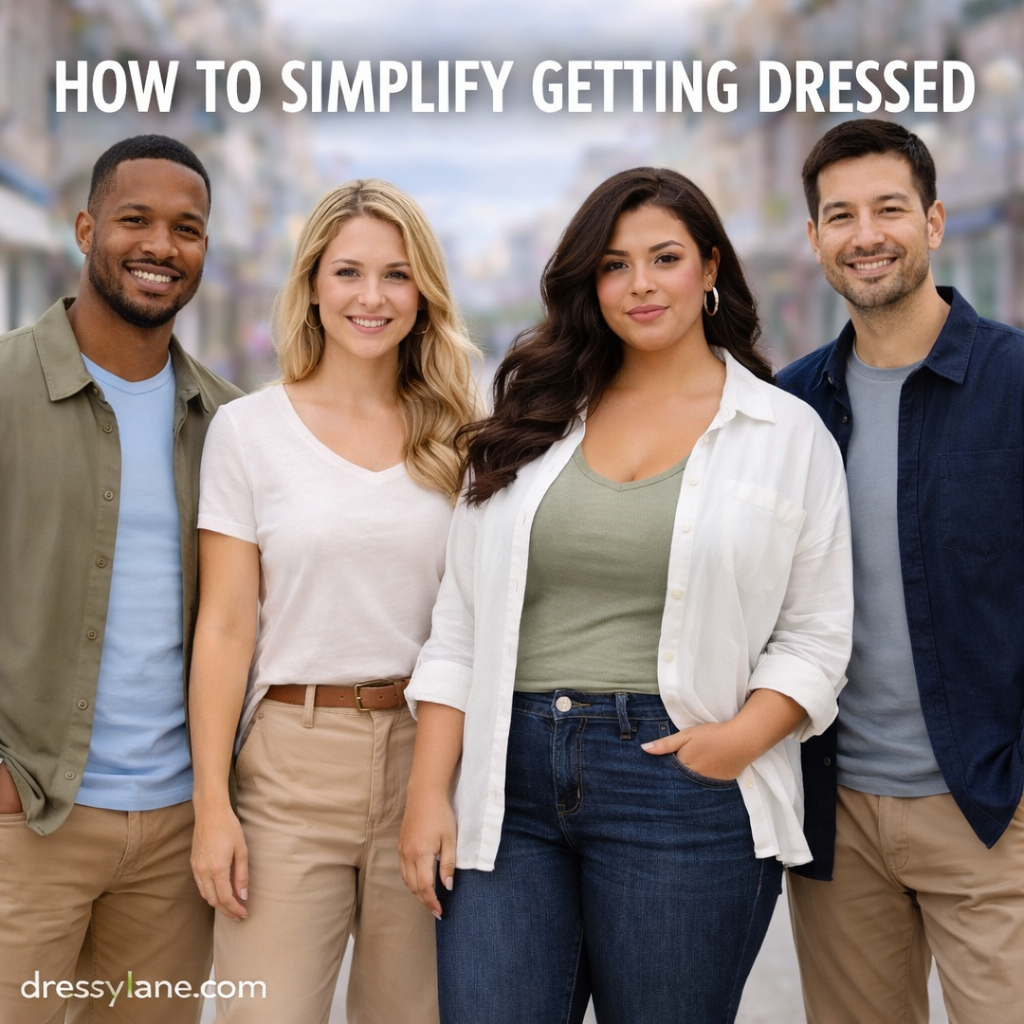
T-shirt + straight-leg jeans + casual jacket + sneakers
or:
Midi dress + cardigan + flats + simple earrings
or:
Polo + chinos + lightweight overshirt + loafers
The individual colors and fabrics can change while the basic combination remains reliable.
If you want to develop several dependable formulas, see how to build simple outfits that always work.
Keep Three to Five Everyday Formulas
You probably do not need 20.
Choose formulas based on your actual week.
Someone who works from home, walks a dog, handles school pickup, and occasionally meets friends for dinner needs different formulas from someone who spends five days a week in a corporate office.
A useful set might include:
- Everyday casual
- Work or polished casual
- Errands
- Social or dinner
- Warm-weather or cold-weather variation
You can then rotate pieces within those categories.
Build a Color Palette That Makes Mixing Easier
A simplified wardrobe works best when much of it coordinates naturally.
You do not have to wear only beige, black, and white. You simply need enough color consistency that getting dressed does not become a matching exercise.
Start with two or three foundation colors such as:
- Navy
- Charcoal
- Black
- Cream
- Camel
- Olive
- Medium-wash denim
Then add colors you genuinely enjoy wearing, such as burgundy, rust, forest green, pale blue, dusty pink, cobalt, or mustard.
If navy trousers work with six of your tops instead of one, they become much more useful.
Pay Attention to Shoes
Shoes often create more wardrobe complications than shirts or pants.
A closet becomes easier when a few pairs cover most situations.
For example:
Women: clean sneakers, loafers or flats, ankle boots, and one dressier shoe.
Men: clean sneakers, casual leather shoes or loafers, boots, and one dressier pair.
Your exact selection should reflect your lifestyle rather than a prescribed wardrobe checklist.
Prioritize Clothes That Are Easy to Wear
An item can look fantastic on a hanger and still make everyday dressing harder.
Pay attention to what a garment demands from you.
Does it wrinkle within minutes? Require constant tucking? Need a particular bra? Feel uncomfortable when sitting? Only work with one pair of shoes?
Those details matter.
For easy everyday dressing, fabrics such as cotton jersey, denim, merino wool, ponte knit, linen blends, Oxford cloth, twill, and quality knitwear can be particularly useful depending on the season.
Pure linen can be comfortable and breathable but wrinkles readily. A linen-cotton or linen-viscose blend may be easier for someone who wants the relaxed appearance of linen with slightly less maintenance.
Likewise, trousers containing a small amount of elastane may be more practical for long days involving driving, sitting, walking, or commuting.
Comfort should be part of the selection process rather than something you evaluate after the outfit is already on. If this is an ongoing struggle, see how to dress to feel comfortable in your body.
Simplify Your Closet Without Getting Rid of Everything
You do not have to build a capsule wardrobe or become a minimalist.
Instead, remove friction.
Look at each item and ask:
Would I realistically choose this on an ordinary weekday?
Pay particular attention to clothing that:
- Has not fit comfortably for a long time
- Needs frequent adjusting
- Requires an inconvenient cleaning routine
- Does not coordinate with anything else
- Belongs to a lifestyle you no longer have
- Is a duplicate you consistently pass over
- Makes you feel self-conscious every time you wear it
Occasion-specific clothes can remain. They simply do not need to occupy prime closet space.
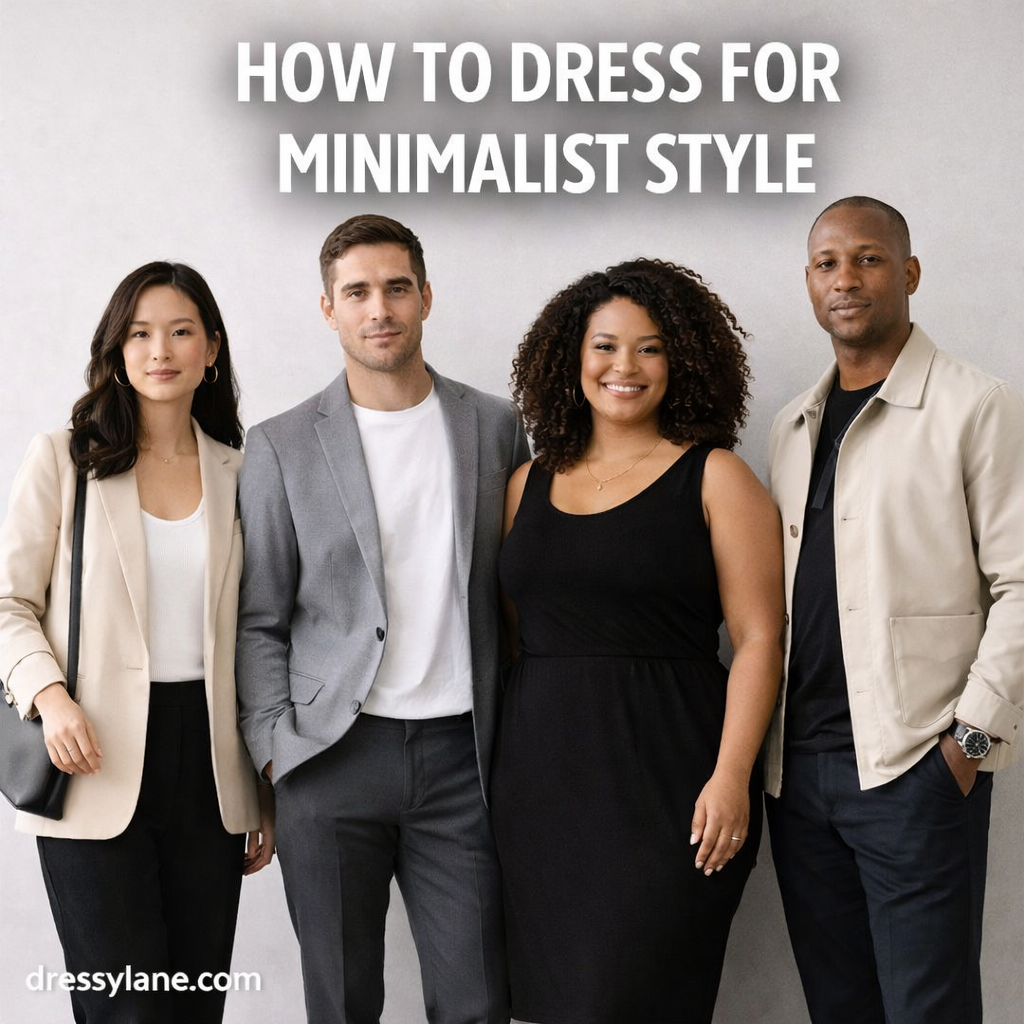
If you enjoy the idea of intentionally owning less, how to dress for minimalist style goes further into creating a deliberately pared-back wardrobe.
Simplifying Getting Dressed for Women
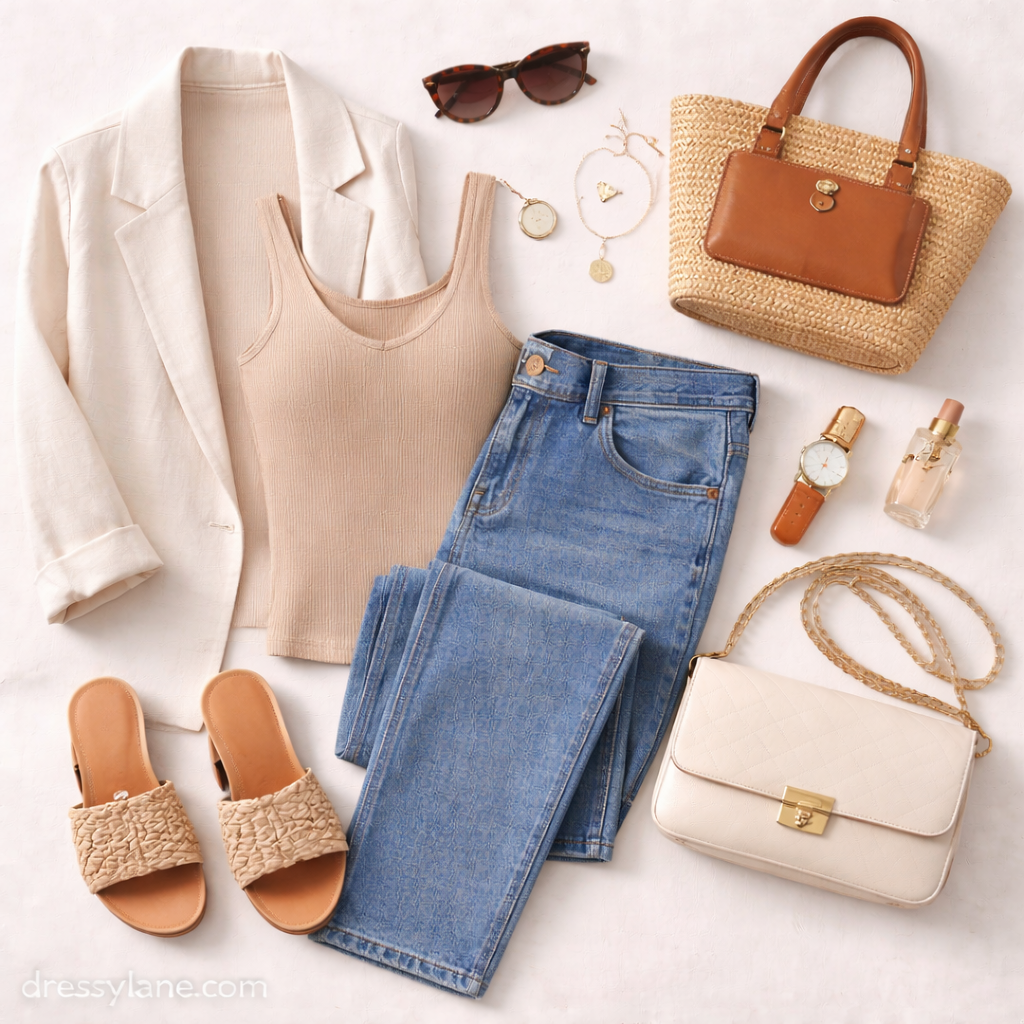
A women’s wardrobe can become complicated when there are many silhouettes, shoe choices, accessories, and levels of formality competing with one another.
The answer is not necessarily fewer feminine or expressive clothes. It is having a dependable everyday foundation.
Useful Women’s Outfit Formulas
For casual days:
Cotton T-shirt + straight-leg jeans + sneakers
For a slightly polished day:
Fine-gauge knit + ankle-length trousers + loafers
For warm weather:
Linen-blend dress + flat sandals + lightweight tote
For casual work:
Shell or blouse + straight trousers + cardigan or unstructured blazer
For colder weather:
Merino sweater + jeans or trousers + ankle boots + wool coat
Matching sets are another useful shortcut. Knit sets, coordinated separates, and two-piece linen outfits create an intentional appearance without requiring much coordination.
Accessories can stay simple. Small hoops, stud earrings, a watch, or one everyday necklace may be enough.
Simplifying Getting Dressed for Men
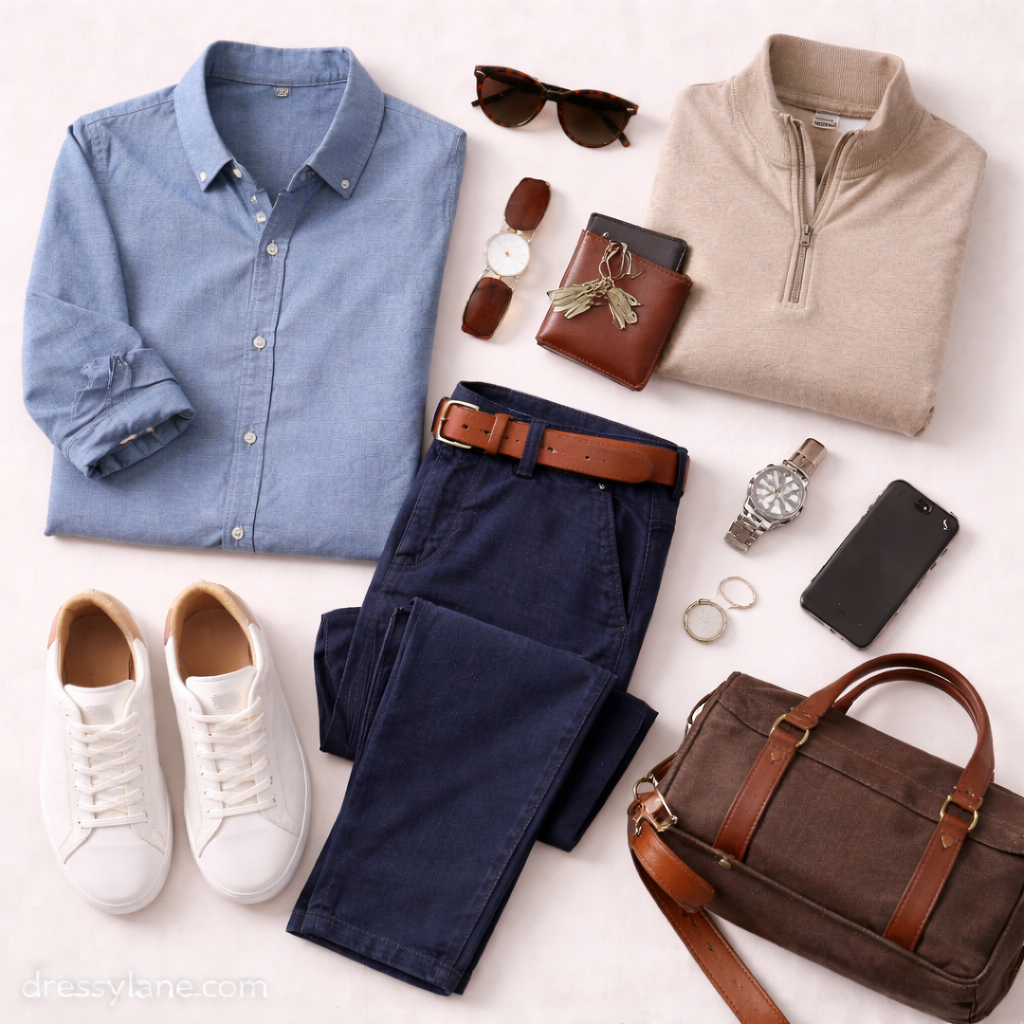
For men, simplicity often comes from standardizing pants, shoes, and layers while rotating shirts.
Useful Men’s Outfit Formulas
For casual days:
Crew-neck T-shirt + chinos + sneakers
For smart casual:
Oxford shirt + dark jeans + loafers
For casual work:
Polo or button-down + chinos + leather sneakers
For colder weather:
Merino crewneck + trousers + boots + casual coat
For warm weather:
Linen or cotton shirt + lightweight chinos + loafers or minimal sneakers
Navy, charcoal, olive, tan, white, gray, and denim are especially easy to combine, but they do not have to make up the entire wardrobe.
Once pants and footwear are dependable, choosing a shirt often becomes the only meaningful decision.
How to Dress When You Want Less Stress
Clothing should not become another source of pressure on an already demanding morning.
When reducing stress is the priority, remove garments that create uncertainty.
Avoid building your everyday wardrobe around pieces that make you repeatedly wonder:
- Is this too tight?
- Is this too dressy?
- Does this wrinkle?
- Which shoes work with this?
- Do I need to change if my plans change?
Instead, favor clothes with some flexibility.
A knit polo can work for errands and a casual lunch. Dark straight-leg jeans can move from daytime errands to an informal dinner. A cardigan, overshirt, or unstructured blazer can quickly make a basic outfit look more finished.
Versatility gives you fewer reasons to reconsider your outfit halfway through getting dressed.
How to Dress When You’re Short on Time
When you have ten minutes to get ready, experimentation is rarely useful.
This is where predetermined outfits earn their place.
Keep two or three complete combinations in mind that you can put on without checking a mirror six times.
For example:
Women: black trousers + cream knit + loafers + small earrings.
Men: navy chinos + light blue Oxford shirt + brown casual shoes.
If mornings are consistently rushed, hang tomorrow’s outfit together the night before. Include the belt, outer layer, and shoes.
That sounds almost too simple to matter, but it removes several decisions at exactly the point when time is scarce.
How to Dress for Busy Days
A busy day may include commuting, sitting at a desk, walking several blocks, picking up groceries, meeting someone for coffee, and going to dinner without returning home.
Those days require clothes that can move between environments.
Look for:
- Breathable fabrics
- Comfortable waistbands
- Shoes suitable for walking
- Layers that can be removed easily
- Bags large enough for daily essentials
- Fabrics that recover reasonably well after sitting
A cotton poplin shirt, stretch twill trousers, merino sweater, dark denim, ponte pants, or structured knit jacket can often handle a longer day better than delicate fabrics or highly restrictive tailoring.
The goal is not athletic clothing unless the day calls for it. It is ordinary clothing that remains comfortable after several hours.
How to Dress for Busy, Real-Life Schedules
Real schedules rarely divide neatly into “work,” “casual,” and “evening.”
You might work in the morning, go to an appointment at lunch, run errands afterward, and meet someone for an early dinner.
Build outfits around the most demanding part of the day and make everything else adaptable.
If dinner requires slightly more polish, for example, start with dark jeans or trousers instead of sweatpants. Add a knit top or button-down and comfortable leather shoes or clean sneakers.
You are now dressed casually enough for daytime but can add a blazer, jacket, scarf, or jewelry before dinner.
A practical wardrobe should accommodate transitions instead of forcing complete outfit changes.
What to Wear for Casual Friday
Casual Friday can actually create more uncertainty than normal office attire because the boundaries are less obvious.
The safest approach is to relax one level from your usual work clothes rather than treating Friday as a completely different dress code.
If you normally wear trousers and a button-down, try dark jeans with the same shirt.
If you normally wear a blouse, tailored trousers, and pumps, try straight-leg jeans, a knit top, and loafers.
Good casual-Friday pieces often include:
- Dark or medium-wash jeans without heavy distressing
- Chinos
- Polo shirts
- Oxford shirts
- Fine-gauge sweaters
- Simple blouses
- Cardigans
- Loafers
- Clean leather or minimalist sneakers where appropriate
Workplace culture still matters. A law office and a small design studio can both advertise “casual Friday” while meaning very different things.
How to Dress for Errands Without Looking Sloppy
Errand clothes need to be comfortable, washable, and easy to move in. They do not have to look accidental.
The simplest technique is combining relaxed clothing with one structured or intentional element.
For women:
Leggings + substantial cotton T-shirt + overshirt + clean sneakers
or:
Relaxed jeans + tank + cardigan + flat sandals
For men:
Jogger-style trousers + polo + sneakers
or:
Jeans + heavyweight T-shirt + casual overshirt
Fit and condition matter more than formality.
A clean, well-fitting T-shirt with simple pants often looks more put together than an elaborate outfit that is wrinkled or poorly fitted.
How to Dress for Practical Living
Practical clothing solves problems.
If you walk frequently, shoes should support walking. If you commute on public transportation, an extremely delicate coat may not be your best everyday option. If you have young children, machine-washable fabrics may matter more than dry-clean-only tailoring.
Consider your real routine:
- Do you drive or walk?
- Are you frequently outdoors?
- Do you carry a laptop?
- Do you need pockets?
- Do you move between air-conditioned and outdoor environments?
- Are spills common?
- Do you spend most of your day sitting or standing?
These questions should influence purchases.
There is little value in creating a theoretically perfect wardrobe that makes your actual life harder.
How to Dress for Real Life
Style advice sometimes assumes every outfit is being assembled for an event.
Most clothes are not.
They are worn while commuting, working, grocery shopping, taking children somewhere, walking the dog, meeting a friend, going to appointments, or sitting in traffic.
Your everyday wardrobe deserves more attention than your hypothetical wardrobe.
A useful rule is to spend wardrobe space and clothing budget roughly in proportion to how you actually spend your time.
If 80 percent of your life is casual, you probably do not need 60 percent of your closet devoted to formal clothing.
That does not mean abandoning aspirational style. It means making sure your real life is adequately dressed first.
How to Dress for a Balanced Lifestyle
A balanced wardrobe sits between two extremes: clothes that are attractive but impractical and clothes that are comfortable but leave you feeling underdressed everywhere.
Try to own pieces that can cross categories.
A knit blazer is less formal than traditional tailoring but more polished than a sweatshirt. Dark denim can work for errands, casual offices, lunches, and many informal dinners. Merino knitwear provides warmth without the bulk of a heavy sweatshirt.
Think in terms of range.
The more ordinary situations an item can handle, the more useful it becomes.
That is particularly helpful if you prefer not to overdress. Our guide to what to wear when you don’t want to overdress covers that middle ground in more detail.
Create a Small “Ready for Almost Anything” Wardrobe
It helps to have a group of clothes capable of handling most ordinary situations.
That might include:
For Women
- Straight-leg jeans
- Neutral trousers
- Cotton or ribbed tops
- Fine-gauge sweater
- Simple midi dress
- Cardigan
- Casual blazer or jacket
- Clean sneakers
- Loafers or flats
- Simple ankle boots
For Men
- Dark jeans
- Chinos
- Plain T-shirts
- Oxford shirts
- Polo
- Merino or cotton sweater
- Overshirt or casual jacket
- Clean sneakers
- Loafers or casual leather shoes
- Boots
This is not a mandatory shopping list. Someone living in Miami will need a very different wardrobe from someone living in Minneapolis.
Use the idea rather than copying the pieces literally: build a dependable core capable of handling most of your normal week.
Organize Your Closet for Faster Decisions
Closet organization should support how often you wear something.
Keep frequent choices easiest to reach.
You can group clothing by category:
shirts | pants | dresses | layers | jackets
Or by function:
work | casual | exercise | occasion
Choose whichever system makes sense when you are standing in front of the closet half-awake.
Seasonal clothing can be rotated out if space is limited.
Formalwear, specialty clothing, and rarely used items can also move away from your primary dressing area.
The goal is not to create a picture-perfect closet. It is to make the useful clothes easier to see.
Prepare for Tomorrow Before Tomorrow Arrives
Even a simplified wardrobe occasionally runs into practical problems.
The shirt you wanted is in the laundry. Your shoes need cleaning. The weather changed. Your pants need ironing.
A two-minute evening check can prevent many of these issues.
Look at tomorrow’s schedule and weather, then choose the broad outfit category you will need.
You may not need to lay out every garment. Simply deciding “chinos, Oxford shirt, sneakers, jacket” reduces tomorrow’s workload.
For important mornings—interviews, flights, presentations, weddings, early appointments—lay out everything.
That includes socks, underwear, belt, jewelry, bag, and outerwear.
Make Uncertain Dress Codes Easier
Some of the hardest outfit decisions happen when you do not know what everyone else will wear.
If an invitation simply says “dinner,” “celebration,” or nothing at all, avoid solving the uncertainty by dramatically overdressing or underdressing.
Look at:
- Venue
- Time of day
- Purpose of the gathering
- Host
- Expected activities
- Typical dress level for similar events
Then choose an outfit with adjustable formality.
A blazer can come off. Jewelry can be added. Sleeves can be rolled. A cardigan can make a dress more relaxed.
For particularly unclear invitations, see how to dress when the invitation is vague.
And when you are dealing with a specific event rather than everyday dressing, the complete guide to dressing for different occasions provides a broader dress-code reference.
For example, an evening at an upscale hotel restaurant may require a different interpretation of “smart casual” than your neighborhood restaurant. Our guide to how to dress for hotel dining covers that situation specifically.
Stop Trying to Make Every Outfit Interesting
This may be one of the most useful mindset changes.
An outfit does not have to be novel to be good.
You can wear the same trousers twice in one week. You can repeat Monday’s outfit formula on Thursday. You can own the same T-shirt in several colors.
People with consistently good everyday style often repeat successful silhouettes far more than you might realize.
The objective is not maximum variety. It is reliability.
A Practical Styling Tip
When an outfit feels slightly unfinished, change one thing before changing everything.
Try tucking the shirt, changing the shoes, adding a jacket, rolling a sleeve, or switching the belt.
One small proportion change can fix an outfit that initially feels wrong.
Replacing three or four pieces at once puts you right back into the decision-making cycle you were trying to avoid.
Build Your Personal Getting-Dressed System
Eventually, simplifying your wardrobe should produce a repeatable system.
Yours might look like this:
Step 1: Check the day’s weather and activities.
Step 2: Choose one of your established outfit formulas.
Step 3: Select the base pieces.
Step 4: Add the appropriate shoes.
Step 5: Add a layer only if the weather or setting requires one.
Step 6: Add one finishing element if you want it.
Then stop.
The stopping point matters.
Constantly second-guessing a perfectly appropriate outfit defeats the purpose of simplifying.
Frequently Asked Questions
How can I get dressed faster in the morning?
Create three to five reliable outfit formulas, keep frequently worn clothes together, and decide the night before what general type of outfit you need. Make sure your most versatile shoes and layers are easy to reach.
What should I wear when I am short on time?
Use a predetermined combination rather than creating an outfit from scratch. Straight-leg jeans or trousers, a familiar top, comfortable shoes, and one optional layer work in many everyday situations.
How can I reduce decision fatigue from clothes?
Reduce the number of decisions rather than simply reducing the number of garments. Establish default pants, shoes, colors, and outfit formulas so you are choosing between a few proven options.
What should I wear on a very busy day?
Choose breathable, comfortable fabrics and shoes that can handle the most physically demanding part of your schedule. Cotton, merino wool, stretch twill, ponte knit, denim, and linen blends can all work depending on weather and formality.
How can I look put together while running errands?
Combine relaxed clothing with one intentional element: a structured overshirt, clean sneakers, a good jacket, a simple bag, or well-fitting jeans. Clothes do not need to be formal to look considered.
What should I wear for casual Friday?
Dress approximately one step below your normal workplace formality. Dark jeans, chinos, knitwear, polos, casual button-downs, loafers, and clean sneakers are common options, but follow your workplace’s established culture.
Do I need a capsule wardrobe to simplify getting dressed?
No. A capsule wardrobe is one method, not a requirement. You can own plenty of clothes while simplifying your routine through coordinated colors, outfit formulas, closet organization, and reliable everyday pieces.
How many outfits do I actually need?
There is no universal number. Focus on having enough combinations to cover your normal laundry cycle and recurring activities without forcing you to keep clothes that rarely serve a purpose.
How do I dress for a schedule that changes throughout the day?
Start with clothes appropriate for the most demanding or formal part of the day, then use removable layers and versatile shoes to adjust. Dark denim, trousers, knit tops, button-downs, cardigans, overshirts, and casual blazers are useful transitional pieces.
How do I simplify my wardrobe without making it boring?
Keep your foundation consistent and create variety through color, texture, accessories, or one distinctive piece. A simple wardrobe does not have to be a neutral wardrobe.
Final Thoughts
Learning how to simplify getting dressed is less about owning the perfect wardrobe and more about creating a dependable relationship between your clothes and your actual life.
Keep the pieces that fit comfortably and work hard. Build a handful of outfit formulas. Make colors easy to combine. Choose shoes for the days you really have. Organize everyday clothing so it is easy to reach, and give yourself permission to repeat successful outfits.
Most importantly, stop asking every outfit to accomplish everything.
Some clothes are for work. Some are for dinner. Some are for errands. And some dependable pieces can move comfortably between all three.
Once you know which is which, getting dressed stops feeling like a daily styling project and becomes what it should be: a straightforward part of getting on with your day.