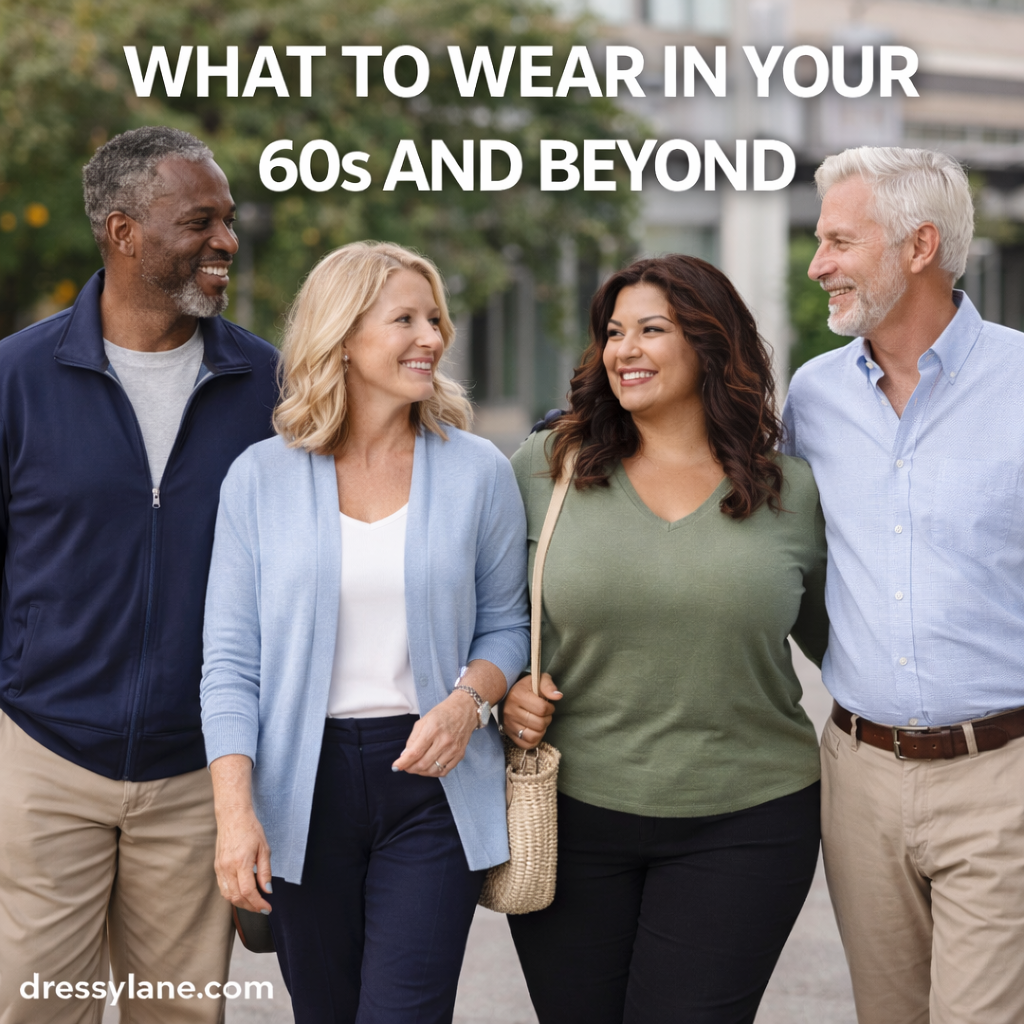
There isn’t a separate set of clothes you’re required to start wearing in your 60s.
Jeans still work. Sneakers work. Tailored suits work. Bright colors, prints, leather jackets, dresses, heels, wide-leg trousers, and whatever else you’ve genuinely enjoyed wearing can remain part of your wardrobe.
What may change is what you expect from those clothes.
Perhaps you no longer tolerate a waistband that digs in after lunch. Maybe heavy shoes feel unnecessary, you run warmer or colder than you used to, or you’ve discovered that a jacket isn’t useful unless you can comfortably move your shoulders in it.
Those are good reasons to change what you wear.
Age by itself isn’t.
Start With How the Clothes Feel After Several Hours
A fitting-room mirror tells you surprisingly little about whether something will become a favorite.
Sit down.
Walk around.
Bend your knees.
Raise your arms.
Button and unbutton the jacket.
If you’re trying on shoes, spend enough time standing in them to notice pressure around the toes, heel, and arch.
For trousers, I pay particular attention to the waistband when sitting. A pair can look beautifully tailored while standing and become unbearable during a two-hour dinner.
The same principle applies to shirts and jackets. If you’re constantly pulling, straightening, tugging, or adjusting something, the fit probably isn’t as good as it looked initially.
Comfort isn’t a consolation prize. It’s part of good fit.
Don’t Automatically Start Wearing Looser Clothes
One of the least useful pieces of age-based style advice is that clothes should simply become looser as you get older.
They don’t have to.
Fitted, straight, wide, relaxed, and oversized silhouettes can all work.
What matters is where the garment fits and where it releases.
A pair of straight trousers might fit comfortably through the waist and hips before falling cleanly through the leg. A relaxed linen shirt can have plenty of room through the body while still fitting correctly across the shoulders.
Likewise, a knit dress can follow the body without being restrictive.
Choose the amount of ease you enjoy rather than assuming more fabric automatically equals more comfort.
Fabric Makes an Enormous Difference
If comfort is becoming more important, pay close attention to fabric.
For warm weather, linen, linen blends, cotton poplin, lightweight cotton knits, and seersucker can provide airflow.
For cooler weather, merino wool is especially useful because it provides warmth without the bulk of a heavy sweater.
For trousers, ponte, wool blends, cotton twill, and fabrics containing a small amount of elastane can provide structure with enough flexibility for sitting and walking.
Useful fabrics might include:
- Cotton poplin
- Oxford cloth
- Linen and linen blends
- Merino wool
- Cotton twill
- Ponte
- Denim with slight stretch
- Soft wool blends
- Fine-gauge cotton knitwear
I’d avoid assuming that “soft” always means comfortable.
A very soft, thin fabric that clings, twists, or loses its shape can be more annoying than a substantial fabric that hangs properly.
What Women Can Wear in Their 60s and Beyond
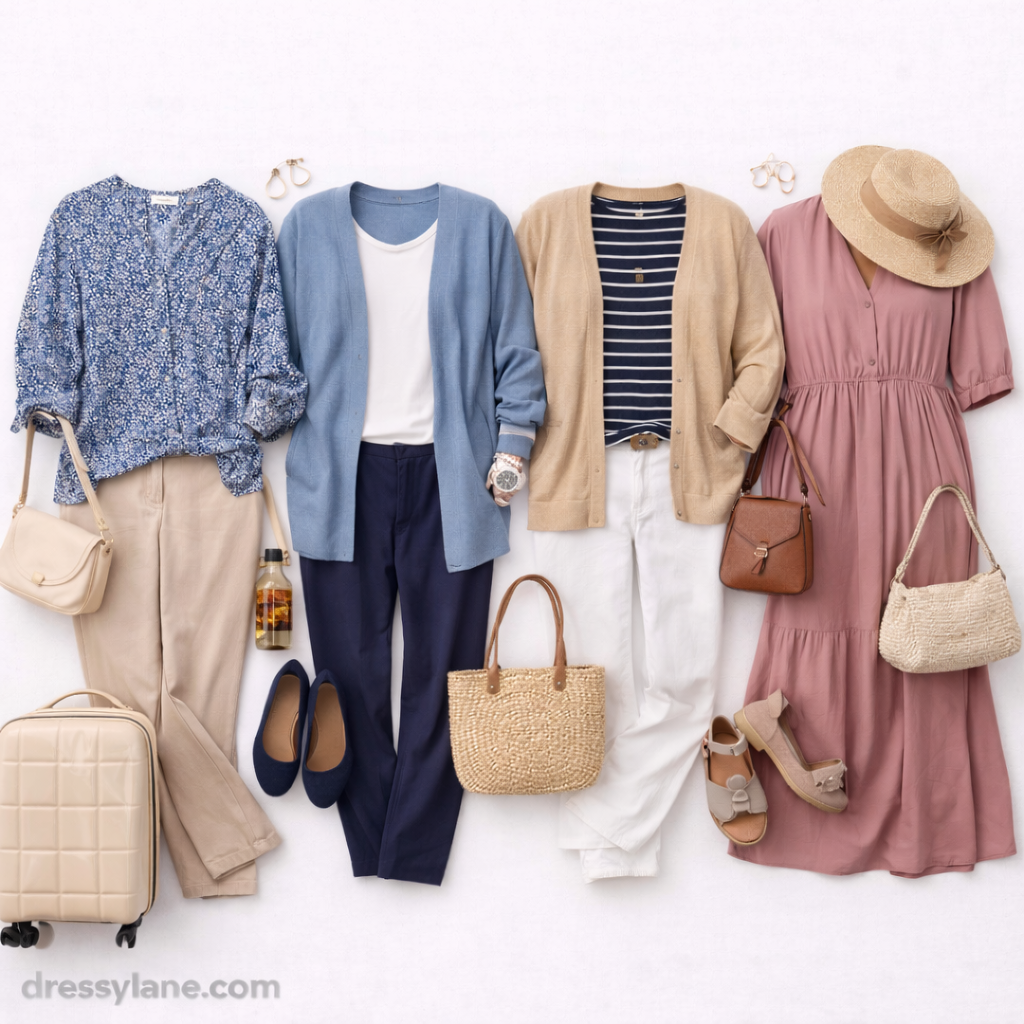
Women’s clothing advice after 60 often becomes unnecessarily restrictive.
You don’t have to hide your arms, stop wearing jeans, lower every hemline, avoid bright colors, or switch entirely to loose tunics.
Instead, build around silhouettes you already know you enjoy.
For a casual day, straight jeans with a cotton shirt, loafers, and a lightweight jacket are easy and adaptable.
For something slightly more polished, try wide-leg trousers with a fine-gauge knit and flats or low block heels.
A midi dress can be practical because it creates most of the outfit in one step, but midi isn’t the only acceptable length. Choose the hem based on the dress, your proportions, and where you’re going.
Some useful combinations include:
- Straight jeans + striped cotton shirt + leather sneakers
- Wide-leg trousers + fitted knit + loafers
- Linen trousers + sleeveless top + lightweight cardigan
- Midi dress + denim or leather jacket + ankle boots
- Dark jeans + silk or matte-satin blouse + flats
- Ponte trousers + cotton shirt + relaxed blazer
The important thing is that these are examples, not a uniform.
Color Can Become More Important, Not Less
There’s no requirement to retreat into beige, gray, navy, and black.
If anything, this can be a good time to become more decisive about color.
If cobalt blue consistently makes you happy when you put it on, that’s useful information. The same applies to red, emerald, pink, mustard, burgundy, turquoise, or any other shade.
You don’t need to determine whether a color is officially “age appropriate.”
You also don’t need to follow rigid rules about complexion.
Natural daylight is more useful. Hold the garment near your face or take a photograph near a window and decide whether you like the effect.
I’d trust that more than a generic list telling everyone of a particular age which colors they’re supposed to wear.
What Men Can Wear in Their 60s and Beyond
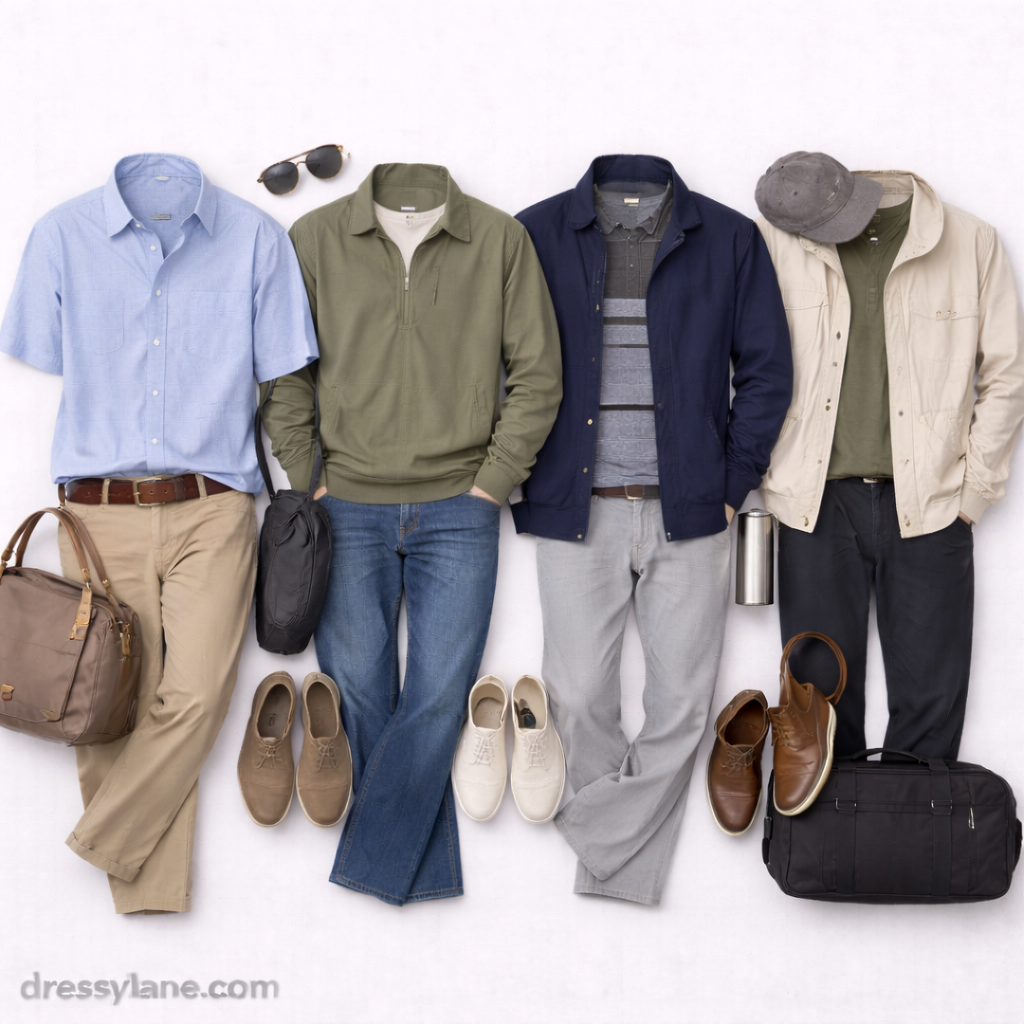
For men, a small number of dependable pieces can cover most everyday situations.
Straight chinos, dark or medium-wash jeans, Oxford shirts, knit polos, merino sweaters, overshirts, casual jackets, and comfortable footwear provide plenty of combinations.
For example:
- Straight chinos + knit polo + suede loafers
- Dark jeans + Oxford shirt + leather sneakers
- Wool trousers + merino crewneck + casual jacket
- Medium-wash jeans + heavyweight T-shirt + overshirt
- Linen-blend trousers + short-sleeve shirt + loafers
- Dark trousers + poplin shirt + unstructured blazer
I particularly like knit polos as an alternative to traditional polo shirts when you want something casual that still has some structure. Cotton, merino, and cotton-silk blends can all work depending on climate and budget.
For jackets, look beyond formal blazers.
An overshirt, Harrington-style jacket, lightweight field jacket, suede jacket, or unstructured blazer can provide shape without feeling stiff.
Shoes Need to Pass a Real-World Test
Comfortable footwear doesn’t automatically mean orthopedic-looking footwear, and stylish footwear doesn’t need to hurt.
There are supportive versions of sneakers, loafers, flats, sandals, boots, and dress shoes.
What matters is the individual shoe.
Check:
- Toe room
- Heel slippage
- Sole flexibility
- Cushioning
- Stability
- Weight
- How securely the shoe stays on your foot
For women, loafers, supportive ballet flats, slingbacks, low block heels, sneakers, and boots can cover a large range of situations.
For men, sneakers, loafers, derbies, Chelsea boots, and other casual leather or suede shoes can do the same.
One thing I’d stop doing is keeping shoes that technically fit but consistently hurt.
If you’ve worn them five times and your feet hurt every time, the sixth outing probably isn’t going to reveal their hidden comfort.
Layers Solve More Problems Than Heavy Clothing
Temperature changes can make an otherwise good outfit frustrating.
You might move from an air-conditioned restaurant to a warm sidewalk, from a cold airplane cabin to a hot destination, or between different rooms in the same building.
Several light layers are often easier to manage than one heavy garment.
A cotton shirt underneath a lightweight cardigan gives you options. So does a T-shirt with an overshirt or an unstructured jacket.
For travel, I particularly like layers that can be removed easily and folded without occupying half a bag.
A lightweight merino cardigan or cotton overshirt usually earns its luggage space more easily than a bulky sweater that only works at one temperature.
Pay Attention to Closures and Small Details
Comfort sometimes comes down to surprisingly small design choices.
A tiny back zipper can be annoying if it’s difficult to reach. Very small shirt buttons may be frustrating. A heavy handbag can become uncomfortable before the day is half over.
If any of those things matter to you, treat them as legitimate shopping criteria.
Look for:
- Easy zippers
- Comfortable waist closures
- Useful pockets
- Bags that aren’t unnecessarily heavy
- Adjustable straps
- Jackets that are easy to put on and remove
Pull-on trousers can also be excellent, but I’d look for versions with a properly constructed waistband and substantial fabric rather than assuming every elastic-waist trouser will look casual.
Ease and polish can absolutely exist in the same garment.
Keep Wearing Denim If You Like Denim
There is no expiration date on jeans.
Straight-leg denim is particularly versatile because it works with sneakers, loafers, flats, and boots, but wider, relaxed, slim, and bootcut jeans are all options.
Look for the rise that feels comfortable when sitting.
A small amount of stretch can be useful, although too much stretch sometimes causes denim to lose its shape during the day.
Dark indigo can look polished, while faded blue denim is excellent for casual outfits.
White, black, gray, and colored denim are options too.
I’d choose based on what works with the rest of your wardrobe rather than trying to identify the jean cut someone over 60 is “supposed” to wear.
Dress for the Life You’re Actually Living
A wardrobe should reflect your schedule.
Someone who travels frequently needs different clothes from someone working several days a week in an office.
If you walk often, footwear becomes a major priority.
If you attend dinners, concerts, religious services, community events, or family gatherings regularly, keep several outfits ready for those situations.
If you’re retired and your lifestyle has become more casual, you may discover that much of your former work wardrobe isn’t earning its closet space anymore.
That’s fine.
Keep the pieces you can repurpose and gradually replace the rest with clothes appropriate for your current routine.
You don’t need to preserve an old lifestyle through your wardrobe.
Don’t Save Everything Nice for Special Occasions
Wear the cashmere sweater.
Use the good handbag.
Put on the watch.
Wear the jacket to lunch.
If you own a beautiful scarf, don’t wait for a sufficiently important Tuesday.
There are obviously clothes intended for genuinely formal events, but many things we call “special” are simply nicer everyday clothes.
I’d rather wear a good wool coat repeatedly and eventually wear it out than protect it in a closet for twenty years.
Clothes are allowed to show evidence of being enjoyed.
Trends Are Still Available to You
Being over 60 doesn’t require withdrawing from fashion.
Try a wider trouser if you like the silhouette. Wear an oversized shirt. Experiment with a different sneaker shape. Add a current color.
The advantage of knowing your style is that you don’t need to accept the entire trend.
Take the part you like.
If a new trouser shape works with your existing knitwear and shoes, great.
If a trend requires you to buy five additional pieces just to make it wearable, I’d probably skip it.
That’s not an age rule. It’s simply sensible shopping.
Keep Clothes in Good Condition
Maintenance becomes especially valuable when you’ve built a wardrobe you genuinely like.
Use a fabric shaver on pilling knitwear.
Steam shirts and dresses.
Condition leather shoes when needed.
Replace worn heel caps.
Repair loose buttons.
Hem trousers that drag.
A garment doesn’t need to look brand-new, but it should look cared for.
And don’t automatically discard something because it’s old.
A ten-year-old wool coat that still fits beautifully and is in excellent condition may be far more useful than whatever happens to be in stores this season.
Final Thoughts
Knowing what to wear in your 60s and beyond isn’t about moving into a safer, quieter version of your previous wardrobe.
It’s about being more specific about what you need from your clothes.
Choose waistbands you can comfortably sit in. Wear shoes you can actually walk in. Use layers when temperatures change throughout the day. Keep the denim, colors, prints, dresses, tailoring, or trends you genuinely enjoy.
And when something no longer works, replace it because the fit, fabric, condition, or function isn’t right—not simply because you’ve reached a particular birthday.
Great style can become easier with age because you have years of evidence about what you actually like.
Use it.