Your 20s can be an awkward decade for getting dressed.
You might need jeans and sneakers for a Saturday afternoon, business-casual clothes for your first office job, something decent for a date that evening, and a wedding outfit a few weeks later. Meanwhile, your closet may still contain clothes you bought for college, pieces from your first paycheck, and trends you aren’t sure you even like anymore.
Looking put together doesn’t mean replacing all of that with expensive “adult” clothes.
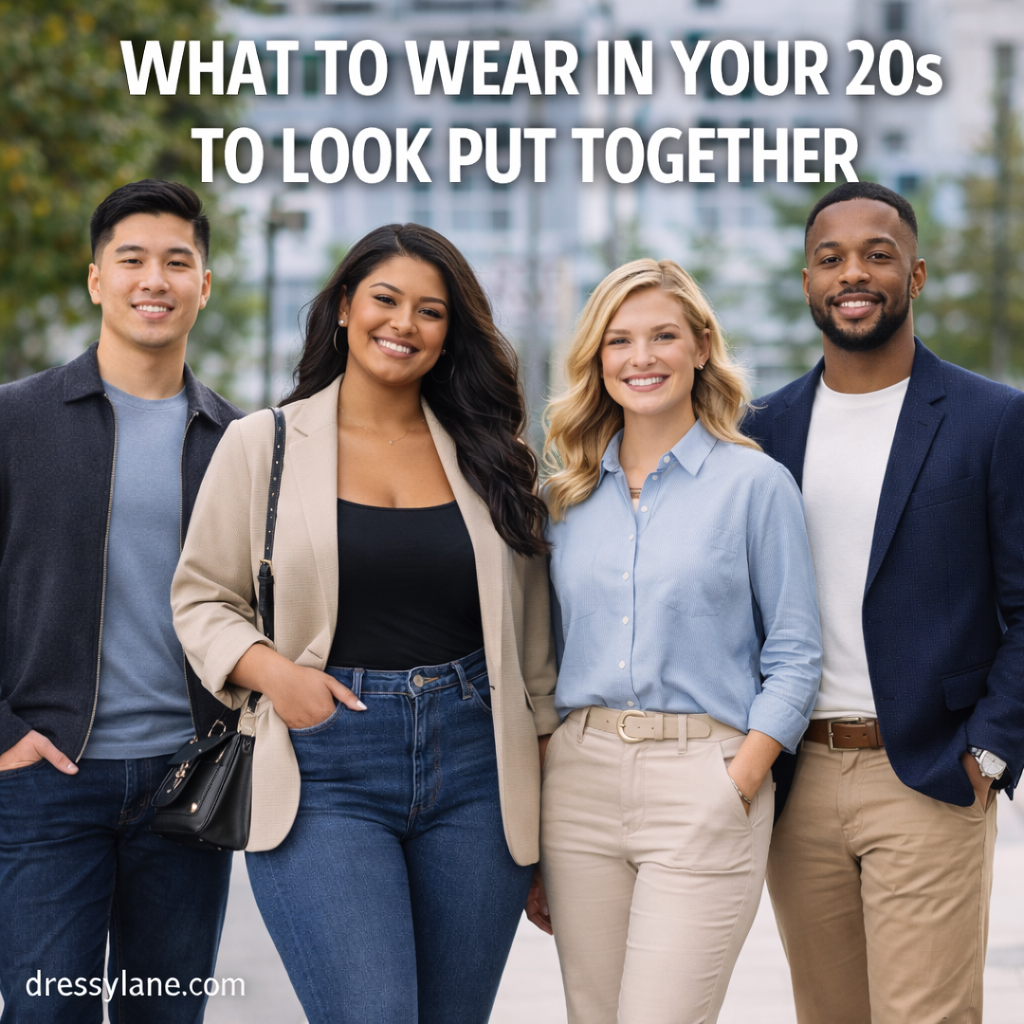
Usually, it comes down to having a few dependable outfits, getting the fit right, and paying attention to small details such as trouser length, wrinkled shirts, worn-out shoes, and whether your clothes actually make sense for where you’re going.
Looking Put Together Isn’t the Same as Dressing Up
One mistake people make in their 20s is assuming they need to dress more formally to look more mature.
You don’t.
A heavyweight cotton T-shirt, straight-leg jeans, clean sneakers, and an overshirt can look more put together than an inexpensive suit that doesn’t fit properly.
The same is true for women. Straight jeans, a fitted knit, leather flats, and simple jewelry can look polished without being remotely formal.
What you’re aiming for is coherence.
Your clothes should fit reasonably well, be in good condition, and look like they belong in the same outfit.
That sounds basic, but it eliminates a surprising number of wardrobe problems.
Start by Fixing the Clothes You Already Own
Before buying a new wardrobe, spend an afternoon trying on what you already have.
Don’t just stand in front of the mirror.
Sit down in your trousers. Raise your arms in jackets and shirts. Walk around in your shoes. Check whether jeans bunch excessively at the ankle or whether a blazer pulls across the back.
Look specifically at:
- Shoulder seams
- Sleeve length
- Trouser and jean hems
- Waist fit
- Shirt and T-shirt length
- Shoes that are visibly worn out
A $15 trouser hem can sometimes improve an outfit more than another $100 shopping trip.
And if you constantly pull down a shirt, adjust a waistband, or straighten a jacket, I’d stop trying to make that piece work. Clothes that require constant management rarely become your reliable favorites.
Build Outfits, Not a Collection of “Basics”
You’ve probably seen lists telling everyone in their 20s to buy the same white shirt, blazer, black trousers, trench coat, and loafers.
I wouldn’t shop that way.
A wardrobe is useful when the pieces create outfits for your actual week.
If you work remotely, go out casually, and rarely attend formal events, owning five blazers isn’t particularly helpful. You might get far more use from dark jeans, straight trousers, knitwear, clean sneakers, a good jacket, and one dressier outfit.
Think about what you repeatedly do.
You may need clothes for:
- Work or interviews
- Classes or commuting
- Dates and dinners
- Casual weekends
- Weddings and special occasions
- Going out with friends
Then build a few reliable combinations for those situations.
That’s more useful than trying to achieve an arbitrary capsule-wardrobe item count.
Fabrics Can Make Simple Clothes Look Better
When an outfit feels cheap or unfinished, the problem isn’t always the price.
Sometimes it’s the fabric.
A substantial cotton T-shirt tends to hang better than a very thin jersey tee. Cotton twill chinos usually have more structure than flimsy synthetic trousers. Fine-gauge merino or cotton knitwear can look polished while still being comfortable.
Useful everyday fabrics include:
- Oxford cloth
- Cotton poplin
- Denim
- Cotton twill
- Merino wool
- Fine-gauge cotton knit
- Linen and linen blends
- Ponte for structured stretch
This doesn’t mean natural fibers are automatically superior. A small amount of stretch can make trousers much easier to wear, and some synthetic blends resist wrinkles beautifully.
Look at how the garment hangs, feels, and recovers after sitting rather than judging quality from the fiber label alone.
What Men Can Wear in Their 20s
For men, I’d start with trousers and shoes.
Those two things often determine whether the rest of an outfit looks deliberate.
You don’t need extremely slim clothes to look put together. Straight and relaxed cuts can look excellent when the proportions make sense.
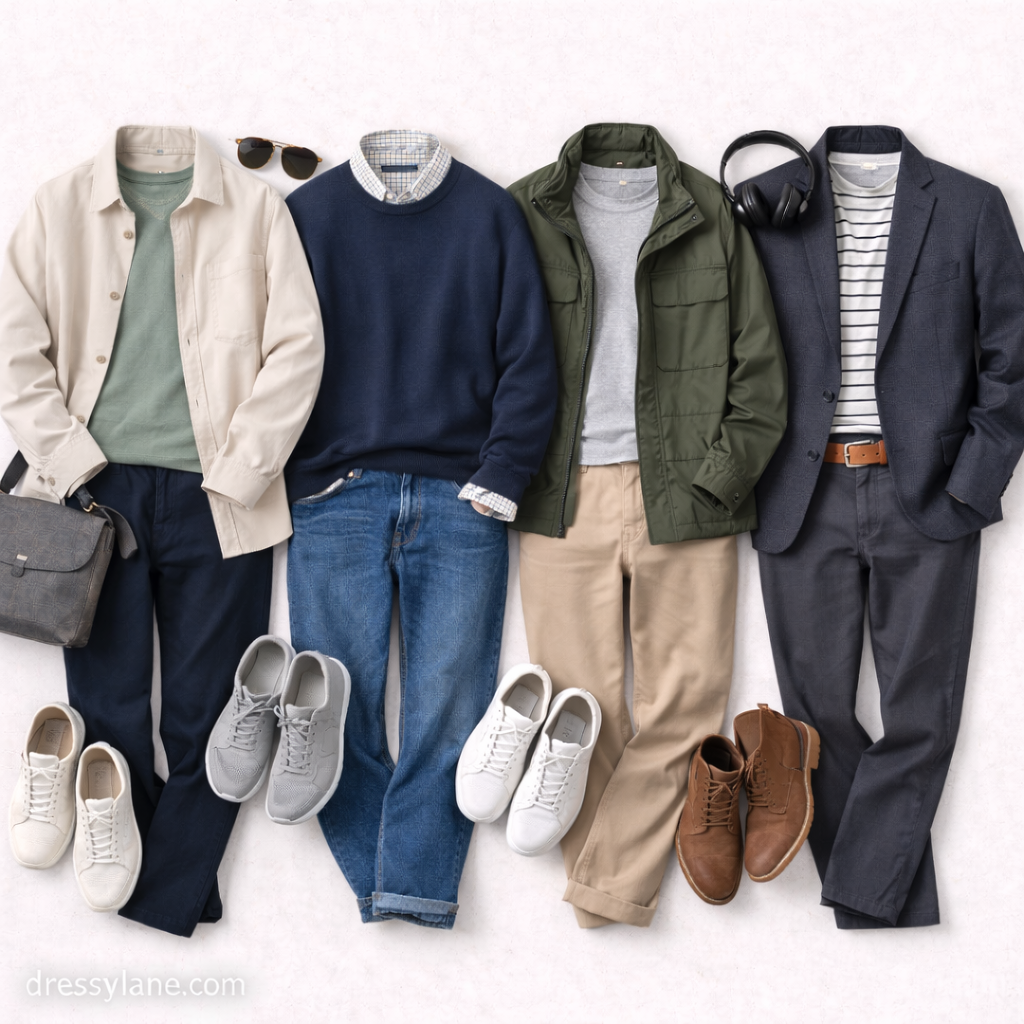
A practical wardrobe might include medium- or dark-wash straight jeans, chinos or casual trousers, heavyweight T-shirts, Oxford shirts, knitwear, an overshirt or casual jacket, clean sneakers, and one pair of smarter leather or suede shoes.
Then turn those pieces into actual outfits.
For an Ordinary Day
Try straight jeans, a substantial white or gray T-shirt, an olive or navy overshirt, and leather sneakers.
Nothing about that outfit is formal, but the layers give it structure.
For a Casual Office
Wear chinos or wool-blend trousers with an Oxford shirt and loafers or minimal sneakers, depending on the workplace.
A fine-gauge crewneck sweater can replace the shirt when you want something even easier.
For a Date or Dinner
Dark jeans or trousers with a knit polo, merino sweater, or casual button-down usually hit the right level.
I’d skip the shiny “going-out shirt” bought specifically because it looks dressy. A well-fitting textured knit or Oxford shirt tends to be more versatile and usually looks less forced.
When You Actually Need to Dress Up
Own at least one outfit you can wear to an interview, nicer wedding, funeral, formal dinner, or similar event.
For many men, a navy or charcoal suit is more versatile than a black one. Get the trousers hemmed correctly and make sure the jacket fits through the shoulders.
You don’t need five suits. You need one that doesn’t look borrowed.
What Women Can Wear in Their 20s
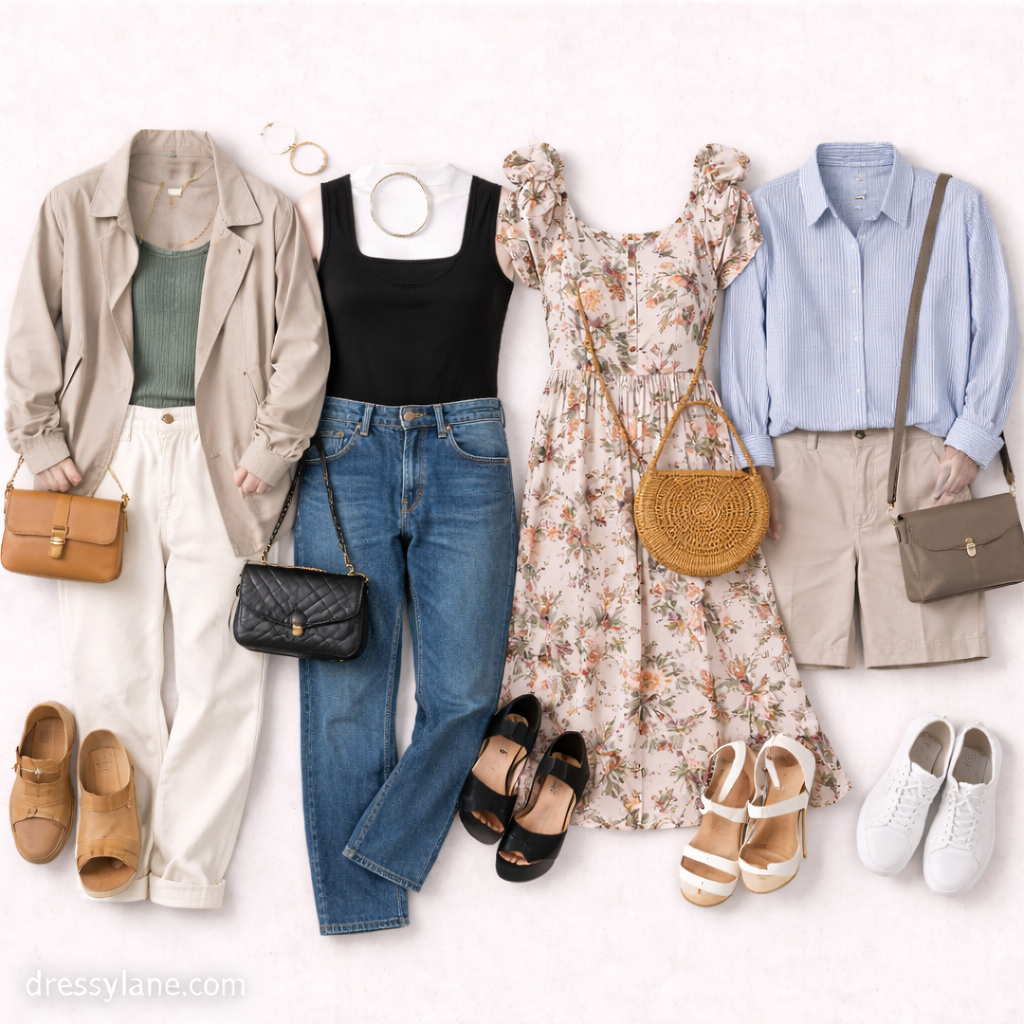
For women, the biggest improvement often comes from having several dependable silhouettes instead of constantly buying isolated statement pieces.
That might mean discovering that you reliably like straight jeans with fitted tops, wide-leg trousers with shorter knits, or midi dresses with flats.
Once you know that, shopping becomes much easier.
For Everyday Wear
Try straight-leg jeans with a fitted ribbed knit or substantial cotton T-shirt, then add loafers, ballet flats, or clean sneakers.
A cardigan, denim jacket, leather jacket, or relaxed blazer can provide another layer without making the outfit feel corporate.
For Work
Straight or wide-leg trousers with a fine-gauge knit, cotton blouse, or poplin shirt create a useful foundation.
Shoes could be loafers, slingbacks, ballet flats, ankle boots, or low heels depending on the office.
I’d prioritize trousers that still feel comfortable after sitting for several hours. Something that looks fantastic standing in a fitting room but digs into your waist at a desk isn’t a particularly good work purchase.
For Dates and Dinners
You don’t necessarily need a separate category of “date clothes.”
Dark jeans with a fitted top and boots can work. So can wide-leg trousers with a knit, or a midi dress with a leather jacket and slingbacks.
The goal is to look slightly more considered than you did while running errands—not like you’ve dressed as an entirely different person.
For Weddings and Events
Keep one or two options that don’t depend heavily on current trends.
A simple midi dress, tailored jumpsuit, or separates in crepe, matte satin, or another dressier fabric can cover a surprising number of invitations when you change the shoes, jewelry, and outer layer.
Your Shoes Are Often What People Notice First
You don’t need expensive shoes.
You do need shoes that aren’t obviously past the point of retirement.
Clean the edges of sneakers. Replace worn laces. Polish leather occasionally. Check whether heels are badly scuffed or soles are separating.
A simple outfit can survive an inexpensive T-shirt much more easily than it can survive visibly neglected footwear.
For a small wardrobe, prioritize shoes that cover different levels of formality rather than owning many versions of the same thing.
For example: one everyday sneaker, one smarter flat/loafer/boot, and appropriate event footwear may cover most situations.
Learn One Easy Way to Make an Outfit More Polished
You don’t need to completely change clothes every time your plans change.
Learn which single adjustment works for you.
It might be:
- Adding a structured jacket
- Swapping sneakers for loafers
- Changing a T-shirt to knitwear
- Adding a belt
- Switching a backpack for a cleaner bag
- Adding simple jewelry
- Tucking or partially tucking a shirt
This is particularly useful in your 20s when you might go directly from work or class to dinner.
A navy overshirt, for example, can live in your bag during the day and immediately give jeans and a T-shirt more structure later.
Don’t Buy Clothes for an Imaginary Version of Your Life
This is probably the shopping mistake I’d avoid most.
It’s easy to buy clothes for the person you imagine becoming: tailored suits for an office you don’t work in, dramatic heels when you always choose flats, or delicate dry-clean-only clothes when you hate garment care.
Buy for the life you’re actually living.
If you walk everywhere, good-looking comfortable shoes deserve more of your budget. If you work in a conservative office, trousers and shirts probably matter more. If your workplace is casual, quality denim and knitwear may be more useful.
Your wardrobe can change when your life changes.
It doesn’t need to predict your entire future at 24.
Trends Are Useful—Just Don’t Rebuild Your Closet Around Them
Your 20s are exactly the time to experiment.
Try wider trousers. Wear the unusual jacket. Buy the color you’ve never worn. Figure out whether you actually like loafers, oversized shirts, long coats, or minimalist sneakers.
Style develops through experimentation.
What I’d avoid is replacing half your wardrobe every time silhouettes change.
If 80 percent of your closet consists of clothes you genuinely like wearing, the remaining 20 percent can be where you experiment.
That gives you room to change without making getting dressed difficult every morning.
Presentation Does More Than Another Shopping Trip
Before deciding an outfit needs another accessory, check the basics.
Is the shirt wrinkled?
Are the shoes dirty?
Is the sweater covered in lint?
Does the coat have loose threads?
Are the trousers dragging on the ground?
A handheld steamer, lint roller, basic shoe-care kit, and inexpensive alterations can do more for a wardrobe than constantly adding new clothes.
I wouldn’t chase “quiet luxury” or any other aesthetic just to look polished. Taking care of ordinary clothes accomplishes much of what people are actually responding to when they say someone looks put together.
Final Thoughts
Knowing what to wear in your 20s to look put together isn’t about finding a uniform for adulthood.
It’s about learning which clothes work for your body, schedule, budget, and social life.
Get the hems right. Keep your shoes in decent condition. Learn which two or three outfit silhouettes reliably work for you. Buy clothes that can survive your real routine, and keep at least one appropriate outfit ready for occasions when jeans and sneakers won’t do.
Most importantly, give yourself room to experiment.
You don’t need to have your personal style completely figured out in your 20s. In fact, this is probably the best decade to discover that the clothes you thought you “should” wear aren’t necessarily the ones you actually like.
Looking put together comes less from owning the perfect wardrobe and more from knowing why the clothes you already chose work together.