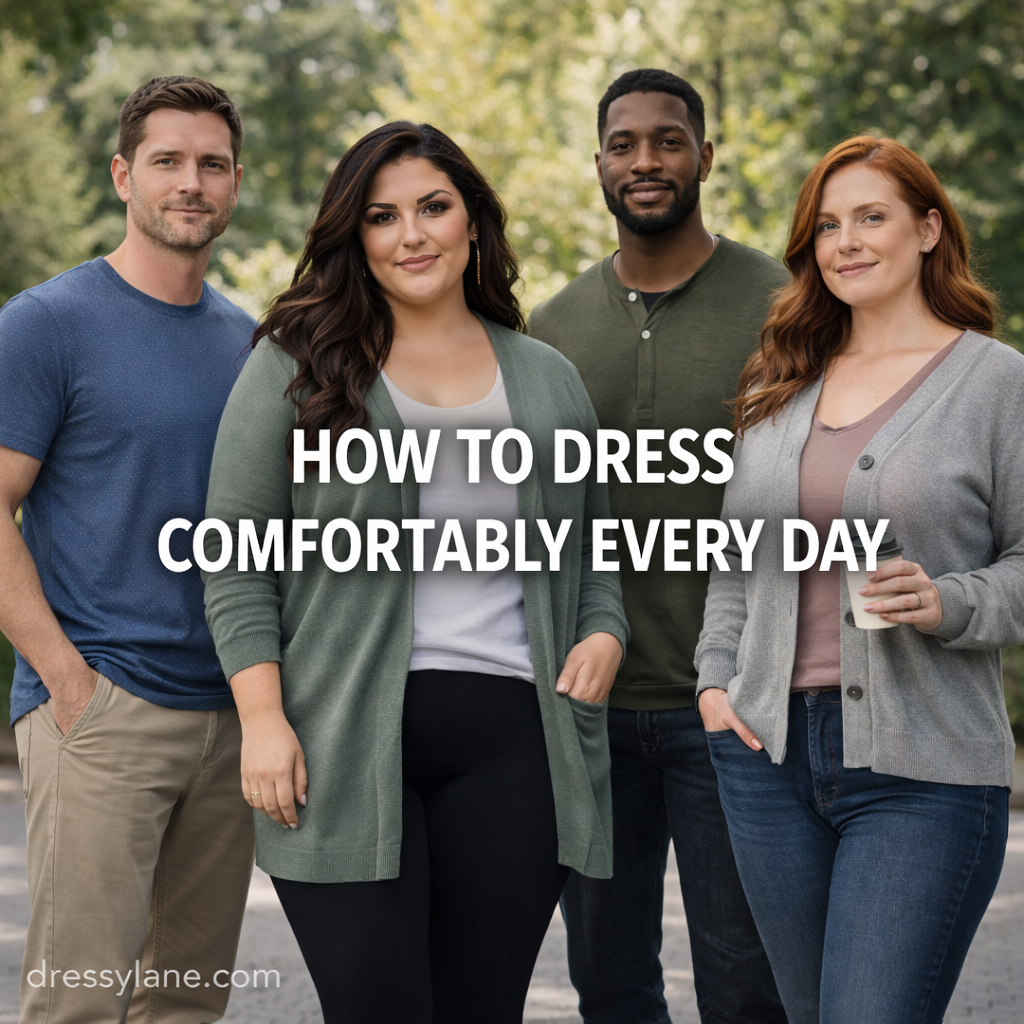
Dressing comfortably every day does not mean living in sweatpants or choosing comfort at the expense of looking put-together. The most comfortable wardrobes are usually the ones that require the least effort: the fabrics feel good, the clothes fit properly, the shoes support your day, and the pieces work together without constant adjusting.
The goal is not simply to wear softer clothing. It is to build outfits that remain comfortable when you are sitting, walking, commuting, working, running errands, eating out, moving between indoor and outdoor temperatures, or spending an entire day away from home.
That means thinking about fabric, fit, temperature, layering, footwear, sensory comfort, and the actual activities on your schedule.
This guide covers how to dress comfortably every day for both women and men, including how to stay polished, dress for changing seasons, handle air-conditioned spaces, stay warm without looking bulky, dress lightly without looking overly casual, and choose clothes with long-term comfort in mind.
What Does Comfortable Dressing Actually Mean?
Comfort is more than whether something feels soft when you first put it on.
A genuinely comfortable outfit should still feel good several hours later.
Think about:
- Physical comfort: Nothing pinches, rubs, digs in, pulls, or restricts movement.
- Temperature comfort: Your clothing helps you stay reasonably comfortable as conditions change.
- Practical comfort: You can sit, walk, bend, commute, and carry out normal activities easily.
- Sensory comfort: Fabrics, seams, waistbands, collars, and labels do not continually irritate you.
- Social comfort: You feel appropriately dressed for where you are going.
- Personal comfort: You feel like yourself rather than as though you are wearing a costume.
That last point matters more than it might seem. An outfit can be physically comfortable but still make you uncomfortable if you feel conspicuously underdressed or overdressed.
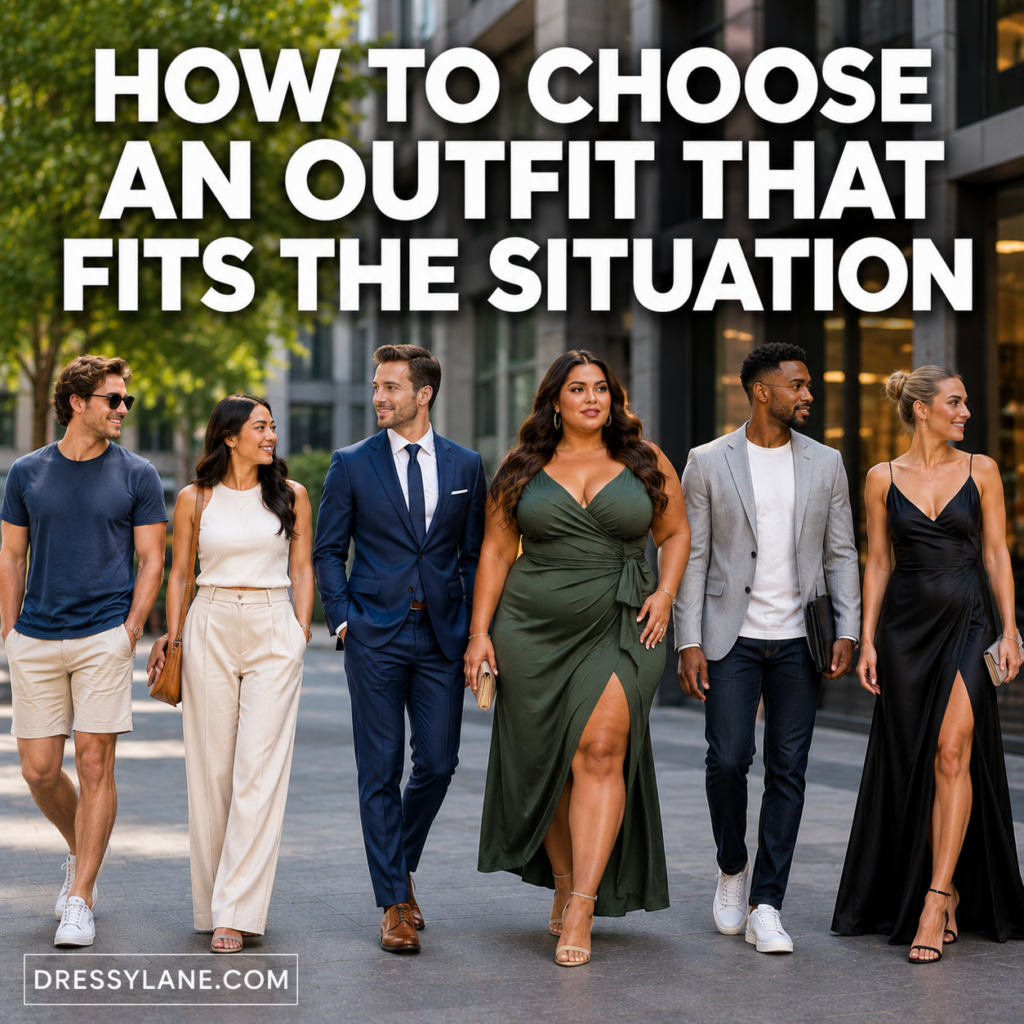
If that is a recurring problem, our guides to choosing an outfit that fits the situation and dressing when you don’t want to overdress can help.
Start With Fit Before Anything Else
People often assume comfortable clothing needs to be loose. It doesn’t.
Clothing that is excessively loose can bunch, drag, shift around, or require constant adjustment. Clothing that is too tight can restrict movement and create pressure around the waist, shoulders, thighs, or neck.
The sweet spot is ease: enough room for your body to move naturally without so much excess fabric that the garment becomes cumbersome.
For women
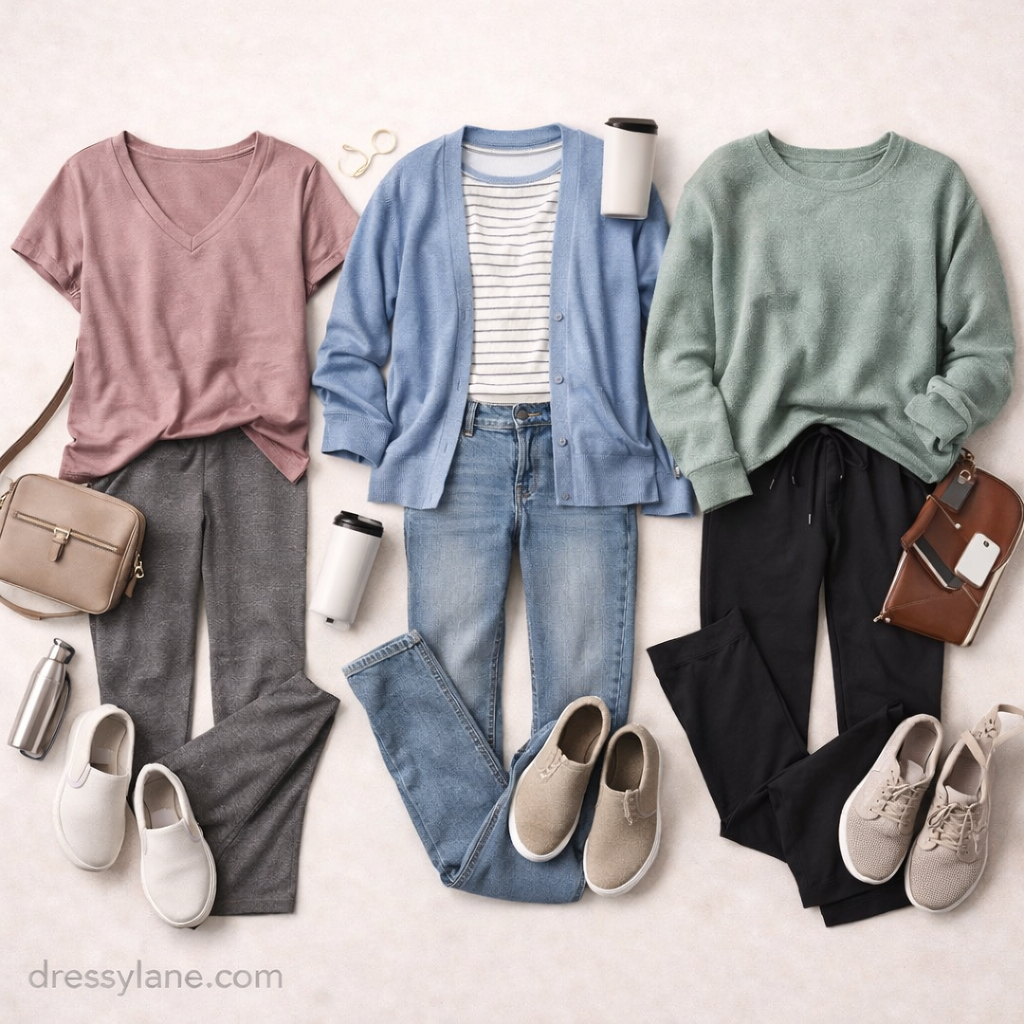
Everyday options might include:
- Straight-leg or relaxed trousers with a soft waistband
- Stretch jeans with enough room through the hips and thighs
- Cotton or modal T-shirts
- Fine-knit sweaters
- Relaxed button-front shirts
- Jersey or knit dresses
- A-line or softly structured skirts
- Cardigans and lightweight jackets
For men
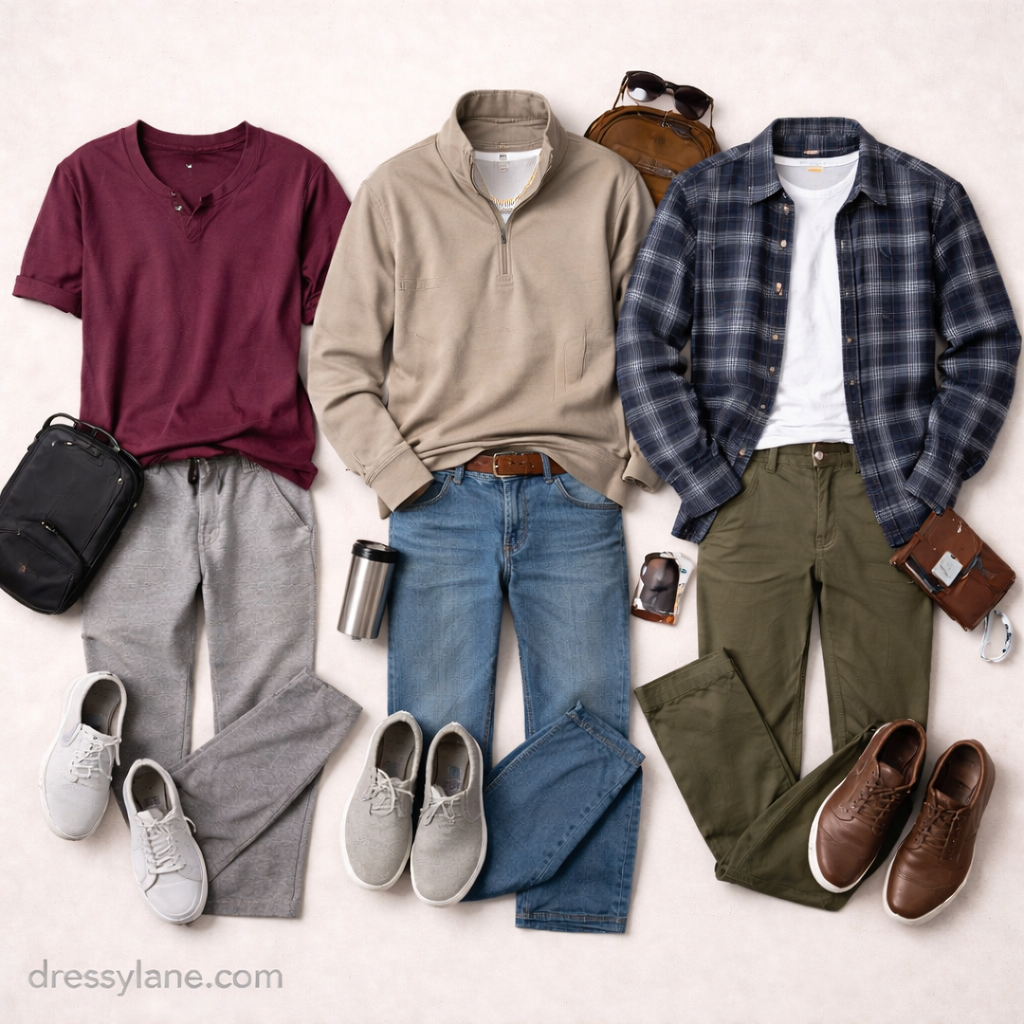
Useful everyday options include:
- Stretch chinos
- Straight or relaxed jeans
- Cotton T-shirts
- Knit polos
- Oxford or casual button-down shirts
- Lightweight sweaters
- Overshirts
- Unstructured jackets
Do a quick movement test when trying something on. Sit down, reach forward, raise your arms, take a long stride, and bend your knees.
If a garment only feels good while standing still in front of a mirror, it probably isn’t an all-day piece.
How to Choose Fabrics for Comfort
Fabric can make an enormous difference to how clothing feels after several hours.
Instead of looking only at the style of a garment, check the fiber-content label.
Cotton
Cotton is soft, familiar, breathable, and easy to wear. It works particularly well for:
- T-shirts
- Casual shirts
- Underlayers
- Dresses
- Lightweight trousers
Pure cotton can wrinkle and may hold moisture, so cotton blends can sometimes be more practical for active days.
Linen
Linen is especially useful in warm weather because it feels airy and does not need to cling to the body.
Try it in:
- Button-down shirts
- Relaxed trousers
- Dresses
- Skirts
- Shorts
Linen wrinkles easily, but that relaxed texture is part of its character. Linen-cotton blends are worth considering if you want some of linen’s breathability with fewer wrinkles.
Modal and Tencel/Lyocell
These fibers are often used in clothing designed to drape softly against the body.
They can work especially well for:
- T-shirts
- Underlayers
- Soft trousers
- Dresses
- Loungewear
They are useful when ordinary cotton feels slightly rough or heavy to you.
Merino wool
Fine merino wool is very different from the heavy, scratchy wool people sometimes associate with winter clothing.
Depending on the garment weight, merino can work for sweaters, socks, base layers, and travel clothing. It provides warmth without requiring extremely thick layers.
Stretch blends
A small amount of elastane or spandex can make denim, chinos, trousers, and fitted tops considerably easier to move in.
You do not necessarily need highly stretchy clothing. Even a modest amount of stretch can make a noticeable difference.
Fabrics to approach carefully
There is no universally uncomfortable fabric, but pay attention to:
- Very stiff denim
- Scratchy wool
- Heavy synthetic fabrics in hot weather
- Rigid waistbands
- Coarse interior seams
- Fabrics that trap heat against your skin
What feels wonderful to one person may bother another, so your own experience should override any list of supposedly “best” fabrics.
How to Dress Comfortably and Still Look Polished
Comfort and polish are not opposites.
A soft outfit can look intentional when the proportions, condition, and overall combination are right.
One easy approach is to combine comfortable foundations with one slightly structured element.
For example:
Women: relaxed trousers + soft T-shirt + cardigan or structured jacket + clean sneakers.
Men: stretch chinos + knit polo + lightweight overshirt + leather sneakers.
The comfortable pieces do most of the work, while the more structured layer gives the outfit definition.
Other small details help:
- Keep shoes clean and in good condition.
- Choose clothing that fits rather than simply sizing up.
- Repeat colors across the outfit.
- Steam or hang out badly wrinkled garments.
- Replace stretched-out collars and worn basics.
- Use simple accessories rather than piling them on.
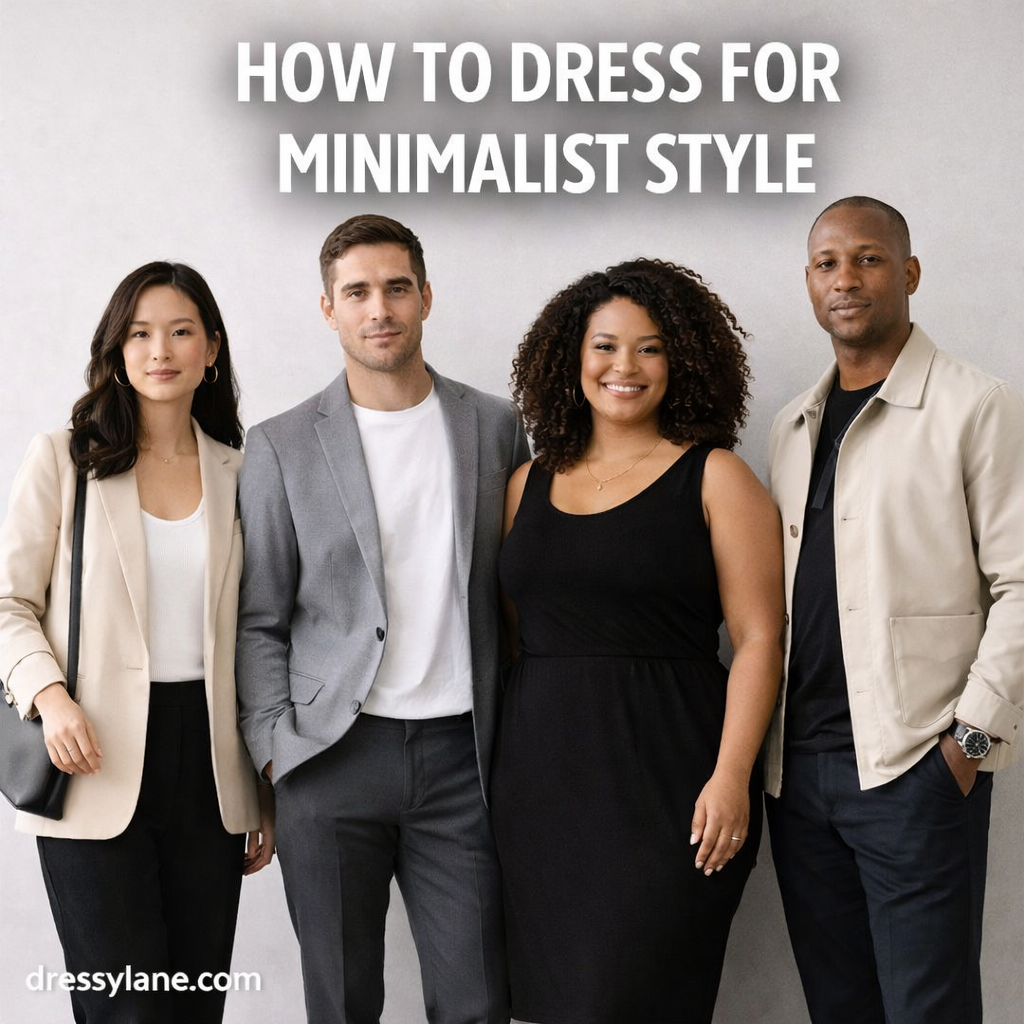
If you prefer uncomplicated wardrobes, see our guide to how to dress for minimalist style.
How to Dress for Daily Comfort and Style
The easiest everyday outfits are usually built from repeatable formulas.
You do not need to invent a completely new combination every morning.
Easy women’s outfit formulas
Casual day:
Straight-leg jeans + soft T-shirt + cardigan + sneakers
Warm weather:
Linen-blend trousers + sleeveless or short-sleeve top + sandals
Polished casual:
Relaxed trousers + knit top + lightweight blazer + loafers
Very relaxed:
Leggings + longer shirt or knit + light jacket + walking shoes
Easy men’s outfit formulas
Casual day:
Stretch jeans + cotton T-shirt + overshirt + sneakers
Warm weather:
Lightweight chinos + polo + breathable sneakers or loafers
Polished casual:
Relaxed trousers + Oxford shirt + unstructured jacket + loafers
Very relaxed:
Drawstring trousers + T-shirt + lightweight overshirt + sneakers
Once you find three or four combinations that reliably work, repeat them with different colors and textures.
Our guide to building simple outfits that always work goes further into creating these formulas.
How to Dress Comfortably at Home and Outside
The difference between comfortable home clothing and comfortable public clothing does not need to be dramatic.
Instead of maintaining completely separate wardrobes, look for crossover pieces.
A soft pair of knit trousers, for example, can work at home with a T-shirt and outside with a sweater, overshirt, or casual jacket.
Other useful crossover pieces include:
- Clean solid-color T-shirts
- Fine-gauge sweaters
- Cardigans
- Relaxed chinos
- Knit dresses
- Dark stretch jeans
- Minimal sneakers
- Soft button-front shirts
Before leaving home, one simple addition can change the entire impression of an outfit: swap slippers for clean shoes, add an overshirt, put on a jacket, or replace a worn lounge top with a fresh knit.
The objective is not to make home clothes formal. It is to choose comfortable pieces that can transition between settings.
How to Dress Comfortably Year-Round
A comfortable wardrobe needs to change with the weather without requiring four completely separate wardrobes.
The solution is a combination of seasonal fabrics and layers.
Spring
Choose breathable midweight clothing that can handle temperature swings.
Useful pieces include:
- Cotton trousers
- Jeans
- Long-sleeve tees
- Lightweight knits
- Cardigans
- Denim or utility jackets
Summer
Prioritize airflow and lighter fabrics.
Look for:
- Linen
- Cotton poplin
- Lightweight cotton
- Chambray
- Lightweight lyocell
- Looser silhouettes
Give hot-weather clothing some space around the body rather than relying only on thinner fabric.
Fall
Fall is ideal for layering.
Try:
- Jeans or chinos
- Cotton shirts
- Fine-knit sweaters
- Cardigans
- Overshirts
- Lightweight jackets
Winter
Focus on insulation rather than simply wearing the thickest garment you can find.
A base layer, knit, and weather-appropriate outer layer can often feel better than one enormous sweater.
How to Dress Light Without Looking Too Casual
Hot weather creates a particular challenge: the clothing that feels best can sometimes look more casual than the occasion calls for.
The answer is usually lighter construction rather than less clothing.
Instead of a heavy blazer, try an unlined or lightly constructed jacket. Instead of thick denim, choose lightweight trousers. Instead of a graphic tee, choose a solid knit top, polo, or linen shirt.
For women, a linen midi dress, wide-leg trousers with a sleeveless blouse, or a lightweight skirt with a knit top can stay cool while looking intentional.
For men, linen-blend trousers, lightweight chinos, polos, short-sleeve button-downs, and unstructured jackets can provide the same balance.
This becomes especially useful for restaurants, vacations, and warm-weather social events. For a specific example, see our guide to how to dress for hotel dining.
How to Dress Warm Without Looking Bulky
More fabric does not automatically mean more warmth.
Several relatively thin layers can often provide better comfort and flexibility than one extremely bulky layer.
A practical cold-weather system might be:
- A close-fitting base layer
- A shirt or lightweight knit
- An insulating sweater or cardigan
- A weather-appropriate coat
Choose pieces that can sit comfortably on top of one another without pulling at the shoulders or bunching around the arms.
Fine merino sweaters, quilted layers, thermal base layers, wool-blend coats, and lightweight insulated jackets can provide warmth without excessive volume.
Also pay attention to your extremities. Warm socks, appropriate footwear, gloves, and a scarf can sometimes improve overall comfort more than adding another heavy layer to your torso.
How to Dress for Air-Conditioned Spaces
Summer dressing gets complicated when it is hot outdoors but cold inside offices, restaurants, stores, theaters, or airplanes.
Plan for both environments.
Start with a breathable base outfit, then bring a lightweight layer such as:
- Cardigan
- Fine-knit sweater
- Overshirt
- Light blazer
- Denim jacket
- Lightweight scarf or wrap
Choose something that can be folded or carried easily when you return outside.
This is one reason an ultra-minimal hot-weather outfit can backfire. You may be comfortable walking from the car to the building and freezing 20 minutes later.
Dress for Sensory Comfort
Some people are much more sensitive than others to seams, textures, tags, pressure, heat, or fabric movement.
If clothing frequently distracts or irritates you, build your wardrobe around the sensations you tolerate well.
Pay attention to:
- Scratchy labels
- Raised seams
- Tight necklines
- Restrictive cuffs
- Hard waistbands
- Rough embroidery against the skin
- Heavy jewelry
- Stiff collars
- Scratchy wool
- Fabrics that become clammy when warm
Look for flat seams, tagless garments, soft knits, smooth waistbands, adjustable closures, and fabrics you already know you tolerate.
There is no reason to force yourself into a supposedly stylish material or silhouette that makes you uncomfortable all day.
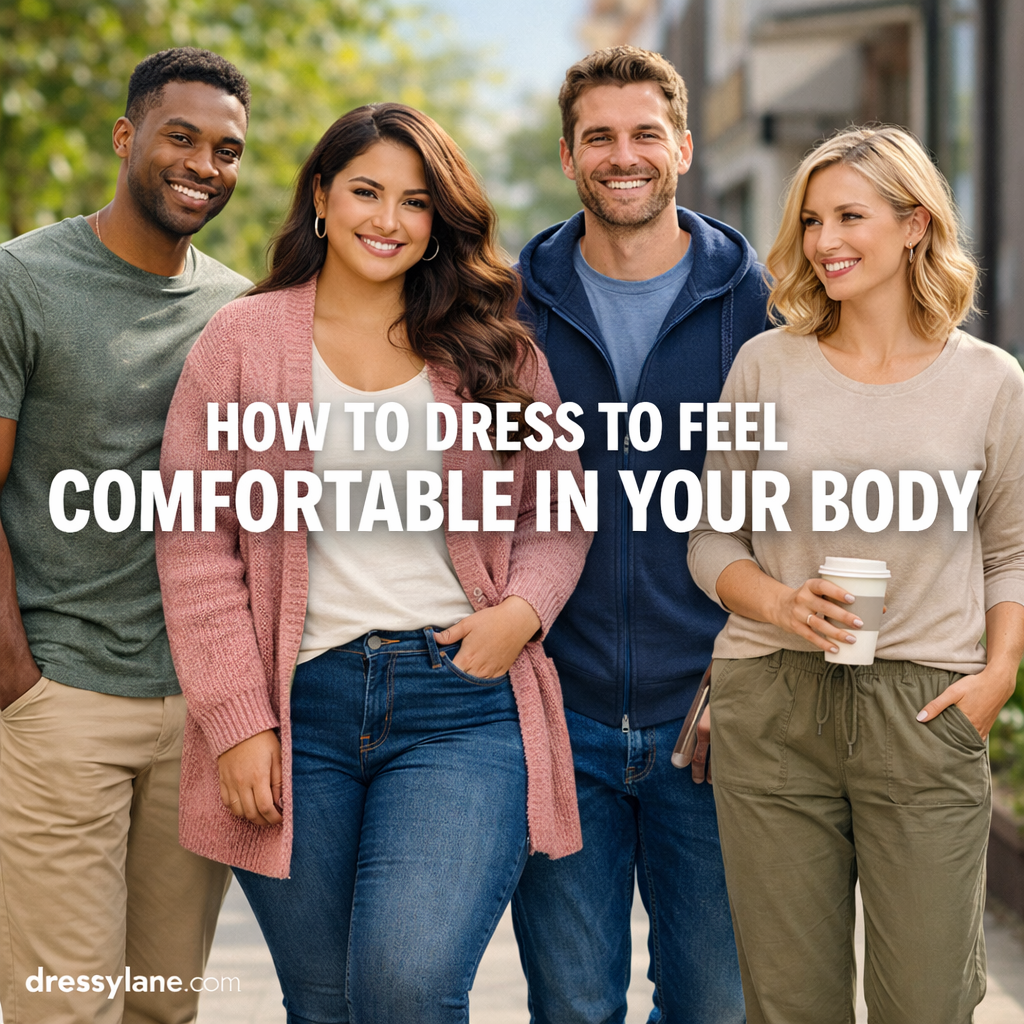
The same principle applies to body comfort more generally. Clothing should work with your body rather than making you spend the day thinking about it. Our guide to how to dress to feel comfortable in your body explores that subject in more detail.
Choose Shoes for the Day You Are Actually Having
A comfortable outfit can be ruined by uncomfortable shoes.
Before choosing footwear, think about the actual amount of standing and walking you expect to do.
For everyday wear, look for:
- Enough toe room
- Secure heel fit
- Appropriate arch support for your needs
- Cushioning suitable for the activity
- Breathable materials when it is warm
- Socks that do not bunch or rub
Sneakers are an obvious option, but they are not the only comfortable shoe.
Depending on your wardrobe and needs, comfortable options can include loafers, supportive flats, walking sandals, low boots, or shoes with low, stable heels.
The key is not the shoe category. It is whether that particular pair fits your feet and your day.
Dress for Long-Term Comfort, Not Just the Fitting Room
A garment can feel comfortable for five minutes and become irritating after five hours.
When shopping, think beyond the first impression.
Ask:
- Will the waistband feel comfortable after a meal?
- Does the fabric breathe?
- Will the shoulders restrict me while driving?
- Does the garment need constant pulling or repositioning?
- Will these shoes still feel reasonable after several thousand steps?
- Can I comfortably sit in this for a few hours?
- Does it require special undergarments that I dislike wearing?
Also consider maintenance.
Clothing that technically feels comfortable but needs constant ironing, dry cleaning, delicate adjustment, or special styling may create another kind of inconvenience.
The pieces you reach for repeatedly are often the best clues to what long-term comfort actually means for you.
Match Comfort to the Occasion
Comfortable dressing still depends on context.
What works for a grocery run may not work for an office, dinner, interview, wedding, or other event.
When the dress code is unclear, start by considering:
- Venue
- Time of day
- Weather
- Activity
- People attending
- Whether photos are likely
- How formal the occasion normally is
Then choose the most comfortable version of clothing that suits that setting.
If the wording on an invitation is confusing, see how to dress when the invitation is vague. For broader guidance, our complete guide to dressing for different occasions covers common dress codes and settings.
What If You Don’t Really Like Fashion?
You do not need to become interested in fashion to dress comfortably and appropriately.
A small wardrobe of dependable combinations can eliminate most of the decision-making.
For example, choose:
- Two or three preferred trouser styles
- Several comfortable tops
- Two layering pieces
- A casual shoe
- A slightly dressier shoe
- One or two outerwear options
Keep the colors reasonably compatible and you can create many outfits without thinking much about trends.
If that sounds more appealing than constantly following new styles, read how to dress when you don’t like fashion.
Common Comfort-Dressing Mistakes
Buying everything oversized
Extra room can feel comfortable, but oversized clothing is not automatically comfortable. Too much fabric can become heavy, bunch up, or distort your proportions.
Wearing the wrong fabric for the weather
A soft polyester top may feel pleasant indoors but become uncomfortable during a hot outdoor walk.
Ignoring shoes
If you are going to walk all afternoon, footwear should be part of the outfit decision from the beginning.
Dressing only for the outdoor temperature
Think about air conditioning, heating, transportation, and how conditions will change throughout the day.
Keeping uncomfortable clothing because it looks good
If you repeatedly put something on and change out of it 15 minutes later, that is useful information. Your wardrobe should reflect how you actually live.
Confusing comfort with carelessness
Old sweatpants may be comfortable, but they are not your only option. Soft fabrics, flexible construction, proper fit, and simple styling can create an outfit that is both easy to wear and put-together.
A Practical Styling Rule That Makes Everyday Dressing Easier
One of the most useful habits is to stop evaluating an outfit only in front of the mirror.
Wear it around your home for ten or fifteen minutes.
Sit at a desk. Walk upstairs. Reach for something. Put on the jacket you plan to wear. Carry your usual bag. Sit down again.
That little test catches problems a mirror doesn’t: a waistband that digs in when seated, a shirt that rides up, sleeves that pull when you reach forward, shoes that slip at the heel, or layers that suddenly feel too bulky together.
A good everyday outfit should largely disappear from your attention once you put it on.
That is often a better definition of comfort than simply asking whether something feels soft.
Frequently Asked Questions
How can I dress comfortably without sacrificing style?
Start with comfortable foundations—soft tops, flexible trousers, breathable fabrics, and supportive shoes—and add one polished element such as a structured jacket, neat cardigan, overshirt, leather belt, or simple accessory. Fit and garment condition often make a bigger difference than formality.
What fabrics are most comfortable for everyday wear?
Cotton, linen, modal, lyocell, fine merino wool, jersey knits, and fabrics containing a small amount of elastane are useful options. The best choice depends on temperature, activity, and your sensitivity to texture.
How can I stay comfortable in both hot weather and air conditioning?
Wear a lightweight, breathable base outfit and carry a thin cardigan, overshirt, blazer, or sweater. You can remove it outdoors and put it back on in heavily air-conditioned spaces.
How do I dress warmly without looking bulky?
Use several thinner layers rather than relying entirely on thick garments. Thermal base layers, fine merino knits, insulated outerwear, warm socks, and scarves can provide warmth without adding excessive volume.
How can I dress lightly without looking underdressed?
Choose lightweight versions of polished garments: linen trousers instead of shorts, a knit polo instead of a basic tee, a linen dress instead of a beach-style sundress, or an unstructured jacket instead of a heavy blazer.
How can I make home clothes appropriate for going out?
Start with crossover pieces such as knit trousers, clean T-shirts, soft sweaters, and simple sneakers. Adding an overshirt, cardigan, jacket, or better shoes can quickly make a relaxed outfit look intentional.
What should I wear if I am sensitive to certain fabrics or clothing textures?
Identify exactly what bothers you—seams, tags, waistbands, collars, wool, tight cuffs, heat, or something else—and shop around those triggers. Look for tagless clothing, smooth fabrics, flat seams, adjustable waistbands, and familiar materials that you know feel comfortable.
Is it possible to dress comfortably for more formal situations?
Yes. Look for softer tailoring, stretch trousers, breathable shirts, knit dresses, unstructured jackets, stable shoes, and garments with enough room for sitting and movement. The goal is to meet the level of formality using the most comfortable version of the appropriate clothing.
Final Thoughts
Learning how to dress comfortably every day is less about finding one perfect outfit and more about understanding what makes clothing work for your body and routine.
Start with fit. Pay attention to fabric. Dress for the temperature and the activities ahead. Use layers when conditions may change. Choose shoes according to how much you will actually walk. And stop keeping clothes that require constant adjusting simply because they looked good on the hanger.
Most importantly, comfort and style do not have to compete.
A breathable shirt, well-fitting trousers, comfortable shoes, and a thoughtfully chosen layer can look every bit as intentional as a more complicated outfit—and you are much more likely to feel good wearing it from morning until night.