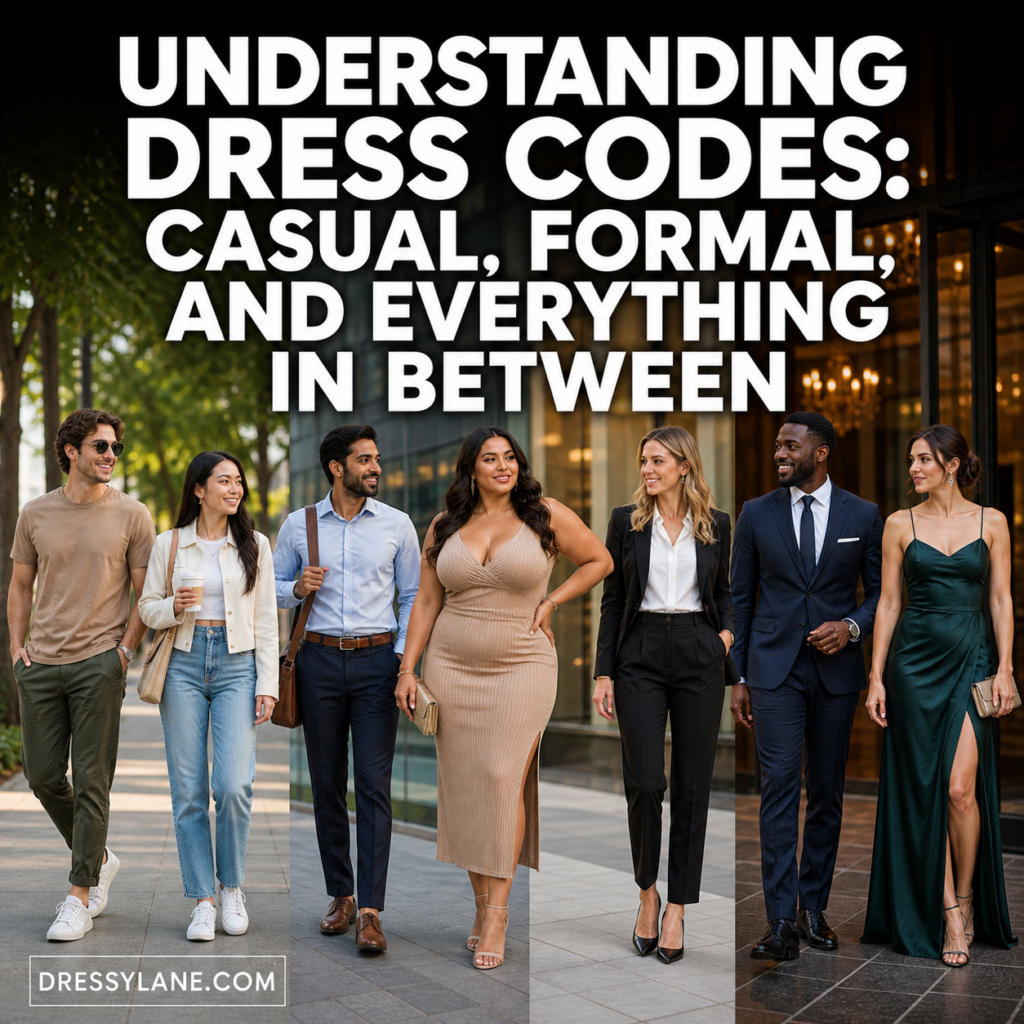
Dress codes can be surprisingly difficult to interpret. “Casual” might mean jeans and sneakers at one event but a sundress or polo at another. “Business casual” varies considerably between workplaces, while terms such as “cocktail,” “semi-formal,” and “formal” are often used as though everyone agrees on exactly what they mean.
The easiest way to understand dress codes is not to memorize a rigid list of allowed and forbidden clothes. Instead, learn the general ladder of formality, then adjust your outfit for the venue, time of day, type of event, local culture, and expectations of the host or organization.
This guide explains the major dress codes for both women and men, from everyday casual through black tie, along with what to do when an invitation is unclear.
In This Guide
- How dress codes actually work
- Casual
- Dressy casual
- Smart casual
- Business casual
- Business professional
- Cocktail attire
- Semi-formal
- Formal
- Black tie
- White tie
- Weddings and special events
- Restaurants and hotel dining
- Funerals, memorials, and religious occasions
- Travel, vacations, and weather-related dressing
- What to do when no dress code is provided
- How to avoid being noticeably overdressed or underdressed
- Frequently asked dress-code questions
Understanding the Dress-Code Spectrum
Most Western dress codes can be placed on a loose spectrum:
Casual → Dressy Casual → Smart Casual → Business Casual → Cocktail/Semi-Formal → Formal → Black Tie → White Tie
This is useful as a starting point, but it is not an exact science.
Two events labeled “smart casual” can have noticeably different expectations. A smart-casual technology-office dinner may be relaxed enough for dark jeans and clean sneakers, while a smart-casual dinner at an upscale hotel may call for trousers, a collared shirt, a polished dress, or loafers.
Context matters.
Instead of asking only, “What does this dress code mean?”, also ask:
- Where is the event?
- What is the occasion?
- What time does it start?
- Is it professional, social, ceremonial, or celebratory?
- Will it take place indoors or outdoors?
- What will you actually be doing?
- Who is hosting it?
Dress codes provide the framework. Context helps you choose the outfit.
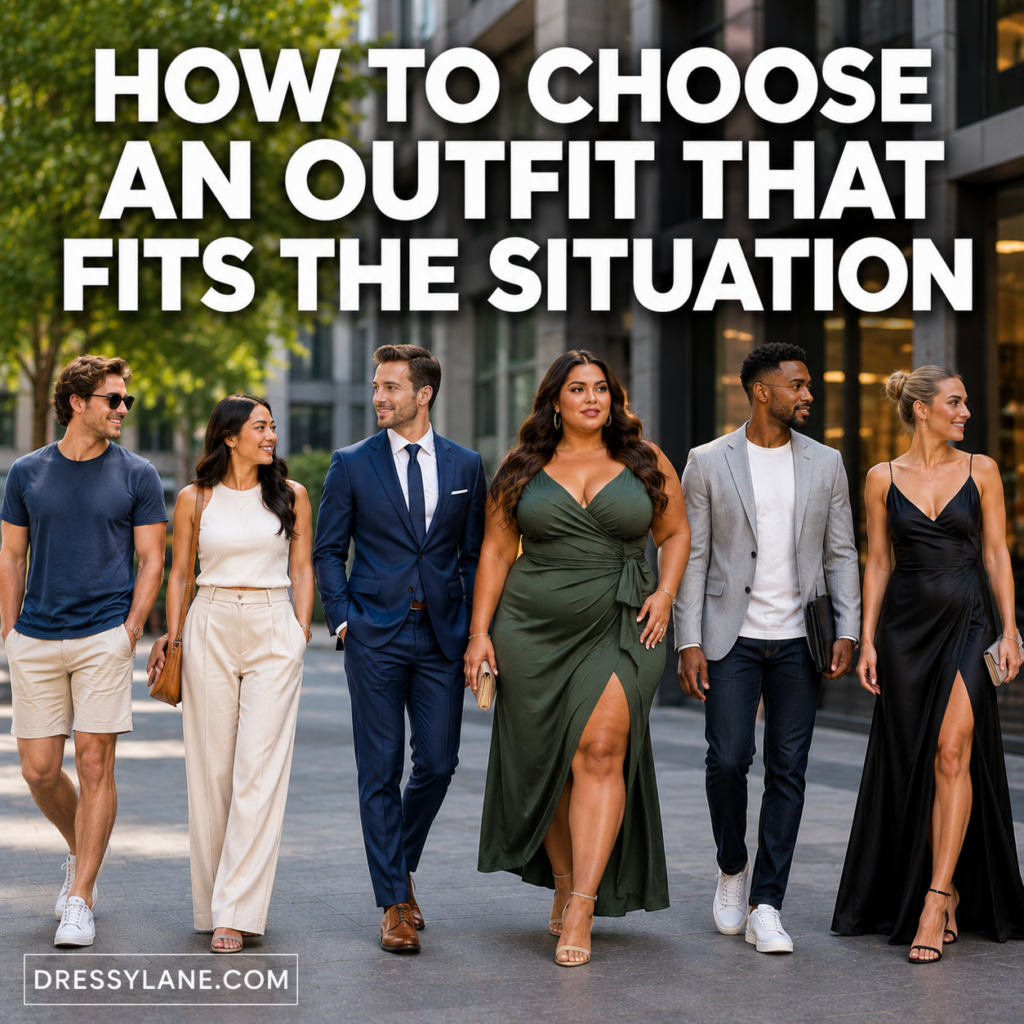
For a broader approach to matching clothing to a particular setting, see how to choose an outfit that fits the situation.
Casual Dress Code
Casual is the least formal common dress code, but it still benefits from looking intentional.
Typical casual situations include:
- Weekend lunches
- Coffee dates
- Informal family gatherings
- Shopping
- Sightseeing
- Casual restaurants
- Relaxed social events
Casual Attire for Women
Examples include:
- Straight-leg or relaxed jeans with a cotton T-shirt
- Linen pants with a tank or simple blouse
- Casual midi or shirt dress
- Chinos with a knit top
- Denim skirt with a T-shirt
- Clean sneakers, flats, sandals, or casual boots
Fabrics such as cotton jersey, denim, linen, chambray, twill, and lightweight knits work particularly well.
Casual Attire for Men
Examples include:
- Jeans with a crew-neck T-shirt
- Chinos with a polo
- Casual button-down with denim
- Linen shirt with lightweight trousers
- Casual shorts with a polo or neat T-shirt in appropriate settings
- Sneakers, loafers, casual boots, or simple leather shoes
The distinction between casual and careless usually comes down to fit, condition, and context.
A clean heavyweight T-shirt, straight jeans, and maintained sneakers can look considerably more intentional than wrinkled clothes that happen to be more expensive.
Dressy Casual
Dressy casual is essentially everyday clothing with a little more polish.
You might encounter it at:
- Birthday dinners
- Bridal or baby showers
- Informal receptions
- Nice restaurants
- Casual weddings
- Holiday gatherings
- Social events held in polished venues
Dressy Casual for Women
Try combinations such as:
- Midi dress + flats or low heels
- Blouse + tailored trousers + loafers
- Dark jeans + polished knit top + ankle boots
- Skirt + fine-gauge sweater + flats
Dressy Casual for Men
Good options include:
- Chinos + button-down + loafers
- Dark jeans + knit polo + casual leather shoes
- Trousers + Oxford shirt + unstructured jacket
- Chinos + merino sweater + loafers
Dressy casual is useful when ordinary casual clothing seems slightly too relaxed but traditional business or event clothing would feel excessive.
Smart Casual
Smart casual causes more confusion than almost any other dress code because there is no single uniform for it.
Think of it as polished casual clothing with intentional structure.
You are usually trying to look noticeably put together without looking formally dressed.
Smart Casual for Women
Examples include:
- Tailored trousers + silk, satin, or polished cotton blouse
- Dark jeans + fine-gauge knit + blazer
- Midi skirt + fitted knit top
- Shirt dress + loafers
- Simple jumpsuit + flats or low heels
Smart Casual for Men
Examples include:
- Chinos + Oxford shirt + loafers
- Tailored trousers + polo + casual jacket
- Dark jeans + button-down + suede shoes
- Chinos + merino crewneck + leather sneakers
- Trousers + knit polo + loafers
A blazer can work beautifully for smart casual, but it is not mandatory.
Likewise, clean minimal sneakers may work in some modern settings, while restaurants, clubs, or more traditional environments may expect leather shoes.
The setting decides where within the smart-casual range you should land.
Business Casual
Business casual is professional clothing with some of the formality of traditional business attire removed.
It commonly appears in offices, conferences, networking events, client-facing workplaces, and professional lunches.
The difficulty is that workplace standards vary dramatically.
Business Casual for Women
Reliable combinations include:
- Tailored trousers + blouse
- Ankle pants + fine-gauge sweater
- Knee-length or midi skirt + knit top
- Simple work dress + cardigan
- Trousers + shell + blazer
Common footwear includes loafers, flats, ankle boots, low heels, and other polished closed-toe shoes.
Business Casual for Men
Reliable combinations include:
- Chinos + Oxford shirt
- Trousers + polo
- Dress trousers + button-down
- Chinos + merino sweater over a collared shirt
- Trousers + button-down + unstructured blazer
Loafers, derbies, brogues, Chelsea boots, and understated leather sneakers may work depending on the workplace.
Are Jeans Business Casual?
Sometimes.
Dark, clean jeans without distressing are accepted in many modern offices but remain too casual for others.
When entering an unfamiliar workplace, trousers or chinos are the safer starting point. You can adjust once you understand how colleagues actually dress.
Business Professional
Business professional sits above business casual and is more traditional and structured.
It may be expected in areas such as law, finance, government, executive meetings, formal presentations, or conservative client-facing environments.
Business Professional for Women
Typical choices include:
- Matching or coordinated suit
- Tailored trousers with a blazer
- Professional sheath or structured dress
- Blouse or shell
- Pumps, loafers, flats, or polished boots
Wool, wool blends, crepe, ponte, and structured woven fabrics are common.
Business Professional for Men
Typical choices include:
- Matching suit
- Dress shirt
- Leather dress shoes
- Belt coordinated with the shoes
- Tie when expected by the workplace or occasion
Navy and charcoal suits are especially versatile.
Business professional is less about showing personality through numerous statement pieces and more about presenting a cohesive, polished appearance.
Cocktail Attire
Cocktail attire moves firmly into event dressing.
It is commonly requested for:
- Cocktail parties
- Evening receptions
- Holiday parties
- Weddings
- Anniversary celebrations
- Fundraisers
- Upscale social events
Cocktail attire should feel more special than office clothing without reaching the formality of black tie.
Cocktail Attire for Women
Options include:
- Knee-length or midi cocktail dress
- Dressy jumpsuit
- Satin or crepe skirt with an elegant top
- Refined tailored separates
- Dress shoes, heels, elegant flats, or dressy sandals
Velvet, silk, satin, crepe, chiffon, lace, and polished jacquard can work well depending on the season.
Cocktail Attire for Men
Options include:
- Dark suit + dress shirt
- Suit with or without a tie depending on the event
- Tailored trousers + dress shirt + blazer for a less formal interpretation
- Loafers, derbies, or other polished dress shoes
Cocktail attire generally benefits from richer fabrics, sharper tailoring, and more polished accessories than smart casual.
Semi-Formal Dress Code
Semi-formal sounds relaxed because of the word “semi,” but it is considerably dressier than smart casual.
It is especially common for weddings.
Semi-Formal for Women
Consider:
- Midi dress
- Knee-length dress
- Dressy jumpsuit
- Elegant skirt and blouse
- Refined separates with dress shoes
Semi-Formal for Men
Consider:
- Suit and dress shirt
- Dress trousers with a blazer
- Tie when the event leans more traditional
- Loafers, derbies, or dress shoes
Time of day can help determine the mood.
Daytime semi-formal events often accommodate lighter colors and fabrics, while evening events generally support darker colors and more polished finishes.
If the invitation involves a wedding specifically, our guide to what to wear to a semi-formal wedding goes into the setting in greater detail.
Formal Attire
Formal attire generally sits above cocktail and semi-formal clothing but below—or sometimes overlaps with—black tie.
The terminology can vary by host, which is why the invitation and venue matter.
Formal attire may be requested for:
- Evening weddings
- Galas
- Formal dinners
- Charity events
- Ceremonies
- Upscale celebrations
Formal Attire for Women
Appropriate choices may include:
- Floor-length gown
- Elegant midi or full-length dress
- Sophisticated evening jumpsuit
- Highly polished formal separates
Silk, satin, chiffon, velvet, crepe, and other refined fabrics fit naturally here.
Formal Attire for Men
Common options include:
- Dark suit
- White or understated dress shirt
- Tie
- Polished dress shoes
If an invitation says “formal or black tie optional,” men can generally choose between a dark formal suit and a tuxedo, while women can choose polished formal evening attire appropriate to the event.
Black-Tie Dress Code
Black tie is a clearly elevated evening dress code.
It is commonly associated with:
- Formal evening weddings
- Galas
- Award ceremonies
- Charity balls
- Formal dinners
Black Tie for Women
Traditional options include:
- Floor-length evening gown
- Sophisticated formal dress
- Highly elevated evening separates or jumpsuit where appropriate
- Dressy heels, flats, or evening shoes
- Refined jewelry and evening bag
The overall outfit should look deliberately formal rather than simply “nice.”
Black Tie for Men
Traditional black tie generally means:
- Tuxedo
- Formal white shirt
- Black bow tie
- Formal black shoes
A standard business suit is not technically equivalent to a tuxedo when the invitation specifically requires black tie.
For wedding-specific considerations, see what to wear to a black-tie wedding.
White Tie
White tie is the highest traditional level of Western evening dress and is relatively rare today.
You are most likely to encounter it at highly ceremonial state, diplomatic, royal, or traditional formal events.
White Tie for Women
Traditionally:
- Full-length formal evening gown
- Formal evening accessories
- Highly polished hair, jewelry, and footwear
White Tie for Men
Traditionally:
- Black evening tailcoat
- White formal shirt
- White waistcoat
- White bow tie
- Formal black trousers
- Highly polished formal shoes
If an invitation actually specifies white tie, follow it literally rather than treating it as another way of saying black tie.
How Wedding Dress Codes Fit Into the Picture
Weddings create additional complications because location, season, ceremony style, and the couple’s preferences can modify the basic dress code.
A beach wedding marked “formal,” for example, may call for lighter fabrics and footwear than a formal winter wedding in a ballroom.
Pay attention to:
- Ceremony location
- Reception venue
- Time
- Season
- Indoor versus outdoor setting
- Specific wording on the invitation
Guest etiquette matters as well. The purpose is to look appropriate for the celebration without dressing in a way that competes unnecessarily with the wedding party.
Restaurant and Hotel Dining Dress Codes
Restaurant terminology can be particularly inconsistent.
“Casual elegant,” “resort casual,” “smart casual,” and “jacket preferred” are not interchangeable.
An upscale hotel restaurant may expect:
Women: dress, tailored trousers with a polished top, skirt and blouse, or sophisticated jumpsuit.
Men: trousers or chinos, collared shirt or knit polo, and polished shoes.
Some restaurants specifically prohibit athletic wear, shorts, flip-flops, baseball caps, or overly casual footwear.
If you are visiting a particular restaurant, checking its current dress policy is better than relying solely on the phrase “upscale.”
For broader guidance, see how to dress for hotel dining.
Dressing for Funerals, Memorials, and Religious Occasions
Serious occasions require a slightly different mindset.
The priority is respect rather than fashion.
For many funerals and memorial services, understated clothing in black, navy, charcoal, gray, or other subdued colors is appropriate.
Women might wear:
- Simple dress
- Blouse and trousers
- Skirt and modest top
- Cardigan or understated jacket
Men might wear:
- Dark suit
- Dress trousers and button-down
- Sweater and trousers for a less formal service
- Conservative dress shoes
Not every culture or religion uses the same mourning colors or clothing traditions. Religious buildings may also have expectations regarding covered shoulders, head coverings, footwear, skirt length, or other aspects of dress.
When attending a ceremony outside your own tradition, specific guidance from the family, congregation, or place of worship takes priority over general fashion rules.
Dress Codes for Travel, Vacation, and Hot Weather
Not every clothing decision fits neatly on a formality scale.
Travel requires balancing presentation with physical comfort.
For a flight, breathable layers such as cotton T-shirts, merino knitwear, stretch trousers, relaxed denim, and lightweight jackets can help accommodate changing temperatures.
Vacation wardrobes depend heavily on destination and activity. Resort dinners, sightseeing, hiking, beaches, and religious sites can all require different clothing even on the same trip.
During very hot weather, linen, cotton poplin, seersucker, chambray, lightweight merino, and breathable blends can help reduce heat without automatically making an outfit look overly casual.
The principle remains the same: dress for both the setting and what your body will actually be doing there.
What If the Invitation Doesn’t Give a Dress Code?
This is where understanding the spectrum becomes genuinely useful.
Look for contextual clues.
Check the Venue
A backyard barbecue and a historic hotel ballroom suggest different expectations even if neither invitation specifies clothing.
Consider the Time
Evening events often—but not always—lean dressier than daytime gatherings.
Consider the Occasion
A retirement dinner usually calls for more polish than an ordinary dinner with friends.
Look at the Invitation Itself
Language, venue information, event website, and descriptions such as “garden ceremony,” “cocktails and dancing,” or “beach reception” can reveal useful clues.
Ask
For important events, asking the host is completely reasonable.
For more guidance, see how to dress when the invitation is vague.
What to Do When You Don’t Want to Overdress
Being noticeably overdressed can feel almost as uncomfortable as being underdressed.
The solution is not automatically choosing the most casual possible outfit.
Instead, aim for the middle of the likely range.
If you think an event falls somewhere between casual and smart casual, for example, choose polished pants or dark jeans, a good top or collared shirt, and versatile shoes rather than either gym clothes or formalwear.
Another useful technique is wearing adjustable pieces.
A blazer can be removed. Sleeves can be rolled. A tie can sometimes come off. Jewelry can be added or simplified.
For situations where this is your main concern, see what to wear when you don’t want to overdress.
Comfort Still Matters at Every Dress Code
Formal does not have to mean physically miserable.
Fit is important at every level.
A well-fitted suit should allow you to sit comfortably. A formal dress should let you walk and breathe normally. Shoes need to be realistic for the amount of standing or walking involved.
For longer events, think ahead.
A five-hour wedding reception requires different footwear considerations from a 45-minute ceremony. An outdoor summer event makes fabric weight much more important than an air-conditioned dinner.
If discomfort regularly makes dressing difficult, how to dress to feel comfortable in your body offers a more detailed approach.
You Don’t Need to Love Fashion to Understand Dress Codes
You can dress appropriately without following trends or having a strong interest in fashion.
A small number of reliable pieces can cover an enormous range of situations.
For example, a woman might use tailored trousers, dark jeans, a simple dress, blouse, fine-gauge knit, blazer, loafers, and dressier shoes as the foundation for many dress codes.
A man might rely on chinos, dark jeans, dress trousers, Oxford shirts, polos, merino knitwear, a blazer, dark suit, loafers, and dress shoes.
The key is learning how to move those pieces up or down the formality scale.
If you would rather keep clothing as straightforward as possible, see how to dress when you don’t like fashion and how to build simple outfits that always work.
A minimalist wardrobe can work particularly well with this approach because versatile pieces can cover multiple dress codes. See how to dress for minimalist style for more.
A Practical Rule for Getting Dress Codes Right
Here is the rule I find more useful than memorizing dozens of clothing lists:
Match the formality first, then express your style inside it.
If the event is cocktail attire, establish the cocktail-level foundation first. Then decide whether your version is minimalist, colorful, classic, romantic, modern, or understated.
Doing this in the opposite order often causes problems.
A favorite outfit may look fantastic on you but still be wrong for the setting.
Once the required level of formality is established, you have much more freedom than dress-code guides sometimes imply.
Frequently Asked Questions About Dress Codes
What is the difference between casual and smart casual?
Casual prioritizes relaxed everyday clothing such as jeans, T-shirts, casual dresses, and sneakers. Smart casual adds polish through tailoring, refined fabrics, structured layers, or more sophisticated footwear.
Is business casual dressier than smart casual?
Usually, business casual has a more professional emphasis, while smart casual has a broader social meaning. There can be substantial overlap between the two.
Is cocktail attire more formal than semi-formal?
The terms frequently overlap. Cocktail attire tends to emphasize polished party or evening clothing, while semi-formal can cover a wider range of events, including daytime weddings. The invitation, venue, and time should help determine the appropriate interpretation.
Is formal the same as black tie?
Not necessarily. Formal attire may permit a dark suit for men and a range of elegant dresses or evening outfits for women. Traditional black tie specifically calls for a tuxedo for men and highly formal evening attire for women.
Can women wear pants to formal events?
Yes. A sophisticated jumpsuit, formal trouser suit, or elegant evening separates can work for many formal events. Fabric, tailoring, footwear, and overall presentation determine whether the outfit reaches the required level of formality.
Can men wear sneakers for smart casual?
Sometimes. Clean, understated leather or minimalist sneakers work in many contemporary smart-casual environments. Traditional restaurants, clubs, workplaces, or events may still expect loafers or other leather shoes.
Are jeans smart casual?
They can be. Dark, clean, well-fitting jeans without distressing are the easiest to dress up. Combine them with a polished shirt or knit, structured layer, and appropriate shoes.
What should I wear if I don’t know the dress code?
Use the venue, time, purpose, and type of event to estimate the likely level of formality. Choose an outfit near the middle of that range and use removable layers or accessories to make small adjustments.
Is it better to be overdressed or underdressed?
Being slightly more polished is often easier to manage than being substantially underdressed, but deliberately jumping an entire dress-code level is unnecessary. Aim to be appropriate rather than simply “dressier.”
What if the host’s dress code seems inconsistent with the venue?
The host’s stated dress code generally deserves priority. If the instructions are genuinely confusing—for example, an invitation says “black tie casual”—ask for clarification rather than guessing.
Final Thoughts
Understanding dress codes becomes much easier once you stop treating every term as an isolated set of rules.
Think of clothing as a spectrum.
At one end are relaxed everyday clothes: denim, cotton T-shirts, casual dresses, sneakers, and sandals. As formality increases, fabrics tend to become more refined, tailoring becomes sharper, footwear becomes more polished, and the overall outfit becomes more deliberate. At the highest levels, specific conventions such as tuxedos and evening gowns come into play.
But the label is only the beginning.
A dress code should always be interpreted alongside the venue, occasion, time, weather, activity, and host’s expectations.
When those factors agree, choosing an outfit is relatively straightforward. When they do not, use context and aim for the middle of the reasonable range.
You do not need an enormous wardrobe or an encyclopedic knowledge of fashion to get dress codes right. You need a handful of dependable clothes, an understanding of formality, and enough flexibility to adapt them to the situation.
For an even broader look at matching outfits to specific events, continue with DressyLane’s complete guide to how to dress for different occasions.