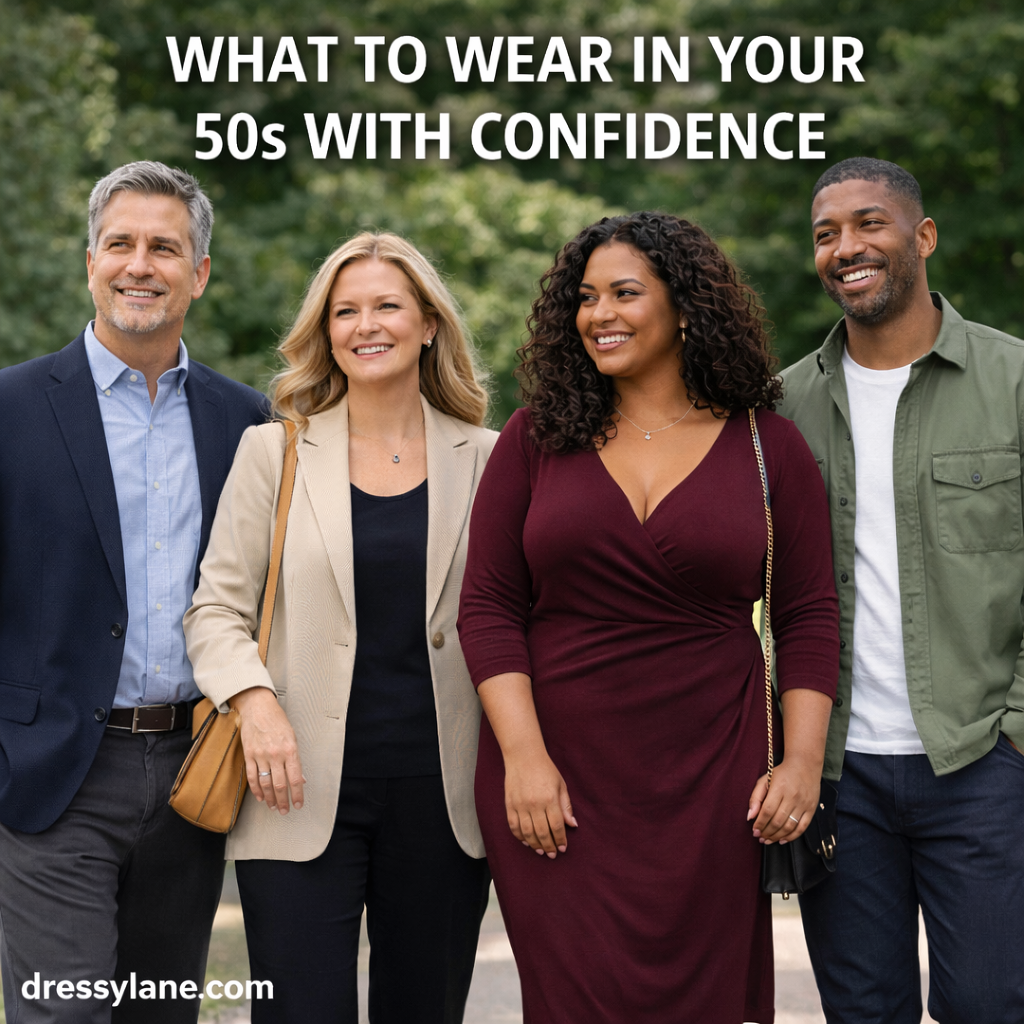
Dressing confidently in your 50s doesn’t require a new set of age-specific fashion rules.
You can wear jeans, sneakers, bright colors, prints, short or long hems, tailored clothes, relaxed clothes, and current trends. The more useful question is whether those clothes still suit your body, lifestyle, and personal taste.
By this point, you may already know that certain trousers always feel better with a higher rise, that you prefer substantial cotton over thin jersey, or that you’ll choose loafers over heels no matter how many heels you buy.
Use that information.
Confidence in clothing often comes from eliminating the small compromises that make you uncomfortable and wearing more of what reliably works.
Dress the Body You Have Today
This is where I’d start before buying anything new.
Try on the clothes you already own and pay attention to what physically happens rather than what the size label says.
Does the waistband dig in when you sit?
Does a jacket pull across the back?
Does a shirt gape at the chest?
Do the trousers slide down throughout the day?
Can you comfortably raise your arms?
Bodies change over time, and so do clothing cuts. A size or silhouette that worked ten years ago doesn’t need to remain your standard.
I’d rather size up, size down, change the rise, or choose an entirely different cut than spend a day adjusting my clothes.
The number on the tag is useful for finding the fitting room. That’s about it.
Comfort Should Come From Construction, Not Just Stretch
Comfortable clothing doesn’t have to mean loose jersey and elastic waistbands—although there’s nothing wrong with either.
Fabric and construction matter just as much.
Cotton poplin can feel crisp without being stiff. Merino wool makes excellent lightweight knitwear. Ponte offers stretch while maintaining structure. Linen blends can provide airflow with less wrinkling than pure linen.
Other useful fabrics include:
- Cotton twill
- Oxford cloth
- Denim with a small amount of stretch
- Fine-gauge cotton knit
- Wool blends
- Crepe
- Soft brushed wool
For trousers, look for enough room through the seat and thigh to sit comfortably. For jackets, check shoulder movement. For knitwear, make sure the neckline and cuffs don’t become irritating after an hour.
Those details matter far more in everyday life than whether a garment is described as “timeless.”
Keep the Silhouettes You Actually Like
There’s no reason everyone in their 50s needs to migrate toward the same straight trousers, midi dress, blazer, and loafer combination.
Those pieces are useful—but only if you like them.
If you love wide-leg trousers, wear them. If you prefer slim jeans, keep wearing them. If your favorite silhouette is a loose linen shirt over straight pants, that’s useful information about your personal style.
Trends can give you new proportions to experiment with, but they don’t automatically invalidate older ones.
One thing I would reconsider is wearing an entire outfit exactly as you wore it during a previous trend cycle.
Sometimes changing one piece is enough.
Keep your favorite slim jeans but try them with a relaxed cotton shirt and substantial loafers. Wear an older fitted blazer over a simple T-shirt and wider trousers. Put contemporary shoes underneath a dress you’ve owned for years.
The goal isn’t constant replacement. It’s keeping familiar clothes in conversation with the rest of your wardrobe.
What Women Can Wear in Their 50s
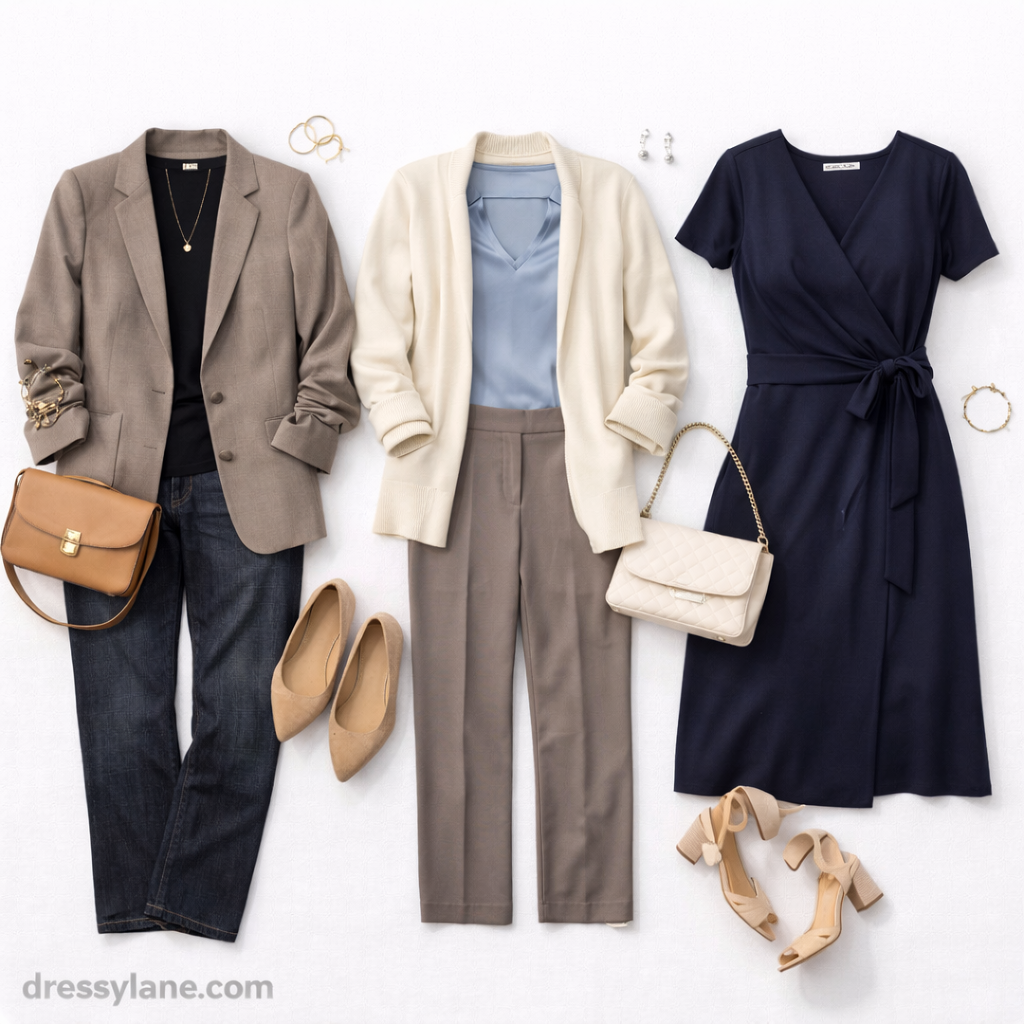
A useful women’s wardrobe at 50 can be as colorful, minimal, tailored, relaxed, feminine, or experimental as you want it to be.
For everyday wear, straight or wide-leg jeans with a fine-gauge knit and loafers create an easy foundation. If you prefer something softer, try relaxed trousers with a cotton shirt and leather flats.
For work, wool-blend or substantial crepe trousers pair well with poplin shirts, knitwear, and jackets.
A midi dress is useful when you genuinely enjoy dresses, but there’s no requirement to move toward longer hemlines. Choose the length based on proportion, comfort, and occasion rather than age.
Some dependable combinations include:
- Straight jeans + white poplin shirt + loafers
- Wide-leg trousers + fitted knit + flats
- Dark denim + merino sweater + ankle boots
- Midi dress + leather jacket + knee-high boots
- Tailored trousers + silk or matte-satin blouse + low heels
- Linen trousers + substantial cotton T-shirt + sandals
I’d put more emphasis on having several complete outfits that work than owning a long checklist of “essential” pieces.
Don’t Automatically Tone Down Color or Prints
There is no fashion rule requiring your wardrobe to become quieter in your 50s.
If you love red, wear red.
A burgundy sweater with cream trousers can look excellent. So can a cobalt shirt with navy trousers, an emerald dress, or a patterned blouse underneath a solid jacket.
Prints aren’t inherently aging, either.
The question is whether you still like the particular print and garment.
If an older floral blouse feels dated, try it with current jeans and different shoes before getting rid of it. Sometimes the print is perfectly good and the old styling formula is what feels stuck in the past.
I’d rather see someone wearing a strong color they genuinely love than a wardrobe of beige they bought because they were told neutrals look sophisticated.
What Men Can Wear in Their 50s
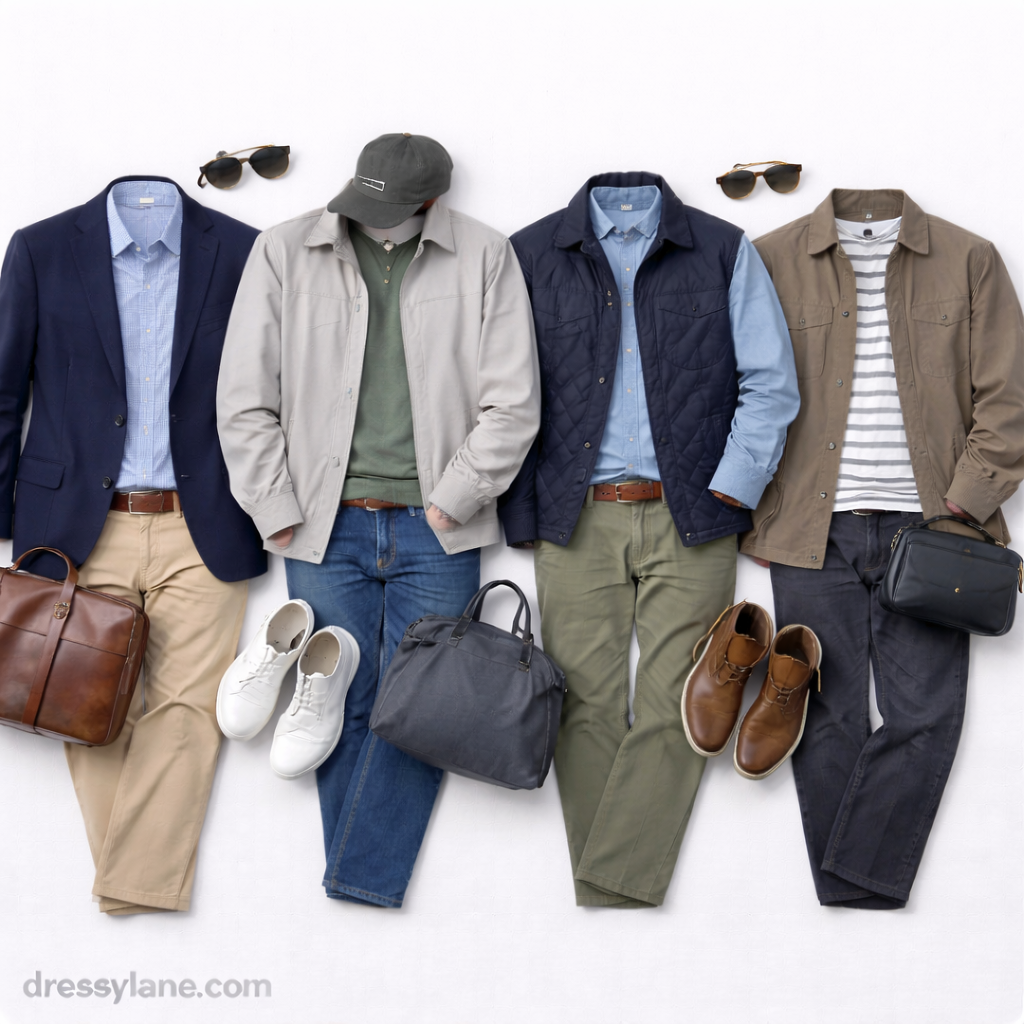
For men, good everyday style often comes from having several levels of the same basic wardrobe.
Start casually with straight jeans or chinos, a heavyweight T-shirt or knit polo, and sneakers.
Move up slightly with an Oxford shirt, merino crewneck, suede loafers, or Chelsea boots.
For smarter settings, wool trousers and an unstructured blazer provide polish without automatically becoming a suit.
Useful combinations include:
- Dark jeans + knit polo + suede loafers
- Chinos + Oxford shirt + leather sneakers
- Straight trousers + merino sweater + casual jacket
- Medium-wash jeans + heavyweight T-shirt + overshirt
- Wool trousers + poplin shirt + unstructured blazer
- Dark denim + crewneck knit + Chelsea boots
Fit matters, but “well fitted” doesn’t mean tight.
A straight trouser with some room through the thigh can look considerably sharper than an aggressively tapered pair pulling across the leg.
Likewise, a jacket should allow you to move your arms without the entire garment lifting with them.
Shoes Deserve More Attention Than Most Wardrobe Lists Give Them
Shoes can change both the comfort and character of an outfit.
For women, that might mean replacing heels you no longer enjoy wearing with slingbacks, loafers, ballet flats, low block heels, or boots.
For men, suede loafers, clean leather sneakers, Chelsea boots, or casual derbies can cover a large percentage of everyday situations.
I’d choose shoes based on your actual walking habits.
If you spend a typical day moving between a parking lot, office, restaurant, and car, your needs are different from someone who regularly walks several miles through a city.
And don’t keep uncomfortable shoes just because they were expensive.
Cost doesn’t make a shoe more useful.
A Good Jacket Can Do More Than Several New Tops
Outerwear is one category where I’d consider spending more if the budget allows.
A jacket or coat is highly visible and gets repeated frequently.
For women, that could be a trench, wool coat, leather jacket, relaxed blazer, or short structured jacket.
For men, consider an overshirt, Harrington-style jacket, suede jacket, unstructured blazer, or wool coat.
Look for a fabric with enough weight to hang cleanly and enough room underneath for the layers you normally wear.
Try coats over an actual sweater in the fitting room rather than a thin T-shirt. A coat that fits beautifully over summer clothing may become useless once winter arrives.
Tailoring Is Useful, but Know What Is Worth Altering
Alterations can make ordinary clothing much better.
Trouser hems are easy wins. Jacket sleeves can often be adjusted. Some waistbands can be taken in, and shirt sleeves may be shortened.
But tailoring has limits.
A jacket that’s fundamentally wrong through the shoulders isn’t usually worth trying to rescue. Neither are trousers several sizes away from fitting properly.
I use a simple test: if the garment already fits well in the difficult areas and needs one straightforward adjustment, tailoring makes sense.
If you’re trying to reconstruct the entire piece, find a better starting point.
Stop Saving Your Best Clothes
One habit worth reconsidering in your 50s—or at any age—is saving perfectly wearable clothes for an occasion that rarely arrives.
Wear the good sweater to lunch.
Wear the nice trousers on an ordinary workday.
Use the leather bag.
Put on the jewelry.
Wear the jacket you keep protecting in the closet.
Obviously, a formal gown doesn’t need to come grocery shopping with you. But many “special” clothes are simply slightly nicer versions of everyday clothes.
If a cashmere sweater spends 360 days a year folded in a drawer because you’re afraid of wearing it out, you’re not getting much value from owning it.
Build Around Your Real Lifestyle
A confident wardrobe should reflect where you actually spend your time.
If you’re still working in a professional environment, trousers, jackets, shirts, dresses, and comfortable polished shoes may deserve more of the budget.
If you work remotely, perhaps knitwear, jeans, casual trousers, and presentable tops matter more.
If you travel frequently, focus on layering, comfortable footwear, pockets, wrinkle resistance, and pieces that can be worn more than once between washes.
If weekends are active, don’t build a casual wardrobe that requires dry cleaning and delicate shoes.
Lifestyle should determine your wardrobe more than age does.
Keep Something Interesting
Practical doesn’t have to mean predictable.
A strong pair of glasses, unusual jewelry, patterned shirt, red shoe, textured jacket, colorful knit, or beautiful scarf can become something you repeatedly wear.
For men, this could be a suede jacket, patterned knit, distinctive watch, colorful polo, or interesting pair of shoes.
For women, it might be sculptural earrings, a bright bag, patterned coat, metallic flat, or oversized cuff.
I like having at least one element in an outfit that feels personal rather than merely correct.
That’s often what separates getting dressed from simply covering all the wardrobe basics.
Don’t Let “Quality Over Quantity” Become an Excuse to Overspend
Quality matters, but price and quality aren’t the same thing.
Before paying more, inspect the garment.
Look at the seams. Check whether patterns line up where appropriate. Test the zipper. Feel whether the knit springs back after being stretched. Look at the stitching around buttons and pockets.
For a T-shirt, check the collar and fabric weight.
For trousers, look at the waistband construction and how the fabric hangs.
For shoes, inspect the upper, sole, lining, and how securely the heel fits.
Sometimes the less expensive garment is perfectly good. Sometimes the expensive one isn’t.
Buy the better piece, not automatically the more expensive one.
Confidence Often Means Saying No Faster
By your 50s, you may have enough experience to recognize clothes you aren’t going to wear.
Use it.
If you never wear dry-clean-only blouses, stop buying them.
If you hate high heels, don’t keep purchasing “comfortable” versions hoping this pair will finally change your mind.
If beige makes you feel dull, don’t build a neutral capsule wardrobe because someone online said you should.
If you always reach for trousers instead of skirts, buy better trousers.
I’d consider that one of the biggest advantages of getting older: you have more evidence about your own preferences.
Your wardrobe should reflect that evidence.
Final Thoughts
Knowing what to wear in your 50s with confidence isn’t about finding the correct wardrobe for your age.
It’s about becoming more selective about what deserves to be in it.
Wear clothes that fit your body today. Choose fabrics you enjoy having against your skin for hours. Keep colors, prints, denim, silhouettes, and trends that genuinely appeal to you, and let go of pieces you’re constantly adjusting or avoiding.
Invest where repeated use makes the expense worthwhile, and don’t save all of your favorite things for special occasions.
Most importantly, use what you’ve learned about yourself.
At this point, confidence doesn’t have to come from dressing younger, dressing older, or following a prescribed version of “timeless style.” It can simply come from knowing what you like—and wearing it without needing to justify the choice.