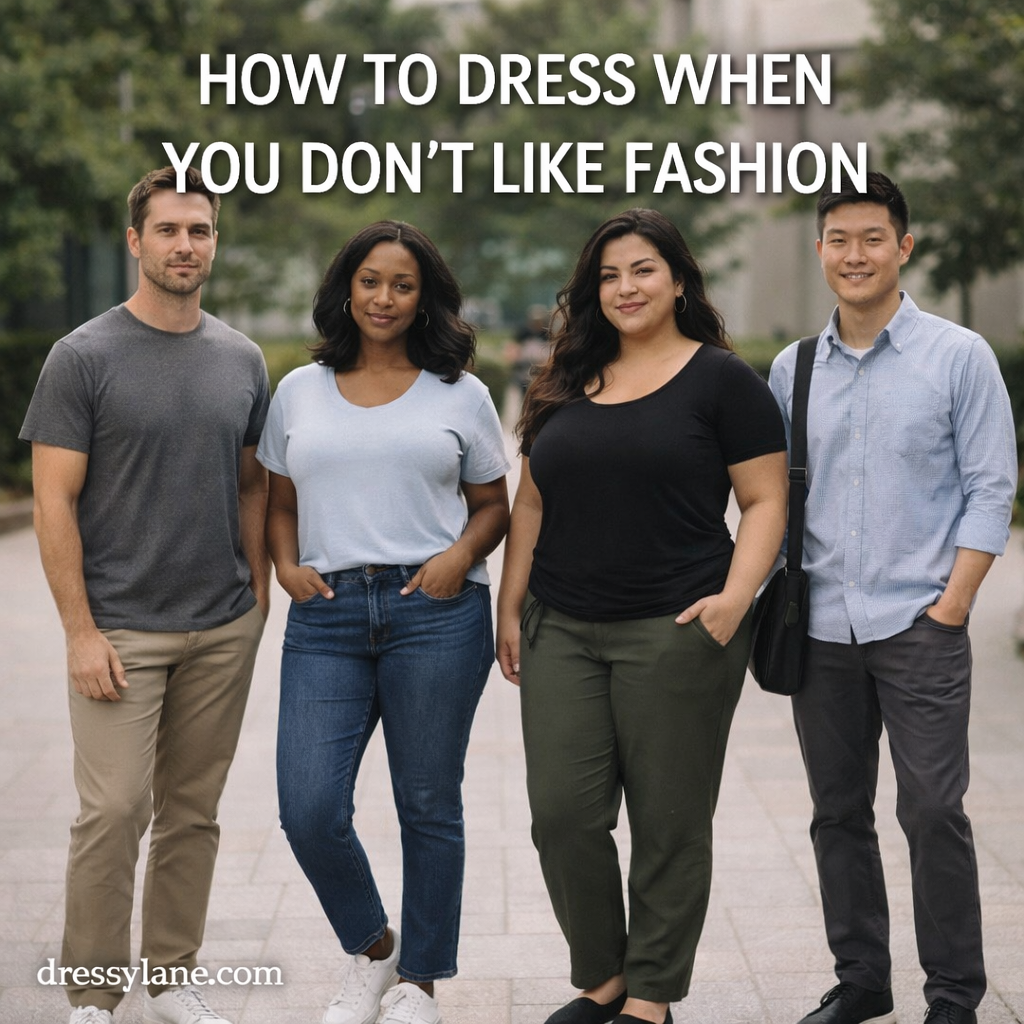
Not everyone enjoys fashion. Some people genuinely like putting outfits together, experimenting with colors, or shopping for new clothes. Others would rather get dressed in five minutes and move on with their day.
If you fall into the second group, you do not need to become interested in fashion to dress well.
In fact, I think the best approach is to stop treating your wardrobe as a creative project. Build a small system of clothes that fit properly, feel comfortable, and work together without much thought. Once you find a combination that works, there is nothing wrong with wearing versions of it over and over again.
What “Dressing Well” Actually Means
Looking well-dressed has much less to do with following trends than most people assume.
A plain navy T-shirt, straight-leg chinos, and clean sneakers can look considerably better than a fashionable outfit that fits poorly. The same is true of a simple knit top with dark jeans and loafers.
Most of the time, looking put-together comes down to a few practical details:
- Your clothes fit your shoulders, waist, and proportions reasonably well.
- Your shoes and clothing are clean and in good condition.
- The colors don’t fight with one another.
- Nothing is excessively wrinkled, stretched, faded, or pilling.
- Your outfit makes sense for where you’re going.
That’s really the standard. You don’t need an eye for fashion to achieve it.
Make Getting Dressed Almost Automatic
If you dislike fashion, I’d actually skip the advice to build a wardrobe full of “interesting” pieces. Interesting usually means another item you have to figure out how to wear.
Instead, make your clothes deliberately predictable.
Choose two or three bottom colors—perhaps dark indigo, charcoal, and khaki—and buy tops that work with all of them. White, navy, gray, cream, olive, and light blue are particularly easy to combine.
You don’t have to wear only neutrals, either. If you love burgundy or forest green, use it. The point is to avoid owning fifteen unrelated colors that create fifteen different outfit decisions.
A useful test when shopping is simple: Can I wear this with at least three things I already own?
If the answer is no, I’d usually leave it in the store.
Buy Clothes That Feel Good for Eight Hours, Not Eight Minutes
Comfort becomes especially important when you aren’t interested in fashion. An uncomfortable garment will eventually end up hanging untouched in your closet, regardless of how good it looked in the fitting room.
Look for fabrics such as cotton jersey for T-shirts, cotton twill with a little stretch for chinos, merino or fine-gauge cotton for sweaters, and soft denim with enough structure to hold its shape.
Pay attention to fit while doing normal things—not just while standing in front of a mirror.
Sit down in the pants. Raise your arms in the shirt. Walk around in the shoes. Button the jacket.
A shirt that looks great while you’re standing still but pulls across your back every time you reach forward isn’t a good everyday shirt.
As a general rule, clothing should follow your shape without squeezing it or hanging several inches away from it. Shoulder seams should land close to the edge of your shoulders, waistbands shouldn’t dig in when you’re sitting, and pant hems shouldn’t bunch heavily over your shoes.
A Low-Effort Wardrobe for Men
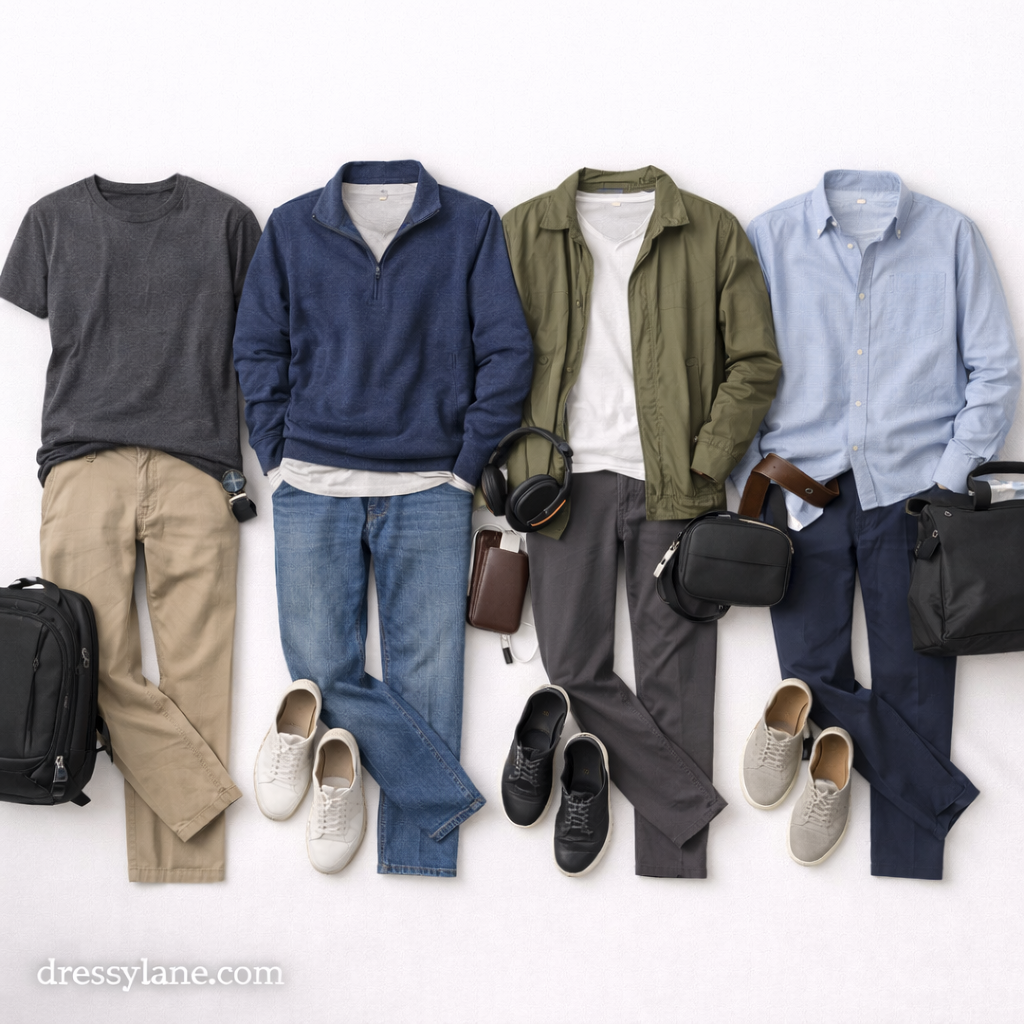
Men can get surprisingly far with a small rotation.
For an ordinary casual day, try a heavyweight cotton T-shirt, straight or slightly tapered dark jeans, and clean leather or canvas sneakers. When you need to look a little sharper, replace the T-shirt with an Oxford-cloth button-down and the jeans with navy or khaki chinos.
A practical core wardrobe might include:
- Several plain cotton T-shirts
- Two Oxford or casual button-down shirts
- Dark straight-leg jeans
- Navy or khaki chinos
- A crewneck sweater
- A lightweight overshirt or casual jacket
- Clean sneakers
- One pair of simple leather shoes
You don’t need a different outfit every day. A navy sweater worn Monday with chinos can be worn Friday with jeans. Nobody is keeping an inventory of your clothes.
A Low-Effort Wardrobe for Women
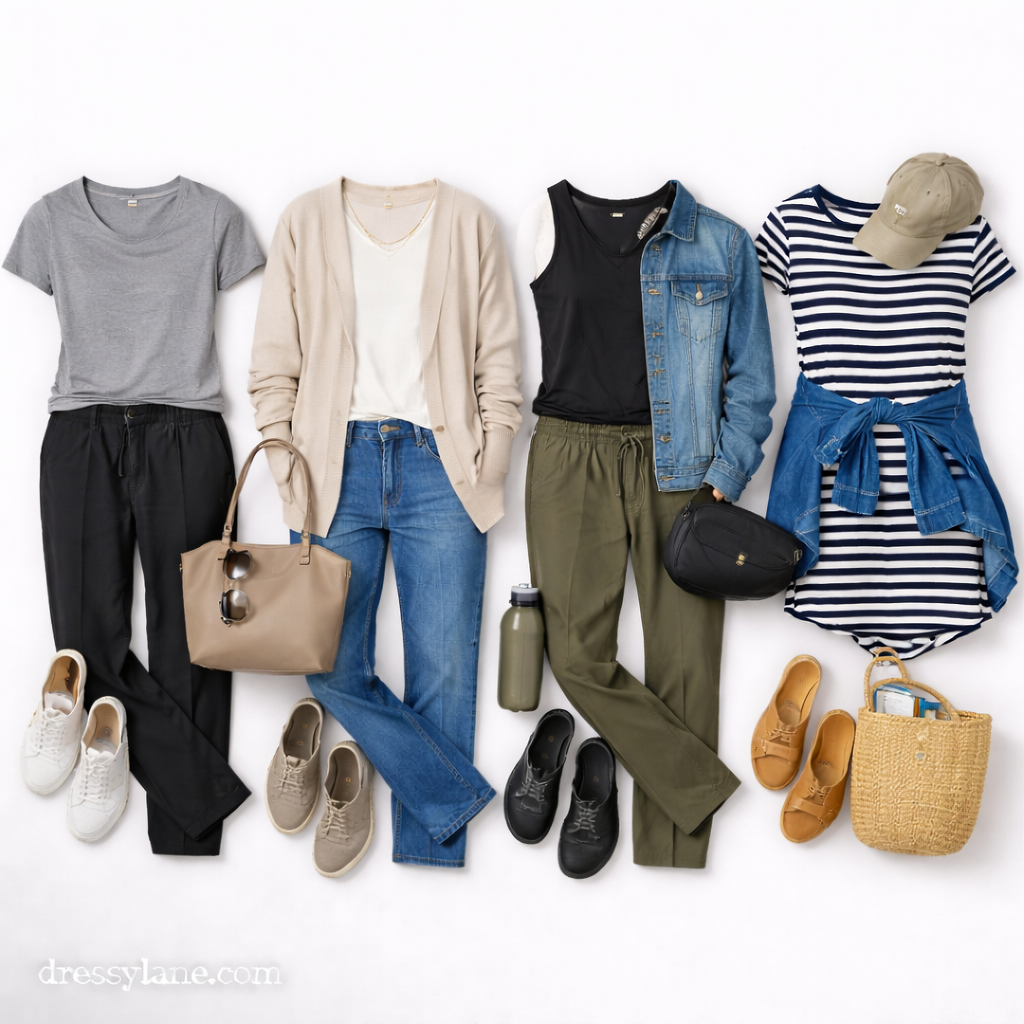
For women who don’t enjoy styling outfits, I’d prioritize pieces with uncomplicated silhouettes: straight-leg trousers, dark jeans, solid knit tops, simple cardigans, and dresses that don’t require special undergarments or complicated accessories.
One easy combination is a crewneck knit top, straight-leg ankle trousers, and loafers or clean sneakers. Another is dark jeans, a tucked or semi-tucked cotton top, and a cardigan.
A simple wardrobe could include:
- Solid cotton or knit tops
- Dark straight-leg jeans
- Black, navy, or tan trousers
- One or two uncomplicated dresses
- A cardigan or lightweight jacket
- Comfortable flats or loafers
- Clean everyday sneakers
- Low boots for cooler weather
A simple dress is particularly useful if you hate coordinating separates. Choose something like a knee- or midi-length knit or shirt dress with a clean silhouette, add shoes, and you’re essentially finished.
Find Your Personal Uniform
One of the most useful things you can do is notice what you already reach for.
Suppose you repeatedly wear straight-leg pants, a crewneck shirt, sneakers, and a lightweight jacket. Instead of forcing yourself to diversify, make that combination better.
Buy another pair of pants in navy. Find the same shirt in white and gray. Replace worn sneakers with a clean version of the same general style.
That’s a personal uniform.
It doesn’t have to mean literally wearing identical clothing every day. It means keeping the basic silhouette consistent while changing colors, fabrics, or layers.
This is also why buying duplicates isn’t necessarily boring. If you’ve finally found a pair of pants that fits properly at the waist, doesn’t pinch when you sit, and works with your shoes, buying a second pair can be much smarter than starting the search all over again.
Don’t Buy Clothes for an Imaginary Version of Yourself
This is probably the wardrobe mistake I’d avoid most.
People often buy clothing for situations they rarely encounter: formal jackets when their workplace is casual, delicate shoes when they walk everywhere, or statement pieces when they feel most comfortable in plain clothes.
Build your wardrobe around your actual week.
If five days out of seven involve working in a casual office, running errands, walking the dog, or meeting friends for lunch, most of your clothing should handle those situations.
You may still need an interview outfit, wedding clothes, or something appropriate for a nice dinner—but those should be the exceptions rather than the foundation of your closet.
Keep Accessories Simple
Accessories are optional.
You don’t need several watches, bags, belts, scarves, or pieces of jewelry simply because a wardrobe guide says you do. If accessories feel like another decision, reduce them.
One everyday bag, one belt that works with your usual shoes, and a simple watch or small piece of jewelry may be plenty.
The same applies to shoes. I’d rather have three pairs that cover distinct purposes—everyday sneakers, slightly dressier shoes, and weather-appropriate shoes—than ten pairs that are only slightly different from one another.
Pay Attention to Maintenance
When your wardrobe is intentionally simple, condition becomes more noticeable.
A $25 plain shirt that fits properly and isn’t faded can look better than an expensive shirt with a stretched collar. Clean sneakers look sharper than fashionable sneakers covered in dirt.
Get rid of persistent wrinkles. Remove sweater pills with a fabric shaver. Replace T-shirts when the collars become stretched. Polish or wipe down shoes occasionally.
These aren’t fashion skills. They’re maintenance skills, and they have a surprisingly large effect on how put-together you look.
Shop Less—and Replace What Already Works
You don’t need seasonal shopping trips.
When something wears out, replace it. When you find something unusually comfortable and flattering, consider buying a duplicate while the same cut is still available.
I’d also avoid buying an item simply because it’s heavily discounted. A $20 shirt you never wear costs more, in practical terms, than a $60 shirt you wear every week.
Over time, your wardrobe should become more predictable, not larger.
Final Thoughts
You don’t have to care about fashion to dress well.
Start with clothes that fit comfortably, choose a limited group of colors that work together, and create two or three outfit combinations you can repeat without thinking. Keep your shoes and clothing in good condition, and don’t buy things that require a completely different wardrobe to make them work.
Most importantly, pay attention to the clothes you naturally reach for. Those pieces are telling you something about what actually works for your body and your life.
If dark jeans, a plain shirt, comfortable shoes, and a simple jacket make you feel presentable and allow you to forget about your clothes for the rest of the day, that’s not a failure to be fashionable.
That’s a wardrobe doing its job.