

Beige is one of those colors that sounds simple until you actually try to match it.
A pair of warm sand-colored chinos doesn’t behave exactly like a cool stone-beige coat, and a creamy beige knit can look completely different beside black than it does beside chocolate brown.
The good news is that beige works with an unusually wide range of colors. White, black, navy, brown, blue, green, burgundy, and even stronger colors such as red can all pair well with it.
The trick is less about finding colors that are “allowed” with beige and more about deciding how much contrast you want—and paying attention to the particular beige you’re wearing.
First, Look at What Kind of Beige You Have
Not all beige is the same.
Some beige leans yellow or golden, similar to sand, camel, or light tan. Other versions are cooler and grayer, closer to stone, mushroom, or taupe.
You don’t need to become an expert in undertones, but recognizing the difference helps.
A warm beige wool coat looks particularly natural with chocolate brown, cream, olive, rust, and burgundy. A cooler stone-beige trouser can look excellent with charcoal, black, navy, or dusty blue.
And sometimes contrast solves the issue completely. A crisp white shirt works with almost any version of beige because the difference between the two colors is obvious.
Beige and White: The Easiest Light Combination
White and beige are difficult to get wrong.
For women, try beige wide-leg trousers with a crisp white cotton poplin shirt and tan loafers. A white T-shirt also works beautifully with a beige midi skirt or linen trousers.
For men, beige chinos with a white Oxford shirt and brown loafers is a reliable smart-casual combination. Swap the loafers for clean white sneakers and it becomes much more relaxed.
The key with an all-light outfit is texture.
A white linen shirt with beige cotton twill trousers has enough difference in texture to keep the outfit from looking flat. The same applies to a ribbed cream knit worn with smoother beige trousers.
Beige and Black: Use the Contrast
Black gives beige much stronger definition.
A black crewneck knit tucked into beige trousers creates a clean, simple outfit because the colors are clearly separated. Black loafers, boots, or a belt can repeat that darker color elsewhere.
Women can also pair a beige skirt with a fitted black top or wear a beige trench over an otherwise black outfit.
For men, a black polo or sweater with beige chinos works particularly well when you want something sharper than the usual beige-and-navy combination.
I’d generally avoid adding several other strong colors to this pairing. Black and beige already create enough contrast to carry the outfit.
Beige and Navy: One of the Most Reliable Pairings
If I had to choose one color to wear with beige repeatedly, navy would be near the top of the list.
It has the depth of black without creating quite as stark a contrast.
A navy merino sweater with beige chinos and brown shoes works for men with almost no effort. For women, a navy blouse or knit with beige trousers and loafers can move easily between casual and office settings.
Navy outerwear also works well over beige. A navy wool coat over cream and beige layers creates a more interesting neutral palette than simply wearing black with everything.
Beige and Brown: Better When the Shades Are Clearly Different
Beige and brown naturally belong together, but I’d avoid trying to match them too closely.
Instead, create obvious separation.
Light beige trousers with a chocolate-brown sweater look intentional. So does a beige dress with dark-brown boots and a cognac bag.
Camel also works, particularly when there’s enough difference in depth between the two pieces.
One of my favorite approaches to neutral dressing is to use three levels of the same warm family: cream at the light end, beige or camel in the middle, and chocolate brown as the darkest element.
That gives you a tonal outfit without making everything look like the exact same shade.
Beige and Gray: Cooler and More Understated
Gray is particularly useful with cooler beige shades.
Try stone-beige trousers with a charcoal sweater, or a beige coat over a heather-gray knit. The result is quiet without looking unfinished.
If the combination seems dull, texture usually fixes it.
Charcoal wool with beige cotton twill has more depth than two flat synthetic fabrics. A gray ribbed knit, brushed wool coat, suede shoe, or textured scarf can do the same thing.
This is one pairing where I’d focus more on fabric than accessories.
Beige and Blue: Much More Than Navy
Lighter blues work just as well.
A pale-blue Oxford shirt with beige chinos is a menswear classic for a reason. It’s clean, relaxed, and works particularly well in spring and summer.
Women can try a dusty-blue blouse with beige trousers, or a light-blue cotton shirt with a beige midi skirt.
Denim counts too.
A medium-blue denim shirt tucked into beige trousers creates an easy casual outfit, while a beige blazer or trench worn with blue jeans gives you the same colors in reverse.
Beige and Green: From Sage to Forest
Green and beige work naturally together because both colors appear frequently in earthy palettes.
Olive is probably the easiest place to start.
Try an olive overshirt with a white T-shirt and beige chinos, or beige trousers with an olive knit and brown shoes.
Sage creates a softer combination, especially with lighter beige. Forest green adds much stronger contrast and works particularly well in cooler weather.
A forest-green wool sweater with beige trousers and dark-brown boots is a good example of how beige can support a richer color without competing with it.
Beige and Burgundy or Red
Beige is also a useful background for red.
Burgundy and wine shades are particularly easy because they’re rich without being extremely bright. A burgundy sweater with beige trousers is simple enough for everyday wear but has considerably more color than an all-neutral outfit.
Brighter red works too.
For women, a red knit with beige trousers and brown or black shoes can look sharp without requiring additional color. A red bag or shoe can also give an otherwise cream-and-beige outfit a clear focal point.
For men, I’d usually introduce brighter red in a knit, polo, tie, or smaller accessory rather than combining several red pieces with beige at once.
Beige and Pink
Blush and dusty rose create a soft combination with beige, but pink doesn’t have to be pale.
A deeper rose or muted raspberry can provide useful contrast against light beige.
If pale pink and beige start looking washed out together, add a darker anchor such as chocolate brown, burgundy, navy, or black.
For example, a blush blouse with beige trousers can feel very light on its own. Add dark-brown loafers and a matching belt or bag and the outfit immediately has more structure.
Beige and Teal
Teal isn’t as obvious as navy or olive, but it can look excellent against beige.
The blue-green depth stands out particularly well against warm sand or camel-leaning beige.
A teal blouse with beige trousers works as a straightforward two-color outfit. A teal knit with beige chinos can do the same for men.
I’d keep the remaining pieces quiet—brown, cream, navy, or another neutral—rather than adding another saturated color.
What Women Can Wear With Beige
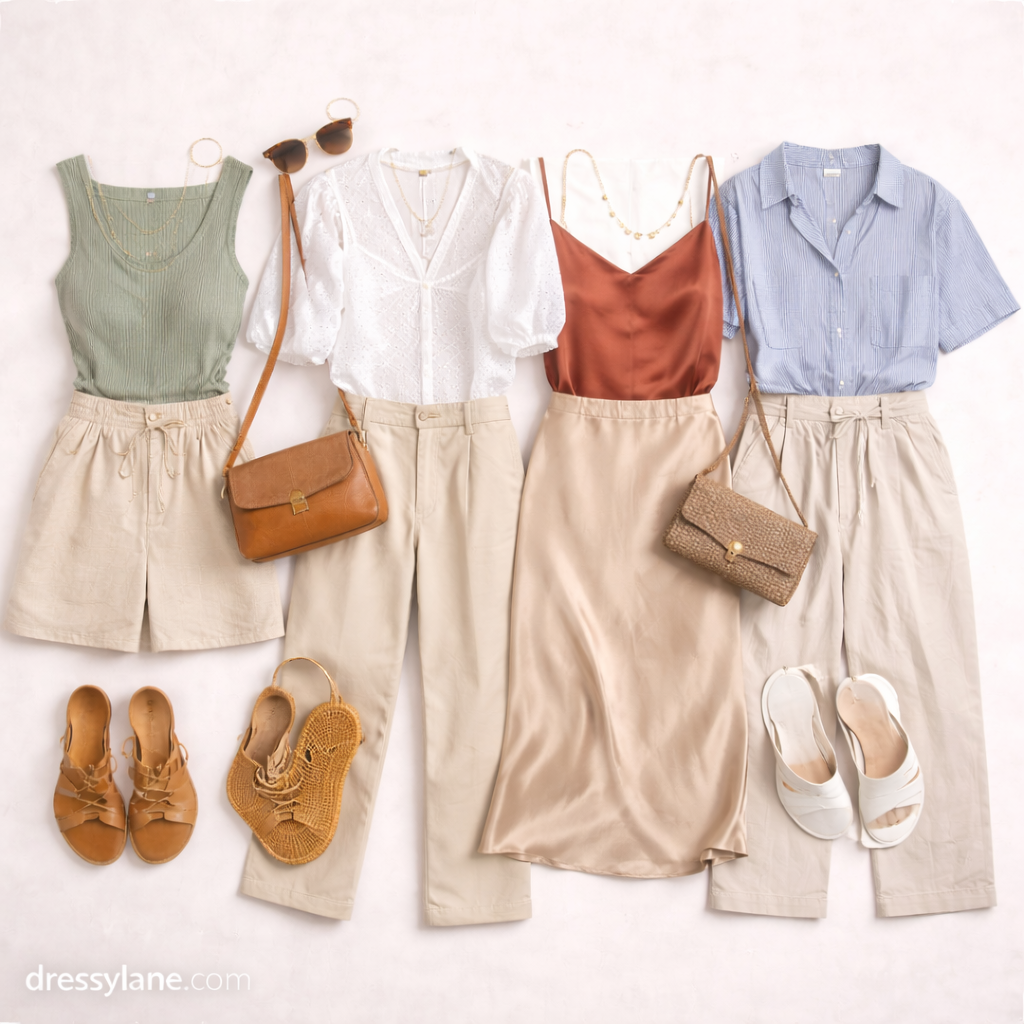
Beige trousers are probably one of the easiest starting points because almost any darker or more saturated top will work with them.
Try:
- Beige trousers + white poplin shirt + tan loafers
- Beige midi skirt + black knit + black flats
- Beige wide-leg pants + navy top + brown shoes
- Beige dress + chocolate-brown boots
- Beige trousers + burgundy sweater + loafers
- Beige skirt + olive blouse + tan sandals
If you’re wearing a beige dress, accessories become particularly useful. Dark brown creates warmth, black adds sharper contrast, and metallic gold can work almost like another neutral.
You don’t need your bag and shoes to be the same shade. In fact, I’d rather see a dark-brown bag with cognac shoes than an almost-but-not-quite matching beige bag and beige shoe.
What Men Can Wear With Beige
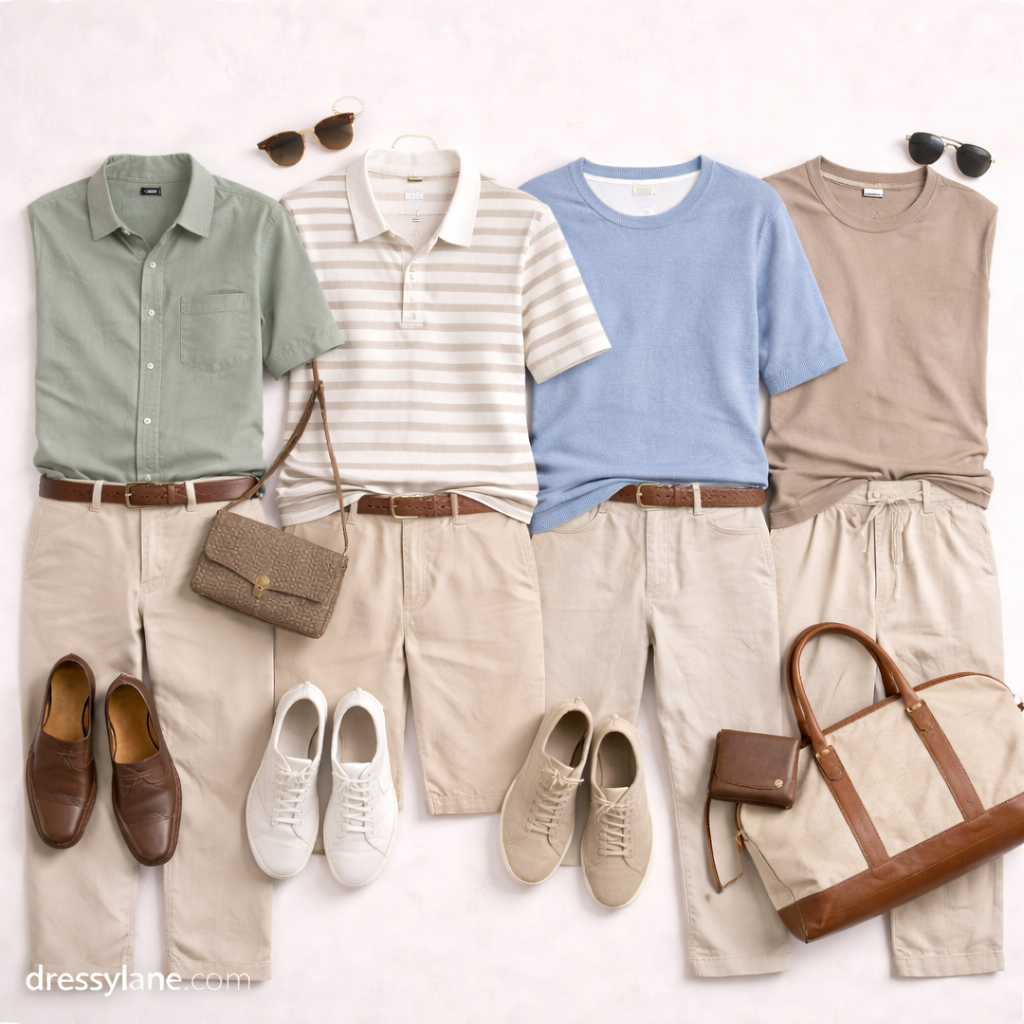
Beige chinos are an easy foundation for men’s casual and smart-casual outfits.
Some combinations worth repeating are:
- Beige chinos + navy polo + brown loafers
- Beige trousers + white Oxford shirt + suede shoes
- Beige chinos + olive overshirt + white T-shirt
- Beige trousers + charcoal sweater + black shoes
- Beige chinos + pale-blue shirt + brown belt and loafers
- Beige trousers + burgundy knit + dark-brown shoes
One thing I’d watch is the difference between beige trousers and beige shorts. Shorts naturally make the outfit more casual, so a light-blue linen shirt, polo, or plain cotton T-shirt usually makes more sense than a formal dress shirt.
Beige Changes With the Season
You don’t need separate rules for beige in summer and winter. Change the surrounding colors and fabrics instead.
In warm weather, beige works naturally with white, cream, pale blue, sage, and lighter denim. Linen, cotton poplin, lightweight twill, and canvas keep those combinations feeling appropriate.
During fall and winter, move toward chocolate brown, burgundy, forest green, rust, charcoal, and navy.
Fabric makes an enormous difference here.
Beige linen trousers with a white shirt look summery. Beige wool trousers with a burgundy merino sweater look distinctly autumnal even though the base color hasn’t changed.
Don’t Be Afraid of Beige-on-Beige
One piece of advice I’d ignore is that similar beige shades should always be avoided.
Tonal beige outfits can look excellent.
The trick is making the shades or textures different enough that you can see the individual pieces.
Try cream knitwear with camel trousers and a beige wool coat, or a sand-colored linen shirt with lighter stone trousers.
What tends not to work as well is wearing several almost-identical beige pieces in thin, flat fabrics. That’s when the outfit can start looking unintentionally uniform.
Use differences in texture, depth, or both.
Final Thoughts
So, what colors go with beige?
White, black, navy, gray, brown, blue, olive, forest green, burgundy, red, pink, teal, and many other colors can all work.
For the easiest combinations, start with white, navy, brown, black, or blue. If you want more color, try olive, burgundy, forest green, rust, or teal.
And pay attention to the beige itself. Warm sand and camel shades naturally complement earthy colors, while cooler stone and taupe shades sit particularly well beside gray, black, navy, and cooler blues.
Most importantly, don’t worry about finding an exact “matching” shade.
Beige works best as a foundation. Give it some contrast, add texture, and let the other color provide the personality.