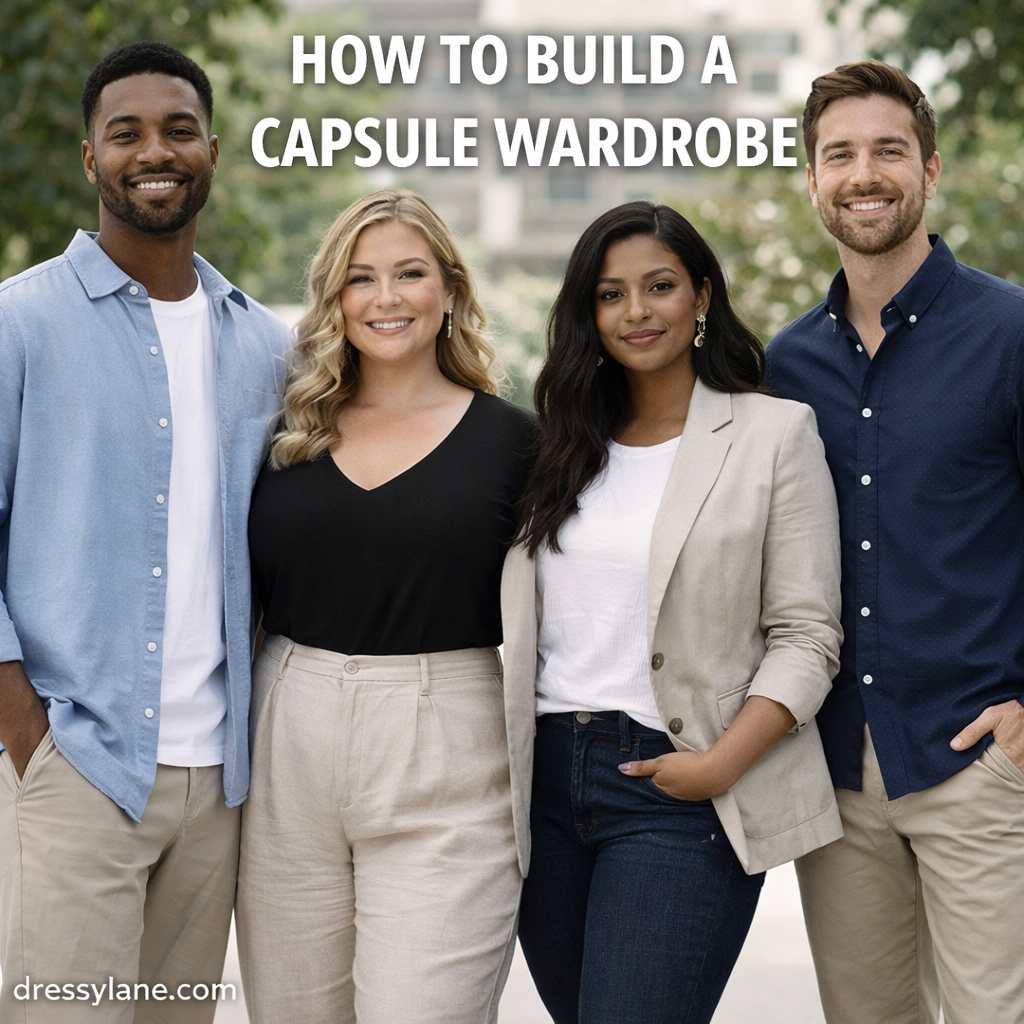
A capsule wardrobe is a carefully chosen collection of clothing that works together. Instead of owning dozens of pieces that require very specific combinations, you build around versatile clothes you can repeatedly mix, match, layer, and dress up or down.
The result is not necessarily an ultra-small or minimalist wardrobe.
It is a functional wardrobe.
For one person, that might mean 30 carefully selected pieces. For someone who divides time between an office, gym, social events, and four distinct seasons, it could be considerably larger.
The number matters less than whether the clothes actually work together and support your real life.
This guide explains how to build a capsule wardrobe from scratch, rebuild an existing wardrobe, create reliable outfit formulas, develop an everyday uniform, dress well with fewer clothes, and keep your wardrobe useful without constantly shopping.
What Is a Capsule Wardrobe?
A capsule wardrobe is a collection of interchangeable clothing built around a relatively consistent color palette, compatible silhouettes, and the situations you regularly dress for.
Most pieces should work with several other pieces.
For example, instead of buying a blouse that works with only one particular skirt, you might choose a blouse that works with:
- Straight-leg jeans
- Tailored trousers
- A midi skirt
- A blazer
- A cardigan
That single blouse now has a clear role in your wardrobe.
A capsule commonly includes:
- Everyday tops
- Shirts or blouses
- Knitwear
- Jeans
- Trousers
- Skirts or dresses, if you wear them
- Jackets
- Coats
- Everyday shoes
- Dressier shoes
Some people aim for 25–50 pieces, but there is no universal capsule wardrobe number.
If 35 pieces leave major gaps in your life, owning exactly 35 pieces has accomplished very little.
Why Build a Capsule Wardrobe?
The biggest advantage is not simply owning less.
It is reducing friction.
A well-built capsule can mean:
- Fewer difficult outfit decisions
- More combinations from the clothes you already own
- Less impulse shopping
- Easier packing
- Fewer unworn purchases
- More consistent personal style
- Easier seasonal transitions
- A clearer idea of what your wardrobe actually needs
It can be particularly useful if you feel like you own plenty of clothing but still regularly think, “I have nothing to wear.”
Often, the problem is not quantity. It is compatibility.
Step 1: Build for Your Actual Lifestyle
Before choosing colors or making a shopping list, look at how you spend a typical month.
Someone working remotely five days a week needs a very different capsule from someone working in a conservative office.
Think about how often you dress for:
- Work
- Working from home
- Errands
- Casual weekends
- Dates or dinners
- Religious services
- Social gatherings
- Exercise
- Travel
- Formal occasions
Do the same with your climate.
A wardrobe in Southern California might rely heavily on cotton, linen, lightweight denim, overshirts, and transitional jackets.
A four-season wardrobe may need merino wool, heavier denim, waterproof footwear, insulated outerwear, and substantial layering pieces.
Your clothes should reflect the life you actually have rather than the life represented by someone else’s capsule wardrobe.
If determining the appropriate level of dress is difficult for you, How to Choose an Outfit That Fits the Situation is a useful companion guide.
Step 2: Audit the Wardrobe You Already Own
Do this before buying anything.
Take inventory of what you actually wear.
Divide your clothes mentally—or physically—into four groups:
Wear constantly: dependable clothes that fit and feel good.
Wear occasionally: useful clothes for specific weather or occasions.
Rarely wear: items you repeatedly overlook.
Don’t wear: poor fit, uncomfortable fabric, wrong size, difficult color, or clothing that no longer fits your lifestyle.
Then study the first group.
Those clothes contain useful information.
Maybe nearly all your favorite pants are straight-leg. Perhaps you consistently choose navy instead of black. Maybe you own numerous heels but wear loafers almost every time you leave home.
Build around those patterns.
Step 3: Choose a Cohesive Color Palette
A capsule wardrobe becomes much easier to combine when colors have some relationship to one another.
Start with two or three base neutrals.
Examples include:
- Black
- Navy
- Charcoal
- Gray
- White
- Cream
- Beige
- Camel
- Brown
- Olive
Then add one or two accent colors if you enjoy them.
For example:
Palette 1: navy + white + camel + light blue + burgundy
Palette 2: black + charcoal + cream + olive + rust
Palette 3: brown + beige + ivory + denim blue + forest green
This does not mean every piece must be neutral.
The purpose is simply to make combinations easier.
If your burgundy sweater works with your jeans, gray trousers, navy coat, and camel trousers, it earns its place much more easily than a color that requires buying an entirely separate set of coordinating clothes.
Step 4: Build From Basics
Basics do most of the work in a capsule wardrobe.
Useful women’s basics
Depending on your lifestyle:
- 3–5 T-shirts or simple tops
- 2–4 blouses or shirts
- 2–3 sweaters
- 1 cardigan
- 1–2 pairs of jeans
- 2 pairs of trousers
- 1 skirt
- 1–2 dresses
- 1 casual jacket
- 1 blazer
- 1 weather-appropriate coat
- 2–4 pairs of versatile shoes
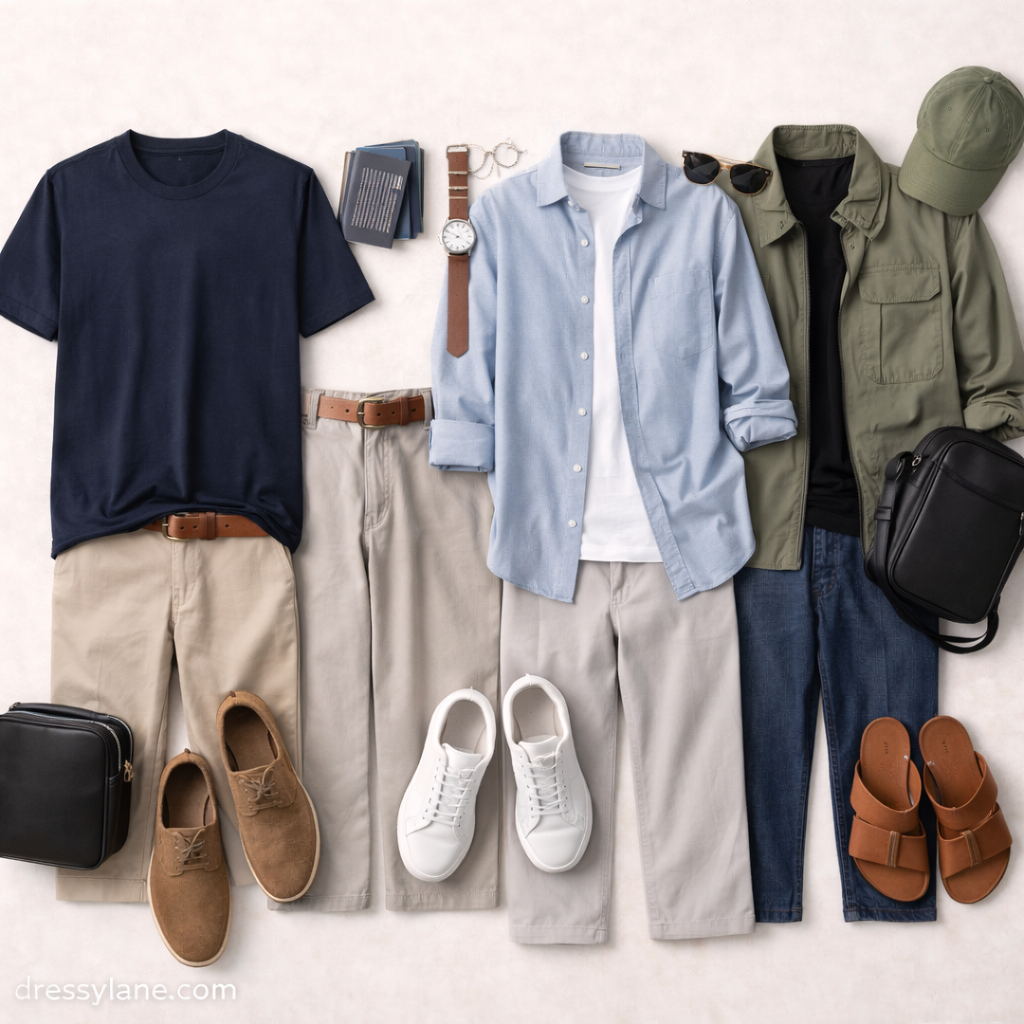
Useful men’s basics
A similar capsule might include:
- 3–5 T-shirts
- 2 polos
- 2–4 Oxford or button-front shirts
- 2–3 sweaters
- 1–2 pairs of jeans
- 2–3 pairs of chinos
- 1 pair of tailored trousers
- 1 overshirt or casual jacket
- 1 blazer
- 1 weather-appropriate coat
- 2–4 pairs of versatile shoes
These are examples, not quotas.
If you never wear skirts, don’t buy one because a capsule checklist says you should.
If you wear an Oxford shirt nearly every day, owning several makes perfect sense.
The best capsule is built around repetition.
Step 5: Pay Attention to Fabric and Fit
When you own fewer clothes, you notice their strengths and weaknesses more often.
Prioritize fabrics appropriate to the garment and climate.
Useful materials include:
- Cotton jersey for T-shirts
- Cotton poplin or Oxford cloth for shirts
- Linen for warm-weather shirts and trousers
- Merino wool for lightweight sweaters
- Lambswool for colder knitwear
- Wool or wool blends for trousers and coats
- Denim for jeans and jackets
- Cotton twill for chinos
- Leather or suede for durable footwear
Synthetic fibers are not automatically bad. Polyester, nylon, elastane, and technical blends can improve durability, stretch, moisture management, or wrinkle resistance.
What matters is how the finished garment performs.
Fit matters just as much.
Your most versatile black trousers are not versatile if you avoid wearing them because the waistband is uncomfortable.
A capsule wardrobe should make dressing easier physically as well as mentally.
If body comfort is a major consideration, see How to Dress to Feel Comfortable in Your Body.
Step 6: Build a Wardrobe That Works Together
A useful capsule is a network rather than a collection of individual good purchases.
Before adding something, ask:
What can I wear this with?
Ideally, an everyday item should work in several combinations.
Suppose you own:
- White T-shirt
- Blue Oxford shirt
- Gray sweater
- Dark jeans
- Olive chinos
- Navy trousers
- Brown loafers
- White sneakers
- Navy jacket
Almost every top works with every bottom.
Both pairs of shoes work with most combinations.
The jacket works over all three tops.
That is wardrobe compatibility.
Ten highly compatible pieces can produce more useful outfits than twenty pieces purchased independently.
Step 7: Build Reliable Outfit Formulas
A capsule becomes dramatically easier to use when you stop inventing outfits from scratch.
Create formulas.
Casual formula
T-shirt + jeans or chinos + sneakers + optional jacket
Smart-casual formula
Oxford shirt/blouse + tailored trousers + loafers + blazer or cardigan
Relaxed dinner formula
Fine knit + dark jeans or trousers + polished shoes + simple outer layer
Warm-weather formula
Linen or cotton top + lightweight trousers/skirt/shorts + sandals or loafers
Cold-weather formula
Base layer + knitwear + trousers/jeans + boots + structured coat
Once you know the formula works, you can change colors and individual pieces without changing the underlying structure.
For more combinations, see How to Build Simple Outfits That Always Work.
Build a Reliable Everyday Uniform
An everyday uniform does not mean wearing identical clothing every day.
It means identifying the silhouette or combination you naturally feel good wearing.
For example:
Women’s uniform: straight-leg jeans + tucked knit or T-shirt + loafers + cardigan
Men’s uniform: chinos + Oxford shirt + leather sneakers + overshirt
You can own several versions of each component.
Monday might be navy chinos and a blue Oxford.
Wednesday might be olive chinos and a white Oxford.
The formula remains familiar even though the outfit changes.
This is particularly useful if you don’t enjoy thinking about clothes. How to Dress When You Don’t Like Fashion takes this low-effort approach further.
How to Build an Outfit Quickly
When you are short on time, start with the bottom half.
Choose:
- Jeans
- Trousers
- Skirt
- Dress
- Shorts
Then choose a compatible top.
Next choose shoes based on the occasion.
Finally, add a layer if needed.
For example:
Dark jeans → cream sweater → loafers → camel coat.
You’re done.
Avoid continuing to add accessories and layers simply because the outfit seems too easy.
Simple is not the same as unfinished.
How to Build Outfits Around One Statement Piece
Capsule wardrobes do not have to eliminate personality.
A statement piece works best when the surrounding outfit is quieter.
Suppose you own:
- Bright red coat
- Patterned midi skirt
- Colorful sneakers
- Printed shirt
- Distinctive handbag
Instead of trying to coordinate several bold items, let one lead.
For example:
Patterned skirt + cream knit + brown boots
or:
Red coat + black trousers + gray sweater + black loafers
This allows statement pieces to remain wearable without requiring an entire wardrobe built around them.
A useful rule is that a statement piece should still work with at least two or three outfits you genuinely expect to wear.
Build a Work Capsule Wardrobe
A work capsule should reflect your actual workplace rather than a generic definition of “professional.”
For a business-casual office, you might use:
Women
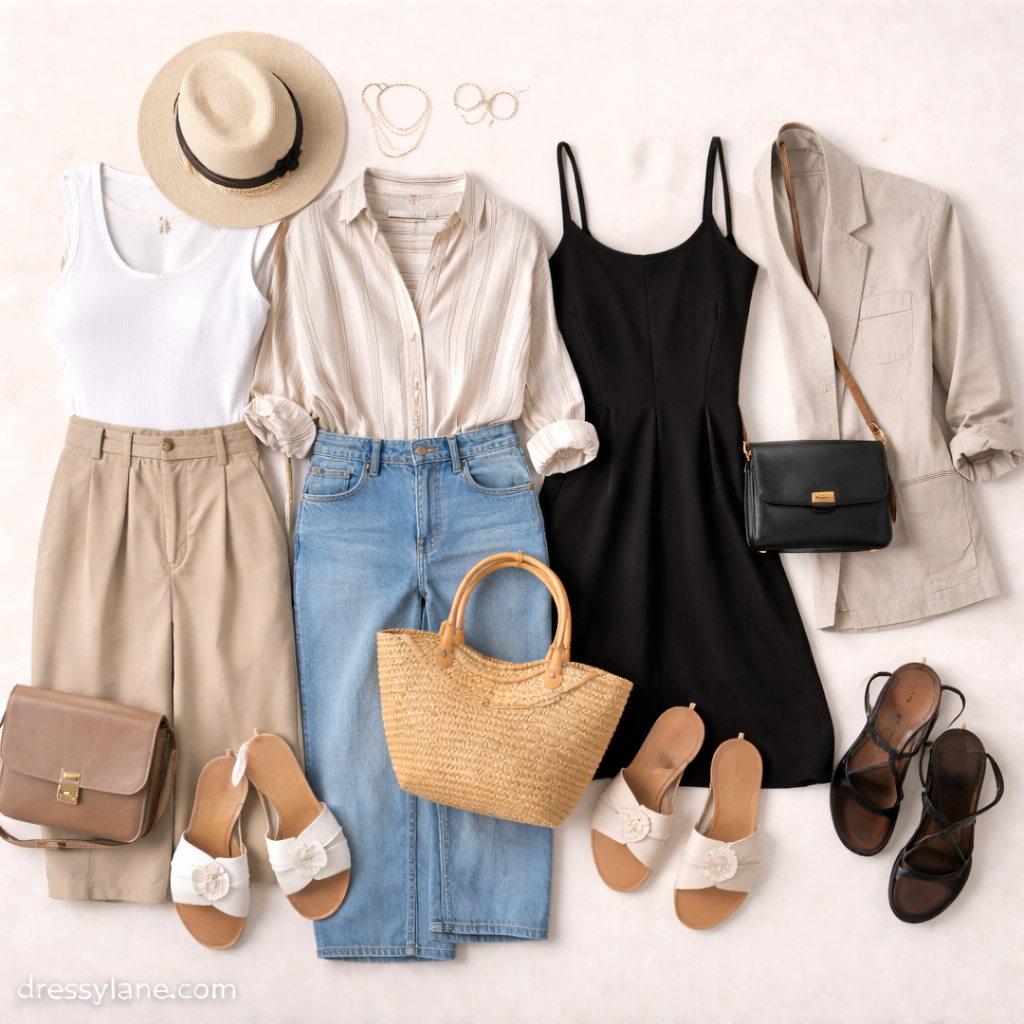
- 2 trousers
- 1 skirt
- 4 blouses or fine knits
- 1 dress
- 2 blazers/cardigans
- Loafers
- Flats or low heels
Men
- 3 chinos or trousers
- 4 Oxford shirts
- 2 fine-gauge sweaters or polos
- 1–2 blazers
- Loafers
- Leather shoes
With compatible colors, a relatively small collection can cover a full workweek without looking identical every day.
More formal workplaces may require suits, dress shirts, conservative dresses, or structured tailoring. Creative workplaces may allow denim, sneakers, or more expressive pieces.
Build a Year-Round Wardrobe With Layers
You do not necessarily need four completely separate wardrobes.
Think in terms of a permanent core plus seasonal modules.
Year-round core
Depending on climate:
- T-shirts
- Shirts
- Jeans
- Chinos
- Trousers
- Lightweight knits
- Sneakers
- Loafers
Warm-weather additions
- Linen shirts
- Shorts
- Lightweight dresses
- Sandals
- Breathable cotton trousers
Cold-weather additions
- Merino or wool sweaters
- Boots
- Heavy trousers
- Wool coat
- Insulated jacket
- Scarves and other cold-weather accessories
During transitional weather, layering allows much of the core wardrobe to remain useful.
Dress Well With Fewer Clothes
Fewer clothes work when the pieces are deliberately interchangeable.
You need enough variation to handle:
- Weather
- Laundry
- Work
- Casual life
- Social occasions
Beyond that, usefulness is more important than quantity.
You may discover that twelve frequently worn pieces contribute more to your daily wardrobe than forty rarely worn ones.
This is also where capsule dressing overlaps with minimalist style. If you prefer the aesthetic as well as the practical philosophy, see How to Dress for Minimalist Style.
Dress Well Without Shopping Often
A functional capsule should reduce the feeling that you constantly need something new.
Instead of shopping recreationally, replace or add clothes when you identify an actual wardrobe gap.
For example:
“I need a lightweight jacket that works over my work clothes and jeans.”
That is a useful shopping objective.
“I want something new for fall.”
That can easily become several purchases without solving any wardrobe problem.
Before buying something, ask:
- Does it fit comfortably?
- Does it work with at least three things I own?
- Do I already own something serving the same purpose?
- Can I imagine wearing it within the next two weeks?
- Does it fit my real lifestyle?
That short test prevents a surprising number of poor purchases.
How to Make the Most of a Small Wardrobe
Repetition is not a failure.
It is how a good wardrobe works.
Change the combinations rather than constantly changing the clothes.
A white shirt might be worn:
- Open over a T-shirt with jeans
- Tucked into trousers
- Under a sweater
- With a skirt
- Under a blazer
- With chinos and loafers
That is six uses for one item before even changing accessories.
Shoes, outerwear, tucking, sleeve styling, and layering can make familiar pieces feel different without requiring new clothes.
Refresh Your Wardrobe Without Replacing Everything
A wardrobe refresh should start with what you own.
Try:
- Tailoring trousers that are slightly too long
- Replacing worn shoelaces
- Cleaning leather shoes
- Removing pilling from knitwear
- Replacing damaged buttons
- Hemming jeans
- Reorganizing clothes so forgotten pieces become visible
- Trying existing pieces in new combinations
Sometimes the problem is one missing connector piece.
For example, you may own plenty of clothes but lack a neutral jacket that connects your casual and slightly dressier outfits.
Adding that one item may make several existing pieces useful again.
Rebuilding Your Wardrobe From Scratch
If your size, career, climate, lifestyle, or preferences have changed significantly, you may genuinely need to rebuild.
Do not replace everything at once.
Start with enough clothing for an ordinary week.
Prioritize:
- Everyday bottoms
- Everyday tops
- Shoes
- Layers
- Work clothing
- Weather-specific clothing
- Occasion wear
Wear that smaller collection for several weeks.
You will quickly discover the actual gaps.
Buying slowly also prevents you from building an entire wardrobe around assumptions that turn out to be wrong.
Dressing With Less Effort
The final stage of a successful capsule is making it almost automatic.
Keep your best outfit formulas in mind—or take photos of them.
You might maintain five dependable combinations:
- Casual everyday
- Work
- Smart casual
- Dinner
- Travel
When something unexpected appears on your calendar, modify the closest formula instead of starting over.
If you’re unsure about an occasion, How to Dress for Different Occasions: Complete Guide can help establish the expected level of formality.
For ambiguous events, see How to Dress When the Invitation Is Vague.
And if your concern is specifically avoiding looking too formal, see What to Wear When You Don’t Want to Overdress.
A Practical Capsule Wardrobe Rule
Here’s one wardrobe habit that is worth adopting:
Don’t judge a potential purchase by how good it looks by itself. Judge it by what happens when you put it next to your existing wardrobe.
Before buying something, name three specific outfits you can make with it.
Not “I’ll wear these trousers with different tops.”
Be specific:
“Cream Oxford shirt, navy sweater, and gray T-shirt.”
If you struggle to name three combinations, stop and think before buying.
The piece may be attractive, but it may not be useful.
That distinction is at the heart of capsule dressing.
Capsule Wardrobe FAQ
How many clothes should be in a capsule wardrobe?
There is no required number. Around 25–50 pieces is a common framework, but lifestyle, laundry frequency, climate, work requirements, and whether shoes or outerwear are counted can dramatically change the total.
Can I build a capsule wardrobe without getting rid of most of my clothes?
Yes. Start by creating a capsule from your existing wardrobe. Store less-used pieces separately if necessary. You can decide what to keep after experiencing the capsule rather than decluttering aggressively beforehand.
Can a capsule wardrobe include bright colors and patterns?
Absolutely. Cohesion matters more than neutrality. A floral dress, striped shirt, burgundy sweater, or brightly colored jacket can work perfectly well if it combines with other pieces.
How do I dress well without a huge wardrobe?
Prioritize fit, condition, compatibility, and appropriate footwear. Repeat reliable outfit formulas rather than expecting every outfit to be completely different.
What should I buy first when rebuilding my wardrobe?
Start with what you need for an ordinary week: a few bottoms, several tops, everyday shoes, and appropriate layers. Add specialized work, seasonal, and occasion clothing afterward.
How do I make simple clothes look better?
Pay attention to fit, fabric, footwear, proportion, and garment condition. A clean cotton T-shirt, straight jeans, leather loafers, and well-cut jacket can look considerably more polished than a complicated outfit made from poorly fitting clothes.
Can I have separate work and casual capsules?
Yes. In fact, this may be more practical if your workplace requires clothing you rarely wear elsewhere. Look for overlap where possible—trousers, knitwear, shirts, outerwear, and shoes can sometimes work in both capsules.
What should I wear to an occasional dressier event?
Keep a small number of occasion-ready pieces rather than trying to force everyday clothes into every situation. For example, a versatile midi dress, dark suit, blazer, tailored trousers, dress shirt, and polished shoes can cover many events. For specific settings such as an upscale restaurant, see How to Dress for Hotel Dining.
How often should I refresh a capsule wardrobe?
There is no need to rebuild it every season. Review it when the weather changes, clothes wear out, your size changes, or your lifestyle changes. Otherwise, replacing items only when there is a genuine need is perfectly reasonable.
Final Thoughts
Building a capsule wardrobe is not about proving how little clothing you can own.
It is about making the clothes you own work harder and work together.
Start with your real lifestyle. Identify the clothes you already wear. Establish a flexible color palette. Add dependable basics in fabrics and fits you genuinely enjoy. Then build repeatable outfit formulas around them.
You can still own statement pieces. You can follow trends occasionally. You can have separate clothes for work, exercise, vacations, or special occasions.
The difference is that new clothing should have a purpose.
Once most of your wardrobe can be combined without much thought, you stop needing a huge number of choices to feel well dressed.
You simply have better choices.