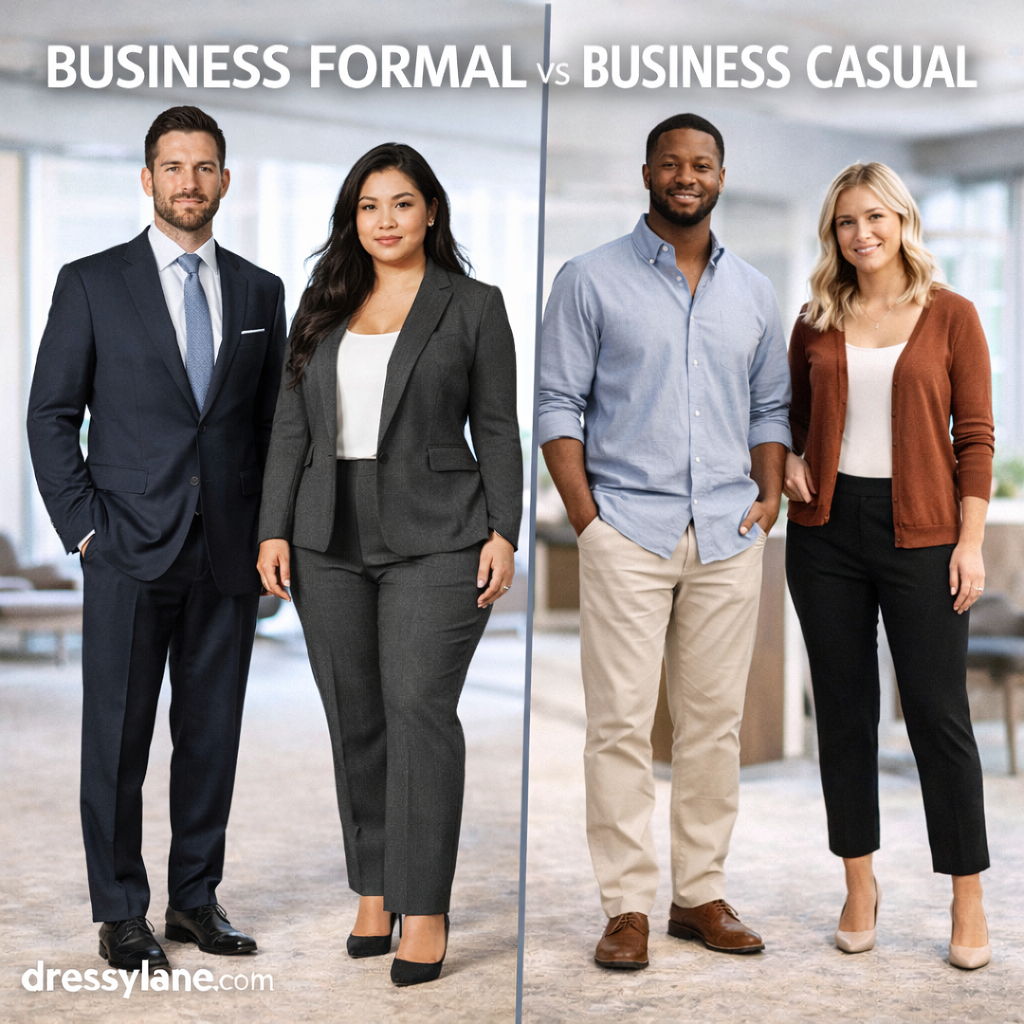
The difference between business formal and business casual often comes down to a few specific pieces. A matching navy suit, crisp dress shirt, tie, and polished Oxford shoes create a business formal outfit. Replace the suit trousers with chinos, remove the tie, and switch to loafers, and you’ve moved into business casual territory.
But knowing which outfit to wear isn’t always straightforward. A financial services office may expect suits for client meetings, while a technology company might consider tailored trousers and a knit sweater perfectly professional.
This guide explains business formal vs business casual, with practical outfit examples for men and women, wardrobe essentials, and advice for choosing the right level of formality.
What Is Business Formal?
Business formal is a traditional professional dress code built around coordinated tailoring, structured silhouettes, and polished accessories.
For men, it typically means a matching suit, dress shirt, tie, and leather dress shoes. For women, a tailored pantsuit, skirt suit, or structured professional dress with an appropriate jacket is a common choice.
Navy and charcoal are particularly versatile suit colors. Wool and wool-blend fabrics work well because they drape cleanly and tend to maintain their shape throughout the day.
When Is Business Formal Expected?
Business formal may be required for:
- Executive and board meetings.
- Interviews at companies with traditional dress expectations.
- Formal presentations and corporate events.
- Certain legal, financial, and government workplaces.
- Client meetings where the organization specifies formal attire.
The important detail is that business formal isn’t automatically required for every senior position or client interaction. Company policy and the occasion should determine your outfit.
If an invitation specifically requests business formal, I’d avoid trying to dress up chinos or jeans with a blazer. A coordinated suit is a more dependable starting point.
What Is Business Casual?
Business casual removes some of the structure of traditional office clothing while maintaining a professional appearance.
Instead of a matching suit, you might wear tailored trousers with a button-down shirt, a blouse with a cardigan, or chinos with an unstructured blazer.
A typical men’s outfit could include charcoal chinos, a light blue Oxford shirt, and brown leather loafers.
For women, black straight-leg trousers, an ivory crepe blouse, and pointed-toe flats create a polished combination without requiring a matching jacket.
Business casual is common in many modern offices, particularly for everyday work, internal meetings, and workplaces with flexible dress policies.
It doesn’t automatically mean jeans and sneakers are acceptable. Those choices depend on the employer’s specific expectations.
Business Formal vs Business Casual: Key Differences
The easiest way to distinguish the two dress codes is to look at the amount of tailoring and coordination involved.
| Clothing | Business Formal | Business Casual |
|---|---|---|
| Jackets | Matching suit jacket | Blazer, sport coat, or cardigan |
| Trousers | Matching suit trousers | Tailored trousers or chinos |
| Shirts | Crisp dress shirts, often with ties for men | Oxford shirts, blouses, knit tops |
| Dresses | Structured professional dresses, often with a jacket | Shirt dresses, tailored or simple midi dresses |
| Shoes | Leather dress shoes, polished flats, or heels | Loafers, flats, low heels |
| Fabrics | Suiting wool, wool blends, structured crepe | Cotton twill, ponte, knits, crepe |
| Overall appearance | Coordinated and traditionally formal | Professional with more flexibility |
Business formal usually relies on a coordinated outfit. Business casual allows you to mix separate pieces, introduce softer fabrics, and use more color or texture.
Neither dress code requires expensive designer clothing. Fit, fabric condition, and appropriate styling make a much bigger difference.
Business Formal vs Business Casual for Men
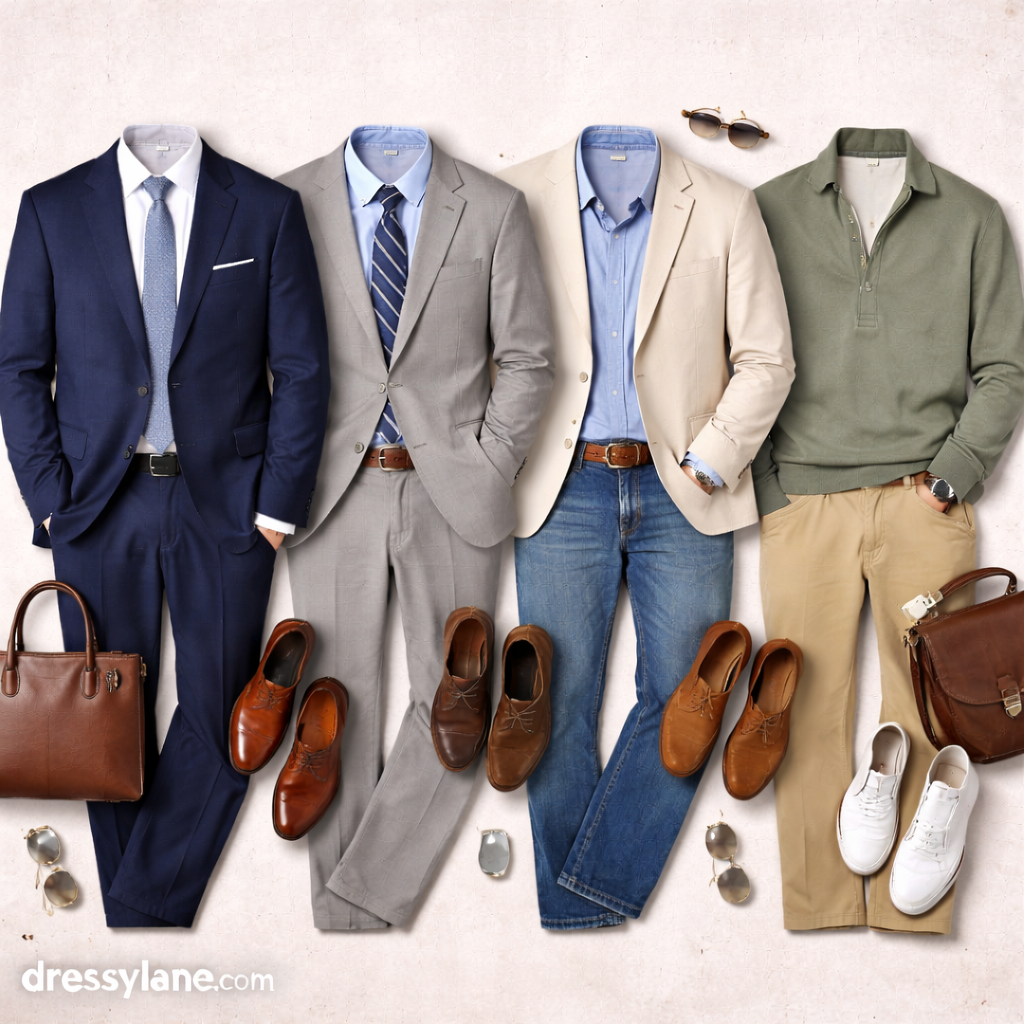
Men can often move between these dress codes by changing just a few wardrobe pieces.
Business Formal: The Matching Suit
Start with a navy or charcoal two-piece suit in lightweight wool or a wool blend.
Add a white or pale blue dress shirt, a silk tie, and black or dark brown leather Oxford shoes.
The jacket and trousers should be made from the same fabric. Two separate navy pieces that are slightly different shades can look mismatched rather than intentionally coordinated.
Pay particular attention to trouser length and jacket shoulders. A well-fitting suit should allow comfortable movement without excessive pulling or bunching.
Business Casual: Tailored Separates
For a less formal office, try:
- Navy cotton-twill chinos.
- A white Oxford button-down shirt.
- A charcoal unstructured blazer.
- Brown leather loafers.
Skip the tie and consider leaving the blazer off during an ordinary desk day.
A fine-gauge merino sweater over a collared shirt is another useful alternative, particularly in cooler weather.
My recommendation: If you’re building a work wardrobe from scratch, invest in a properly fitted navy suit and a separate pair of versatile chinos. Those two purchases cover considerably more situations than buying several inexpensive suits that don’t fit particularly well.
Business Formal vs Business Casual for Women
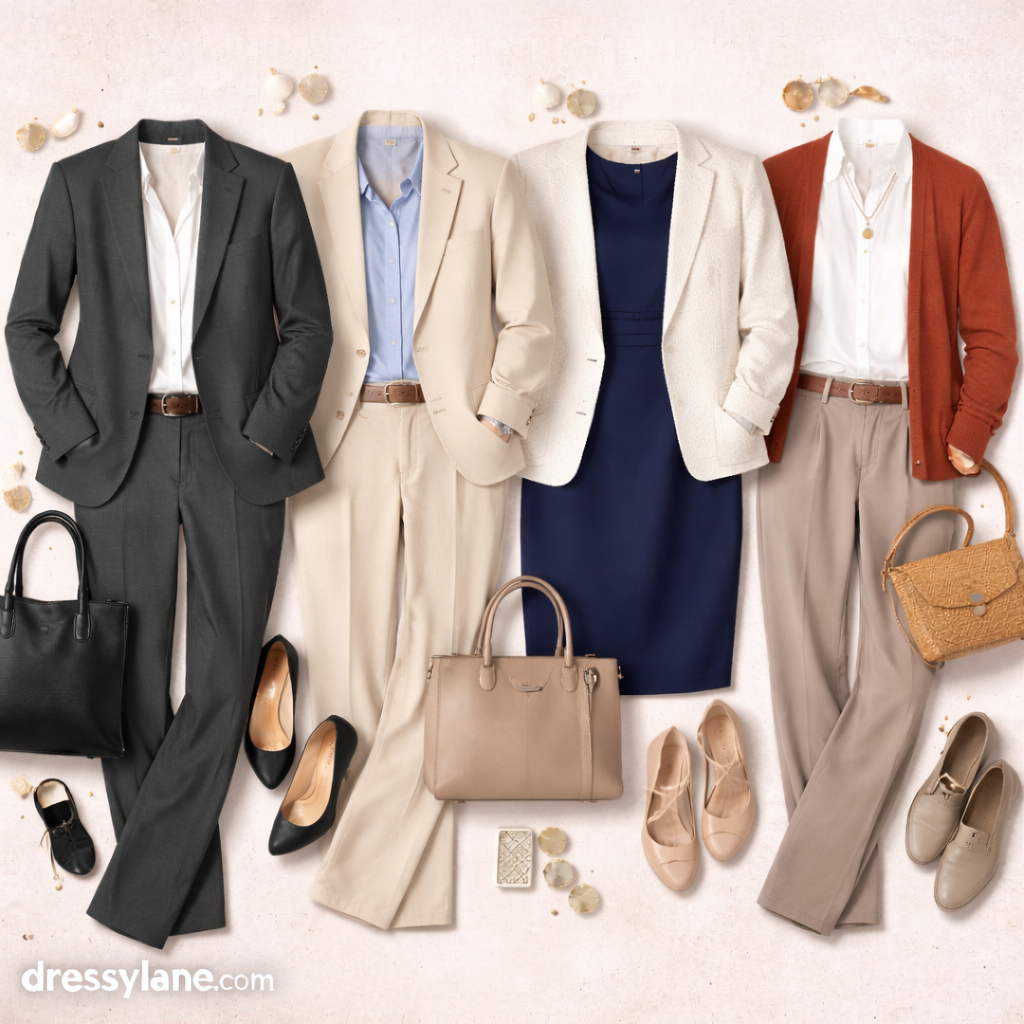
For women, the distinction often comes down to coordinated tailoring, fabric, and how individual pieces are styled.
Business Formal: Coordinated Tailoring
A charcoal pantsuit with straight-leg trousers and a single-breasted blazer is a dependable business formal option.
Pair it with a cream silk or opaque crepe blouse, polished leather flats or low heels, and a structured handbag.
A matching skirt suit is another option, as is a structured dress with a coordinating jacket when appropriate for the workplace.
Choose fabrics that maintain their shape. A lined wool-blend blazer generally creates a sharper silhouette than a thin, unstructured knit jacket.
Business Casual: Polished Separates
For an everyday office outfit, try:
- Black ankle-length trousers.
- A fine-knit ivory sweater.
- A camel cardigan or relaxed blazer.
- Leather loafers or pointed-toe flats.
A midi skirt with a tucked-in blouse also works well, particularly when the skirt has enough structure to hang neatly rather than cling.
One detail I’d prioritize is checking how an outfit fits when sitting down. Trousers that look perfect while standing can pull uncomfortably at the waist, and some skirts ride up considerably when seated.
Comfort shouldn’t be an afterthought, especially for clothing you’ll wear for an entire workday.
Can You Wear the Same Clothes for Both Dress Codes?
Yes, but some pieces transition more easily than others.
A white dress shirt, leather loafers, tailored trousers, and a simple blouse can work in both wardrobes.
A matching suit is more specific to business formal, while chinos, cardigans, and relaxed knitwear are generally associated with business casual.
For example, a woman could wear a matching navy pantsuit and blouse for a formal presentation, then wear the trousers separately with a knit top and loafers for an ordinary office day.
Similarly, a man could wear his suit for a formal meeting and use the jacket separately with contrasting chinos for business casual, provided the jacket’s fabric and cut work as separates.
I’d avoid separating a particularly shiny or heavily structured suit. Some suit jackets look noticeably out of place when paired with casual cotton trousers.
How to Choose the Right Dress Code at Work
Consider the workplace, the occasion, and any instructions you’ve received.
For a job interview, look at the company’s published dress guidance or ask the recruiter if you’re uncertain. A traditional corporate employer may expect a suit, while a more relaxed workplace may consider tailored separates appropriate.
For an important client meeting, follow your organization’s expectations and consider the client’s environment.
If your office normally allows business casual but a formal event is scheduled, don’t assume your everyday outfit will be suitable.
When you genuinely don’t know what to wear, tailored trousers, a collared shirt or blouse, a blazer, and polished shoes provide a useful starting point. Add a coordinated suit and tie, where appropriate, if the occasion requires business formal.
Common Mistakes to Avoid
A few small details can undermine an otherwise appropriate outfit.
- Wearing mismatched suit pieces and assuming they look like a coordinated suit.
- Choosing trousers that drag on the floor or bunch excessively at the ankles.
- Wearing wrinkled shirts or blouses that pull between buttons.
- Assuming expensive sneakers are automatically acceptable for business casual.
- Selecting stiff clothing that restricts movement throughout the workday.
Don’t overlook footwear condition, either. Scuffed leather shoes or worn-down heels can make carefully tailored clothing look less polished.
How Workplace Dress Codes Are Changing
Many workplaces now allow more relaxed clothing than they did when suits were standard daily office attire.
Business casual can include knitwear, softer tailoring, and comfortable footwear, while some employers permit dark denim or minimalist sneakers.
However, formal attire remains relevant wherever a company or event specifically requires it.
Rather than assuming an entire industry follows one dress code, pay attention to the actual workplace. Two companies in the same field may have very different expectations.
Final Thoughts
The main difference between business formal and business casual is the level of structure and coordination.
Business formal generally calls for matching suits, traditional tailoring, and polished footwear. Business casual allows tailored separates, softer fabrics, and more flexibility while remaining suitable for a professional environment.
You don’t need an enormous wardrobe to accommodate both. A well-fitting suit, versatile trousers, quality shirts or blouses, and dependable shoes can cover most situations.
Start with the dress code required for the occasion, then focus on fit, fabric, and comfort. Those details will do more for your appearance than simply choosing the most expensive or formal-looking clothes.