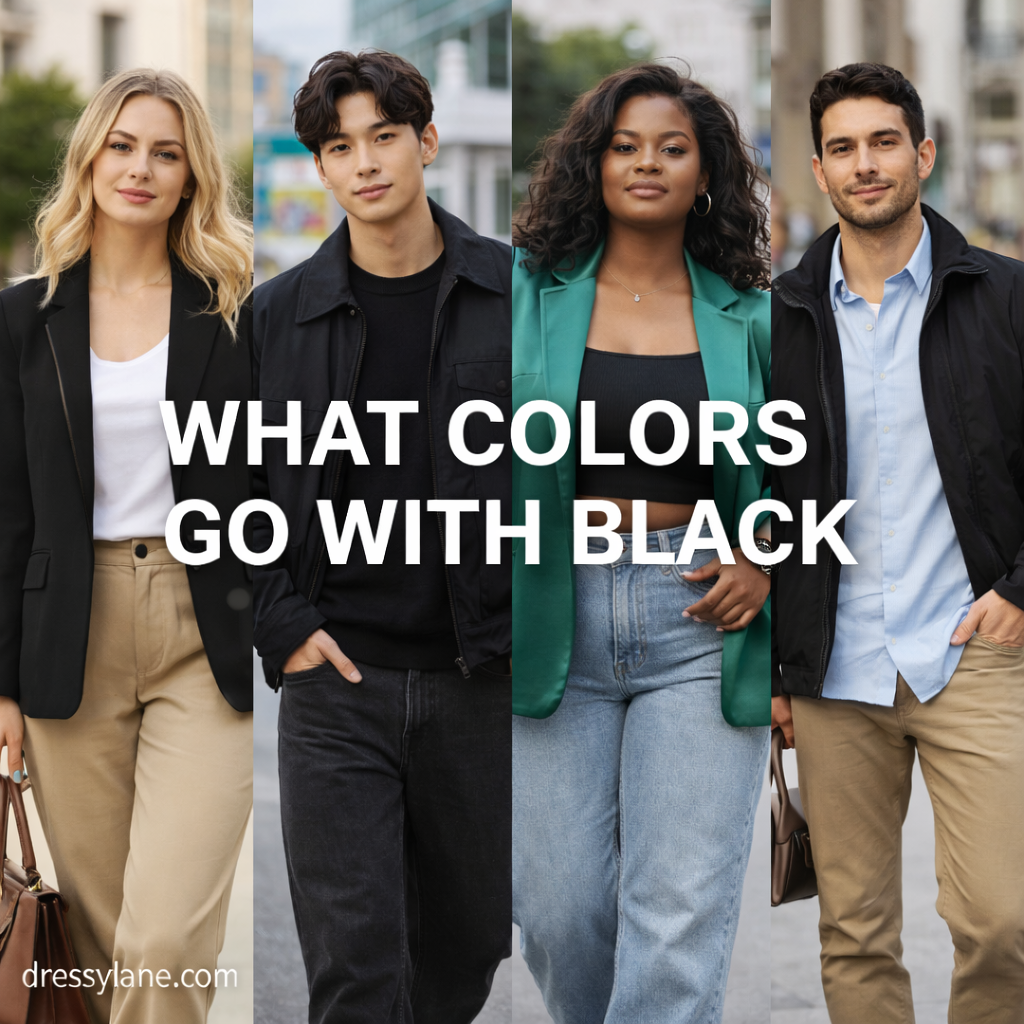
Black goes with almost every color, which is both its biggest advantage and the reason advice about styling it can become unnecessarily complicated.
A black pair of trousers can work with a white Oxford shirt, camel sweater, burgundy knit, olive jacket, pale-blue blouse, or bright red top. The question usually isn’t whether a color “goes” with black. It’s what kind of contrast you want the outfit to have.
White makes black look sharper. Camel warms it up. Gray makes it quieter. Red puts the color front and center.
Once you think about black that way, matching it becomes much easier.
Black and White: High Contrast and Hard to Get Wrong
Black and white is probably the most straightforward combination.
For women, black straight-leg trousers with a crisp white poplin shirt and loafers can work for the office, dinner, or a smart-casual event. A black midi skirt with a fitted white T-shirt gives you the same colors in a more relaxed silhouette.
For men, black trousers with a white Oxford shirt are equally reliable. A white heavyweight T-shirt under a black overshirt or jacket creates a more casual version.
One thing I’d watch is the fabric.
A thin white T-shirt with faded black sweatpants doesn’t have the same effect as a substantial cotton tee with clean black twill trousers. With such a simple color combination, fit and texture become much more noticeable.
Black and Gray: Better With Some Separation
Gray is useful when you want less contrast than black and white.
Charcoal creates a dark tonal outfit, while heather or light gray makes the individual pieces much more distinct.
Try black trousers with a gray merino sweater, or black jeans with a heather-gray sweatshirt and leather sneakers.
I’d avoid worrying about whether black and charcoal are “too close.” They can look excellent together. Just make the difference intentional through texture or shade.
For example, smooth black trousers under a charcoal brushed-wool coat create enough variation even though both colors are dark.
Black and Beige: An Easy Way to Warm It Up
Beige, camel, tan, cream, and taupe all soften black.
A camel wool coat over black trousers and a black knit is one of the easiest ways to break up an all-black outfit without introducing a strong color.
Other combinations include:
- Black jeans + cream sweater
- Black trousers + camel blazer
- Black skirt + beige knit
- Black dress + tan or cognac accessories
- Black chinos + stone-colored overshirt
I’d choose a beige that’s visibly different from your skin tone or surrounding pieces rather than obsessing over whether it has the “correct” undertone.
The contrast with black usually does most of the work.
Black and Blue Absolutely Work Together
The old rule against wearing black and navy together isn’t particularly useful.
They can look very good together—especially when it’s obvious that you meant to combine them.
A navy wool coat over black trousers works. So does a navy sweater with black jeans or a black jacket over a blue shirt.
The combination becomes trickier when the navy is so dark that it looks like mismatched black under certain lighting. If that’s happening, create more separation with fabric or use a clearer medium-to-dark navy.
Lighter blue is even easier.
A pale-blue cotton shirt with black trousers gives you a clean combination for work, while blue denim with a black T-shirt or knit is one of the simplest casual pairings available.
Black and Red: Let One of Them Lead
Red becomes much more prominent next to black.
That can be exactly what you want.
A red crewneck knit with black trousers is strong but uncomplicated. A burgundy blouse with a black midi skirt gives you a quieter version of the same idea.
If bright red feels like too much, move toward:
- Burgundy
- Wine
- Oxblood
- Brick red
- Deep cherry
I’d usually stop after introducing the red. Black trousers, a red top, black shoes, and a neutral bag need very little else.
Adding another equally strong color can turn a clean two-color outfit into something much busier.
Black and Green: Olive for Casual, Emerald for Dressier Outfits
Olive and black are particularly easy to wear casually.
Think black jeans, a white or gray T-shirt, and an olive utility jacket. Or black trousers with an olive knit and dark leather shoes.
Forest green creates more richness, especially with wool and heavier fall fabrics.
Emerald is brighter and can look excellent for evening outfits—a black skirt with an emerald satin blouse, for example, or a black suit with a deep-green shirt when the setting allows something less traditional.
Green doesn’t have to be treated as an accent. A substantial green top or jacket can easily become the main color.
Black and Pink: From Pale to Saturated
Pale pink softens black considerably.
A blush knit with black trousers is an easy combination if you want contrast without the starkness of white. Dusty rose has a similar effect.
But bright pink works too.
A saturated pink shirt or sweater with black trousers can look sharper than trying to soften the color with several other pastels.
I wouldn’t automatically avoid strong pink simply because black is already a strong neutral. In many cases, black is exactly what makes a vivid color easier to wear.
Black With Brown Isn’t a Mistake Either
Black and brown are another combination people are sometimes told not to wear together.
Again, I’d ignore the rule.
Chocolate brown with black can look especially good because the difference is subtle but visible. A brown suede jacket over a black knit and black jeans is a good example.
Cognac and tan create more obvious contrast.
The same principle applies to accessories. Brown shoes aren’t automatically wrong with black clothing, although the formality and overall outfit matter.
With a black business suit, black shoes are usually the cleaner traditional choice. With black jeans or casual trousers, brown boots can work extremely well.
How Women Can Build Outfits Around Black
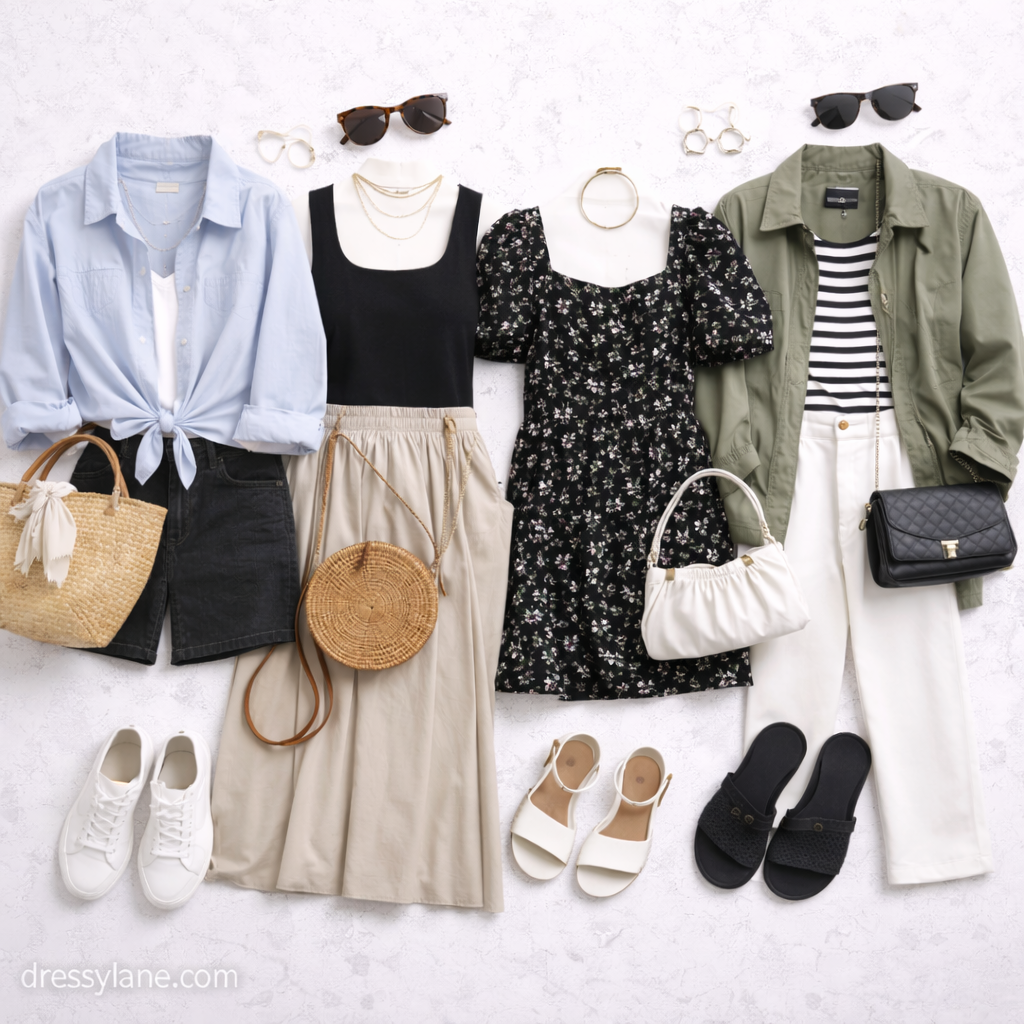
Black trousers, skirts, dresses, and outerwear give you plenty of room to introduce color elsewhere.
Some combinations I’d actually wear repeatedly are:
- Black trousers + white poplin shirt + loafers
- Black jeans + camel sweater + ankle boots
- Black midi skirt + burgundy knit + black shoes
- Black dress + emerald or red accessories
- Black trousers + pale-blue blouse + flats
- Black jeans + olive jacket + white T-shirt
- Black skirt + cream sweater + brown boots
A black dress is especially useful because changing the shoes, bag, jewelry, or outer layer can completely change the color story.
You also don’t need colorful accessories simply because the dress is black. Black shoes and a black bag can look deliberate if texture provides enough interest—smooth leather, suede, satin, knitwear, or metal jewelry.
How Men Can Build Outfits Around Black
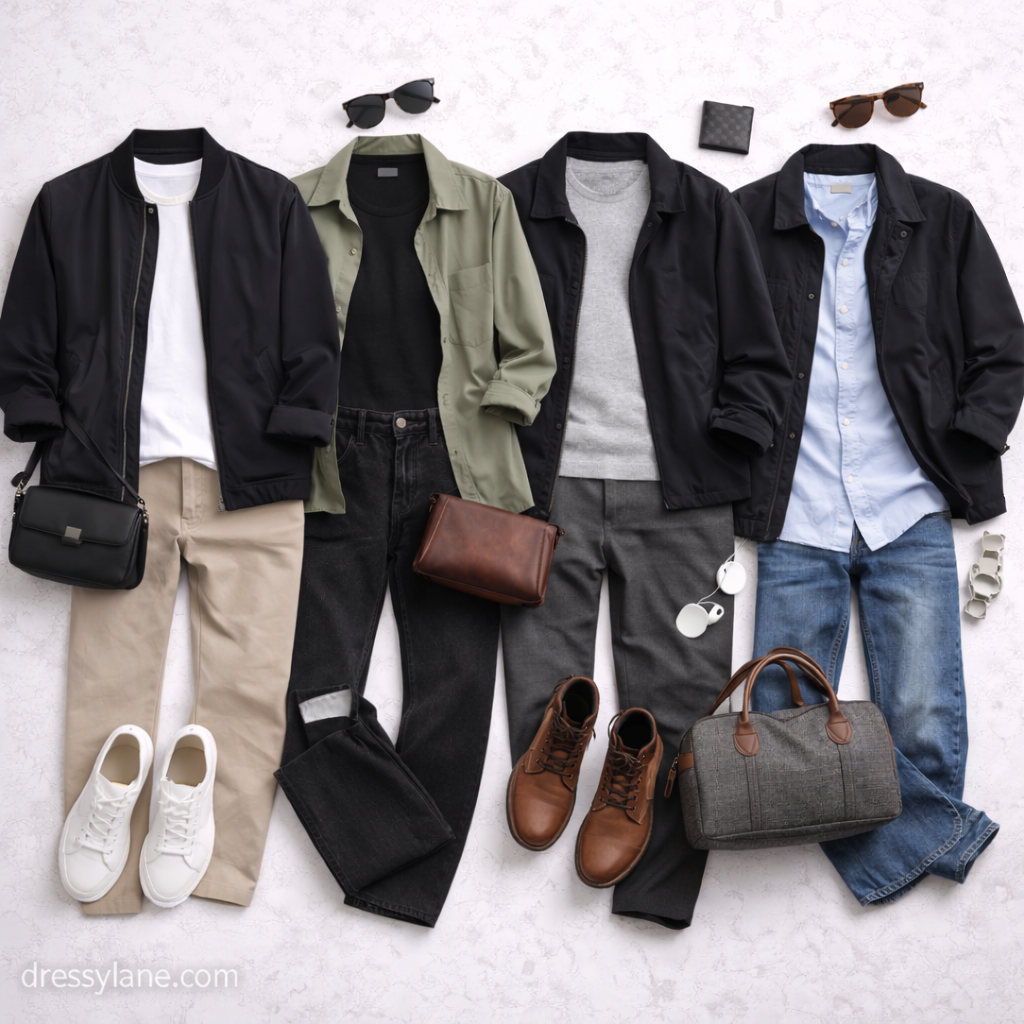
For men, black works particularly well in casual and evening wardrobes.
Try:
- Black jeans + gray merino sweater + boots
- Black trousers + white Oxford shirt + loafers
- Black chinos + olive overshirt + white T-shirt
- Black jeans + camel knit + dark sneakers
- Black trousers + burgundy polo
- Black jacket + navy sweater + gray trousers
I’d be slightly more selective with black in traditional business settings. Navy and charcoal suits are often more versatile during the daytime, while black can feel more severe depending on the workplace.
That doesn’t make black unsuitable. It simply means the garment and occasion matter as much as the color pairing.
Pastels Work Better With Black Than You Might Expect
Baby blue, lavender, mint, blush, and other pale colors create strong contrast against black.
The effect is noticeably different from pairing those colors with cream or beige.
A lavender knit with beige trousers looks soft throughout. Put the same lavender knit over black trousers and the lavender becomes much more noticeable.
That’s useful when a pastel normally feels too delicate for your taste.
I’d keep the rest of the outfit fairly simple and let that light-dark contrast be the main feature.
Bright Colors and Neon Aren’t Automatically Wrong
Black is actually one of the easiest neutrals to use with very bright colors because it gives them a clear background.
Cobalt, orange, hot pink, vivid green, and yellow can all work.
Even neon can work when that’s genuinely the look you’re going for.
The issue is usually quantity rather than the color itself.
Black trousers with a cobalt sweater are straightforward. Black jeans with a bright-orange jacket can be intentional and striking. But combining black with several competing saturated colors requires much more styling.
If you’re unsure, use one strong color and let black handle most of the rest.
All-Black Outfits Need Texture More Than Color
You don’t actually have to pair black with another color.
An all-black outfit can work extremely well.
The trick is preventing the individual pieces from disappearing into one flat block.
Try combining different surfaces:
- Black denim with a wool sweater
- Matte trousers with a silk or satin blouse
- Cotton jersey with a leather jacket
- Wool trousers with a fine-gauge knit
- Suede shoes with black twill pants
You can also mix slightly different blacks. Cotton, wool, denim, leather, and satin rarely appear exactly the same shade anyway.
I’d rather intentionally mix those textures than spend time trying to make every black garment match perfectly.
Does Black Change With the Seasons?
Black itself doesn’t need to change. The fabrics and surrounding colors can.
During spring and summer, black works well with white, pale blue, cream, pink, light denim, and brighter colors. Linen, cotton, poplin, lightweight jersey, and sandals or low-profile sneakers keep the outfit from feeling unnecessarily heavy.
During fall and winter, black naturally pairs with camel, burgundy, forest green, chocolate brown, charcoal, and heavier navy.
A black linen dress and a black wool coat are technically the same color, but they communicate completely different seasons.
Final Thoughts
So, what colors go with black?
Almost all of them.
White, gray, beige, camel, brown, navy, blue, red, burgundy, green, pink, pastels, and brighter colors can all pair successfully with black.
Instead of asking whether a color is permitted, think about what you want it to do.
Choose white for sharp contrast, camel or brown for warmth, gray for a quieter palette, navy for subtle depth, or red and green when you want the color to become a stronger part of the outfit.
And don’t assume black always needs another color to make it interesting.
Sometimes a black outfit built from denim, wool, leather, cotton, or satin has enough variation on its own.
Black’s real advantage isn’t that it magically makes everything stylish. It’s that it gives you a dependable background against which almost any other color can work.