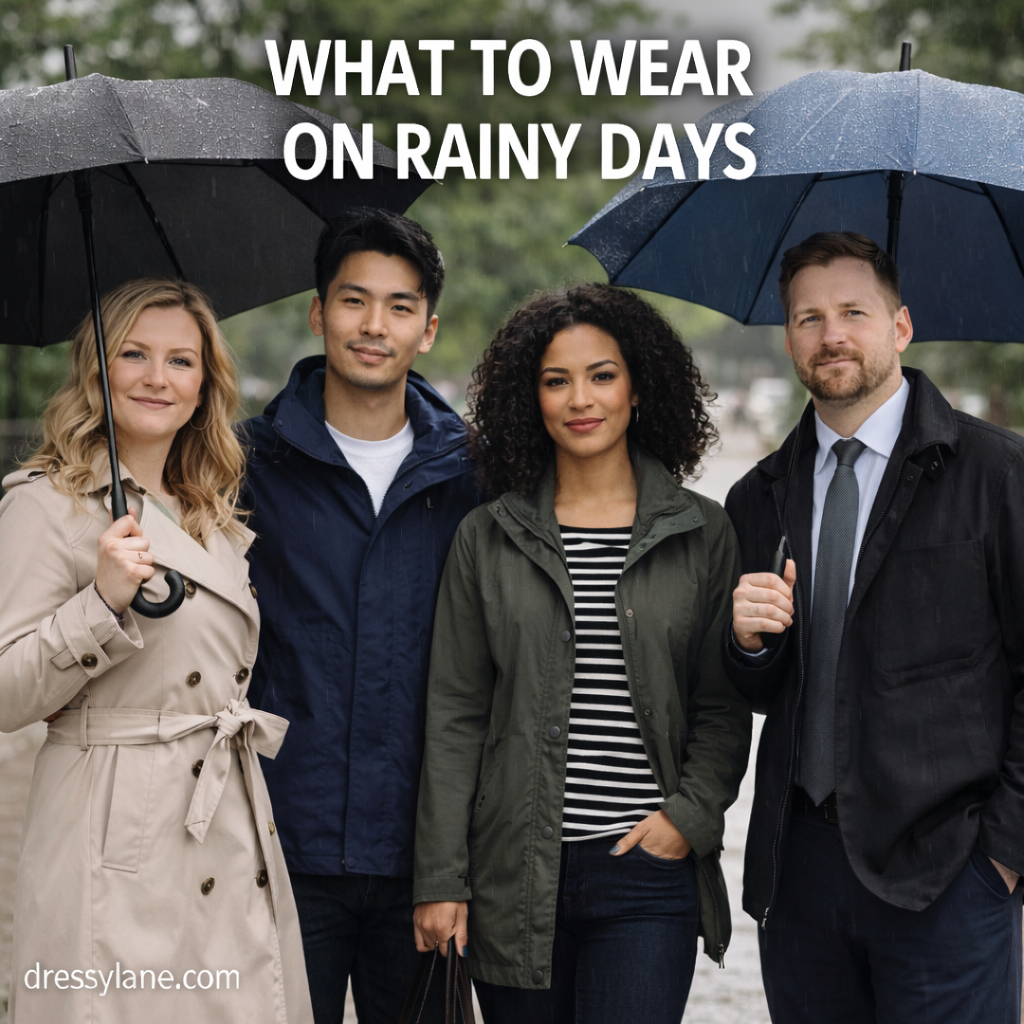
A rainy-day outfit has to solve a few problems that an ordinary outfit doesn’t: water coming from above, puddles and spray coming from below, and the possibility that you’ll move between damp outdoor weather and a warm indoor space.
That doesn’t mean dressing head to toe in technical rain gear every time there’s drizzle in the forecast.
For most everyday situations, knowing what to wear on rainy days comes down to protecting your outermost layer, keeping hems away from wet pavement, and wearing shoes with enough traction for slick surfaces.
A trench over normal work clothes may be enough for light rain. A day of steady rain and walking requires something more substantial.
Start With the Shoes
On rainy days, I often choose shoes before the rest of the outfit.
There’s a practical reason: wet feet are much harder to ignore than a few drops of water on your jacket.
For steady rain, waterproof or water-resistant ankle boots are one of the most versatile options. Rubber soles with visible tread are useful when sidewalks, tile floors, and transit platforms become slippery.
Other options include:
- Waterproof boots
- Weather-resistant leather boots
- Rubber-soled loafers or dress shoes
- Water-resistant sneakers
- Traditional rain boots for genuinely wet conditions
I’d avoid wearing brand-new leather shoes on a day when heavy rain is expected. Even if the leather can handle some moisture, you probably don’t want the first real test to involve puddles and several hours outside.
Suede requires more caution too. Properly treated suede can handle occasional moisture better than its reputation suggests, but when I know I’ll be walking through sustained rain, I’d still choose smooth leather, rubber, or another less delicate material.
Your Raincoat Should Match the Amount of Rain
A classic trench is excellent for light rain, commuting, and situations where you want outerwear that still looks appropriate with office clothes.
For heavier rain, however, actual water-resistant or waterproof construction becomes more important.
Look for features such as:
- A water-resistant or waterproof shell
- A hood that stays in place
- Secure front closures
- Adjustable cuffs
- Enough length to protect your upper legs
- Sealed or protected seams when serious rain protection is needed
I’d choose a functional rain jacket over an umbrella alone when it’s both windy and wet. An umbrella becomes much less useful once rain starts blowing sideways.
Fit matters as well. Your raincoat should have enough room for whatever you’ll realistically wear underneath it without pulling across the shoulders.
Keep Your Hemlines Away From Puddles
This is one of the simplest rainy-day adjustments and one of the most useful.
Very long wide-leg trousers can look great indoors and become frustrating the moment the hems start brushing wet pavement.
On rainy days, ankle-length or slightly cropped trousers are easier to manage.
For women, midi skirts can also work well as long as the hem clears the ground comfortably. A skirt with tights and waterproof ankle boots is often more practical than floor-skimming trousers during steady rain.
For men, straight or gently tapered chinos and trousers are usually easier than extra-long, heavily pooled pants.
I wouldn’t choose rainy weather as the day to experiment with a dramatic puddle-length trouser—especially if you’ll actually encounter puddles.
What Women Can Wear on Rainy Days
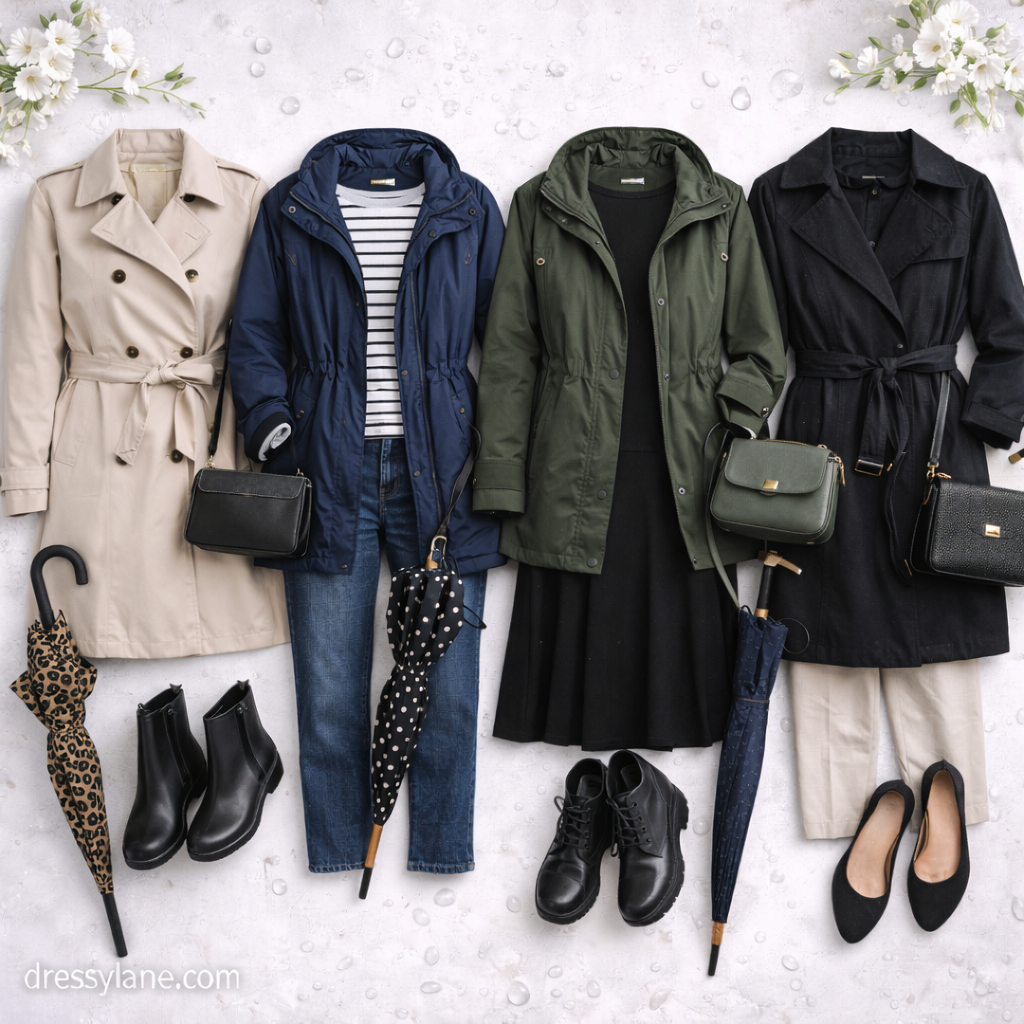
A simple women’s rainy-day outfit might be:
Ankle-length trousers + lightweight knit + trench + waterproof ankle boots.
For something more casual:
Straight-leg jeans + cotton T-shirt + rain jacket + weather-resistant sneakers.
Other practical combinations include:
- Midi skirt + fine sweater + tights + ankle boots
- Cropped trousers + button-down + trench + loafers with rubber soles
- Knit dress + raincoat + knee-high weather-resistant boots
- Straight jeans + cardigan + hooded shell + sneakers
I’d be careful with very full maxi skirts and dresses when heavy rain is expected. Even if the top half stays dry, a long hem can pick up water from sidewalks, stairs, and puddles.
Your bag deserves consideration too. A coated canvas, nylon, or other water-resistant bag is less stressful than carrying a delicate untreated leather or suede bag through a downpour.
What Men Can Wear on Rainy Days
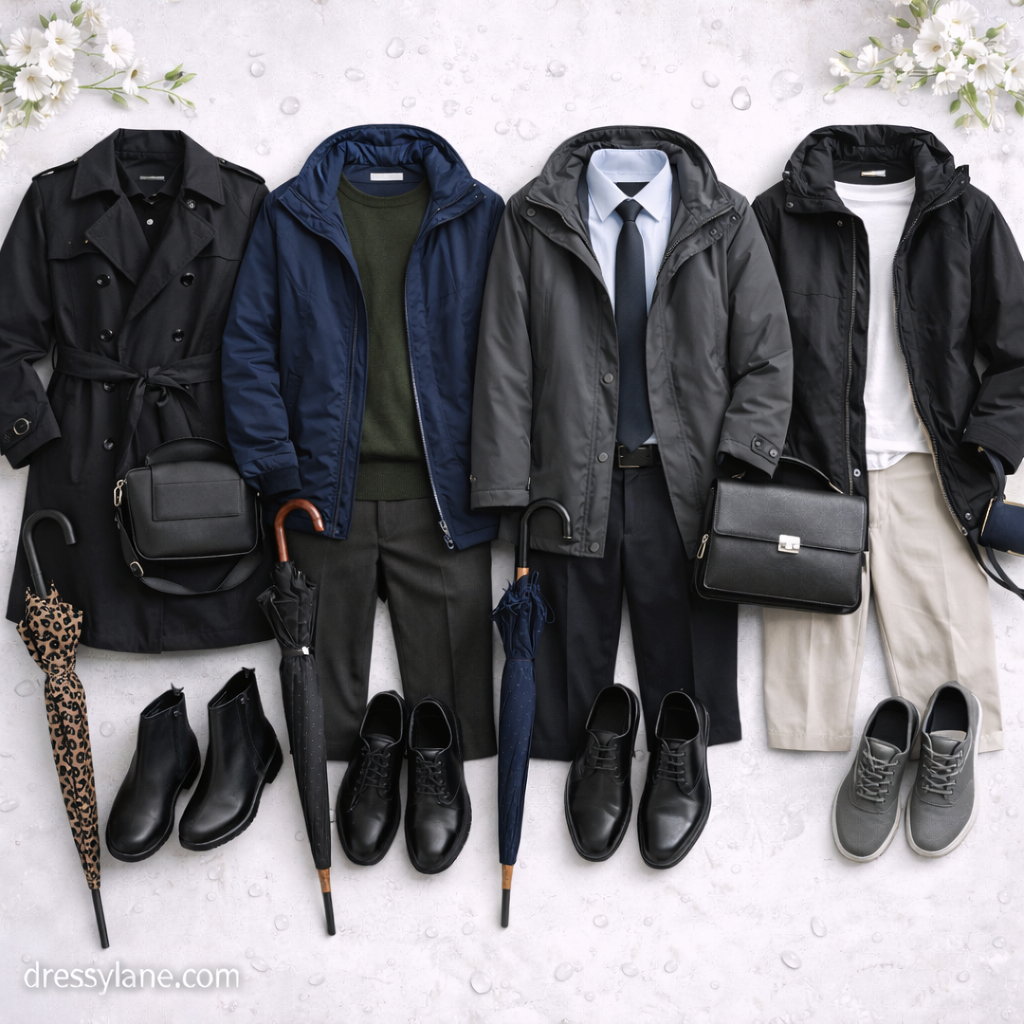
For men, one of the easiest combinations is:
Oxford shirt + chinos + raincoat + weather-resistant leather boots.
It works for commuting and still looks normal once the raincoat comes off indoors.
For casual days, try:
Lightweight sweater + straight jeans + waterproof shell + weather-resistant sneakers.
Other options include:
- Polo + lightweight trousers + trench + rubber-soled loafers
- Button-down + merino crewneck + raincoat + boots
- T-shirt + overshirt + water-resistant shell + sneakers
I’d choose straight or gently tapered trousers over extremely wide hems when sidewalks are wet. The goal isn’t necessarily a slim silhouette—it’s simply keeping excess fabric from collecting water around your shoes.
For work, a longer raincoat can also protect more of your trousers than a waist-length jacket.
Choose Fabrics Based on What Gets Wet
Your outermost layer takes most of the weather, so that’s where water resistance matters most.
Nylon and polyester shells are commonly used for rainwear because they can be engineered for water resistance and dry relatively quickly. Treated cotton can also work for lighter rain.
Underneath, ordinary clothing is usually fine if your outer layer provides enough protection.
Wool is useful in cool, damp conditions because it can continue providing insulation when somewhat damp, but that doesn’t make a wool coat waterproof.
I wouldn’t deliberately expose a favorite wool coat to a prolonged downpour simply because wool handles moisture better than some fabrics.
Likewise, heavy denim isn’t necessarily disastrous in rain—it just becomes unpleasant once saturated because it can take a long time to dry.
Warm Rain and Cold Rain Need Different Outfits
A 75°F summer shower and a 40°F winter rain shouldn’t be dressed for the same way.
Warm Rain
Keep the layers minimal.
Try a lightweight T-shirt or breathable shirt with trousers or shorts and a thin waterproof shell. A heavy lined raincoat can become clammy very quickly in warm, humid conditions.
Look for ventilation where possible, especially if you’ll be walking.
Cold Rain
This is when insulation matters.
A merino sweater underneath a waterproof or highly water-resistant outer layer can provide warmth without requiring an enormous number of layers.
Cold rain can feel especially uncomfortable when wind is involved, so a shell that blocks both water and wind is useful.
I’d rather wear a proper waterproof outer layer over one good insulating layer than stack several sweaters underneath a coat that gradually soaks through.
Don’t Forget About Traction
Rainy-day footwear isn’t only about keeping water out.
Wet painted surfaces, smooth stone, tile entrances, metal grates, and fallen leaves can all become slippery.
Look at the outsole before deciding whether a shoe is genuinely suitable for rain.
A smooth leather sole may look polished but provide very little grip on a wet sidewalk. Rubber soles with some texture are generally more practical.
This becomes even more important if your rainy commute involves stairs or public transportation.
The Umbrella Still Matters
A raincoat protects your clothes, but an umbrella can keep water away from your face, hair, bag, and much of your lower body.
For commuting, I prefer an umbrella large enough to provide meaningful coverage rather than the tiniest possible model that fits in a pocket.
A compact umbrella is convenient to carry, but check that it feels reasonably sturdy when opened.
On windy days, however, prioritize your raincoat. Fighting with an umbrella that’s constantly turning inside out is rarely worth it.
What I’d Leave at Home
For a genuinely wet day, I’d generally avoid:
- Floor-length trousers or dresses
- Untreated suede shoes
- Delicate silk exposed to the weather
- Shoes with very smooth soles
- Heavy denim if it’s likely to become soaked
- Open bags that can’t protect what’s inside
- Outerwear that absorbs water quickly
You don’t have to treat every garment as fragile. The point is to avoid pieces that become uncomfortable, difficult to clean, or impractical once wet.
Build One Reliable Rainy-Day Combination
You don’t need an entire wardrobe dedicated to rain.
For most people, a dependable rain setup can be surprisingly small:
One good raincoat + one pair of weather-resistant shoes + one umbrella.
Choose neutral, versatile versions and they can work over most of the clothes you already own.
If you walk or use public transportation frequently, investing in better rain protection makes more sense than it does for someone who mainly moves between a car and indoor spaces.
That’s the practical question I’d ask before buying specialized rainwear: how much time do you actually spend outside when it rains?
Final Thoughts
Knowing what to wear on rainy days isn’t about replacing your normal style with waterproof clothing. It’s about protecting the parts of your outfit most likely to cause problems when they get wet.
Start with shoes that provide traction and can tolerate moisture. Keep trouser and skirt hems away from puddles, then add a trench, raincoat, or waterproof shell appropriate for the amount of rain you’re expecting.
For light showers, normal clothes underneath a trench may be all you need. For prolonged cold rain, combine proper weather protection with an insulating layer. And when wind is involved, don’t rely on the umbrella to do all the work.
The best rainy-day outfit is one you can wear through the weather, take off the outer layer when you arrive, and continue with your day without thinking about the rain anymore.