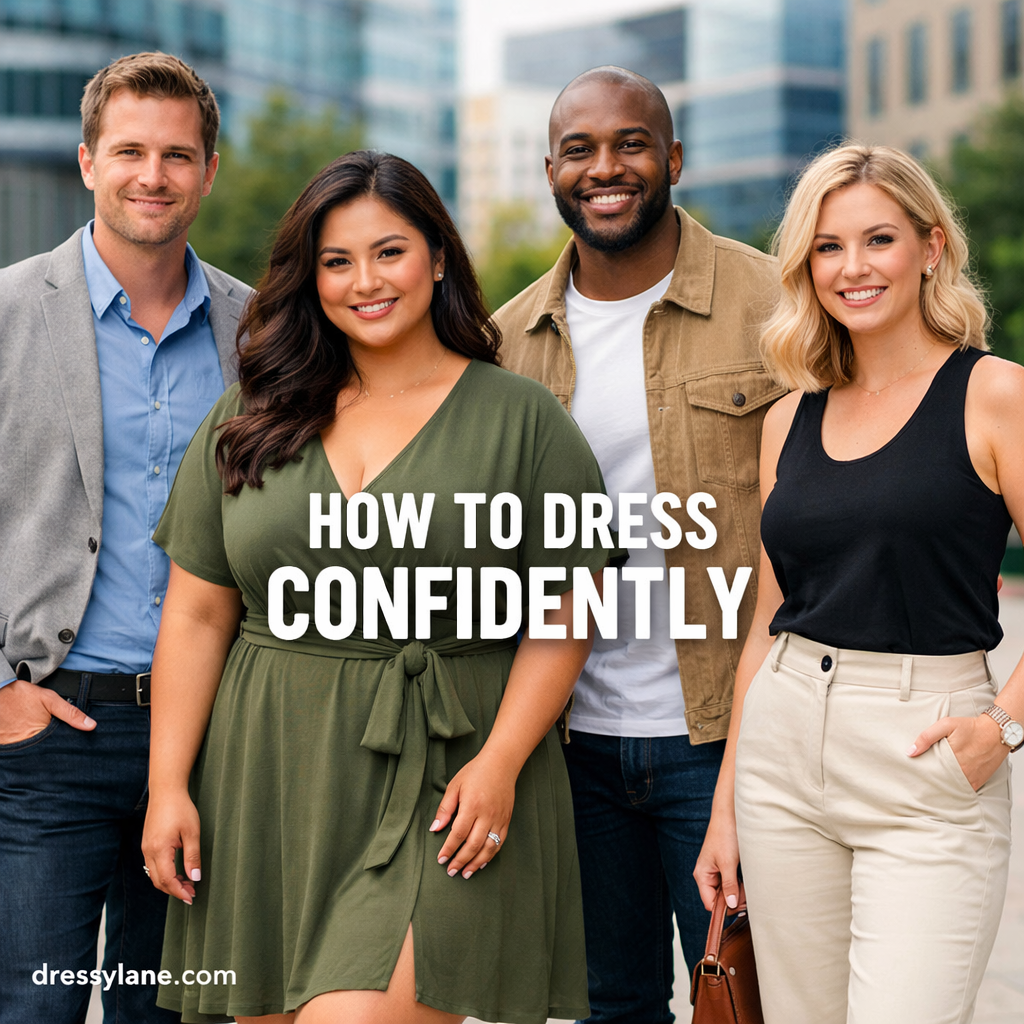
Dressing confidently is not about wearing expensive clothes, following every trend, or trying to become the best-dressed person in the room. In everyday life, confidence usually comes from something much simpler: knowing that your clothes fit, suit the situation, feel comfortable, and look like they belong to you.
A confident outfit should let you get on with your day.
You should be able to walk into work, meet someone for dinner, attend an event, run errands, or spend time with friends without repeatedly wondering whether your shirt is pulling, your shoes look wrong, or everyone else is dressed differently.
That kind of confidence is something you can build.
This guide covers how to dress confidently for everyday life, how to develop calm rather than attention-seeking confidence, how to dress confidently at any age, and how both women and men can build a wardrobe they trust.
What Does It Mean to Dress Confidently?
Confident dressing is less about a particular aesthetic and more about the relationship you have with your clothes.
Someone in jeans and a T-shirt can look completely confident. So can someone in a tailored suit, colorful dress, linen trousers, or minimalist black outfit.
The common denominator is usually intentionality.
Your clothes:
- Fit your body properly
- Feel physically comfortable
- Suit what you are doing
- Reflect your personal taste
- Do not require constant adjusting
- Feel appropriate for the setting
- Work together as an outfit
You are not spending the day fighting them.
Confidence also does not require being particularly interested in clothing. If fashion has never been your thing, our guide to how to dress when you don’t like fashion explains how to build a functional wardrobe without turning fashion into a hobby.
Start With Fit, Not Trends
One of the fastest ways to feel uncertain in an outfit is to wear something that does not fit properly.
A beautiful jacket that pulls across the shoulders will probably bother you all day. Trousers that continually slide down will make you adjust them every time you stand. A shirt that feels too tight across the chest can make you unusually conscious of your body.
Proper fit removes those distractions.
Check these areas first
For shirts, jackets, and tops, look at:
- Shoulder placement
- Chest and bust
- Sleeve length
- Arm movement
- Whether buttons pull
- Whether the garment rides up
For trousers and jeans, check:
- Waist comfort when sitting and standing
- Room through the hips and thighs
- Rise
- Hem length
- Whether the waistband stays in place
Fit does not mean tight.
A relaxed shirt can fit correctly. So can wide-leg trousers or an oversized jacket. The important distinction is whether the volume looks intentional and allows you to move comfortably.
If body comfort is part of what makes getting dressed difficult, read our guide to dressing to feel comfortable in your body.
Build Confidence Around Your Real Lifestyle
A confident wardrobe should belong to the life you actually live.
It is easy to buy clothes for an imagined version of yourself: elaborate evening clothes when you rarely attend formal events, uncomfortable office shoes when you walk to work, or highly styled pieces when you prefer getting dressed in five minutes.
Instead, look at an ordinary month.
Where do you actually go?
Perhaps your life mostly includes:
- An office
- Working from home
- School or university
- Commuting
- Client meetings
- Errands
- Casual restaurants
- Family activities
- Religious or community events
- Dates
- Social gatherings
Build around those situations first.
If 80 percent of your life is casual, most of your wardrobe should probably support casual dressing. You can still keep dressier clothing for the remaining occasions.
Knowing how to choose an outfit that fits the situation removes much of the uncertainty that people mistake for a lack of fashion confidence.
Develop a Personal Style You Can Actually Repeat
You do not need a dramatic “signature style.”
Start by identifying patterns in the clothes you already enjoy wearing.
Maybe you consistently prefer:
- Straight-leg trousers
- Crew-neck T-shirts
- Midi dresses
- Button-down shirts
- Knit polos
- Cardigans
- Denim jackets
- Loafers
- Clean sneakers
- Neutral colors
That information is valuable.
Instead of constantly buying something different, build outward from the silhouettes you already trust.
For example, someone who loves straight-leg jeans and simple tops might expand into straight-leg chinos, wool trousers, linen trousers, knit tops, Oxford shirts, and different jackets without abandoning the basic proportions they like.
Confidence often grows through familiarity.
Build a Reliable Color Palette
A cohesive color palette makes getting dressed easier because more of your clothes naturally work together.
You do not need to wear only neutrals, but they make useful foundations.
Common base colors include:
- Navy
- Black
- Charcoal
- Gray
- White
- Cream
- Beige
- Camel
- Brown
- Olive
Then add colors you genuinely enjoy.
That might mean burgundy, forest green, cobalt blue, rust, pink, lavender, or something brighter.
For example, a wardrobe built around navy, cream, gray, and olive could easily incorporate burgundy as an accent.
The goal is not to determine which colors you are “allowed” to wear. It is to make combinations easier.
If a smaller, more coordinated wardrobe appeals to you, see our guide to how to dress for minimalist style.
Create Go-To Outfit Formulas
Confidence suffers when every morning starts with experimentation.
A few reliable outfit formulas remove that pressure.
Everyday formulas for women
Relaxed everyday
Straight-leg jeans + cotton T-shirt + cardigan + sneakers
Polished casual
Wide-leg trousers + knit top + loafers + structured bag
Work
Tailored trousers + blouse or fine-knit top + blazer + flats or low heels
Easy dress outfit
Midi dress + lightweight jacket or cardigan + simple shoes
Everyday formulas for men
Relaxed everyday
Straight-leg jeans + cotton T-shirt + overshirt + sneakers
Smart casual
Chinos + knit polo + loafers
Work
Wool-blend trousers + Oxford shirt + unstructured blazer + leather shoes
Weekend
Dark jeans + crew-neck sweater + casual jacket + sneakers
These are starting points rather than rules.
Once you discover combinations you trust, repeat them. Change the color, texture, jacket, or shoes rather than reinventing the entire outfit.
For more combinations, see how to build simple outfits that always work.
How to Dress With Calm Confidence
Not all confident dressing needs to attract attention.
In fact, some of the most convincing outfits are quiet.
Calm confidence means looking comfortable and intentional without appearing as though you spent the entire morning trying to impress everyone around you.
A calm outfit often relies on:
- Simple silhouettes
- Good fit
- Coordinated colors
- Limited accessories
- Clean footwear
- One clear focal point, if any
Imagine navy trousers, a cream knit, brown loafers, and a simple watch. Or straight-leg jeans, a white shirt, a camel cardigan, and clean sneakers.
Nothing needs to shout.
Avoid adding something just because the outfit feels “too simple”
This is one of the easiest ways to overstyle an outfit.
If your trousers fit well, your shirt looks good, and your shoes make sense, you may already be finished.
You do not automatically need another necklace, scarf, belt, jacket, hat, or statement accessory.
Simple and incomplete are not the same thing.
How to Dress for Everyday Confidence
The clothing that matters most is not necessarily what you wear to weddings or important meetings. It is what you wear repeatedly.
Everyday confidence comes from reducing small sources of friction.
Prepare for your actual day
Think about what you will be doing before choosing an outfit.
If you are walking extensively, wear shoes that can handle it.
If you will move between hot weather and strong air conditioning, bring a layer.
If you have a meeting after a casual morning, choose an outfit that can be elevated with a jacket or shoe change.
Keep your everyday clothes in good condition
A basic outfit immediately feels less confident when:
- A collar is stretched
- Shoes are dirty
- Knitwear is badly pilled
- A button is missing
- Trousers drag on the ground
- A white shirt has become gray
- A hem is coming undone
You do not need expensive replacements. Basic clothing that is clean, properly fitted, and maintained usually looks better than expensive clothing that has been neglected.
How Women Can Dress More Confidently
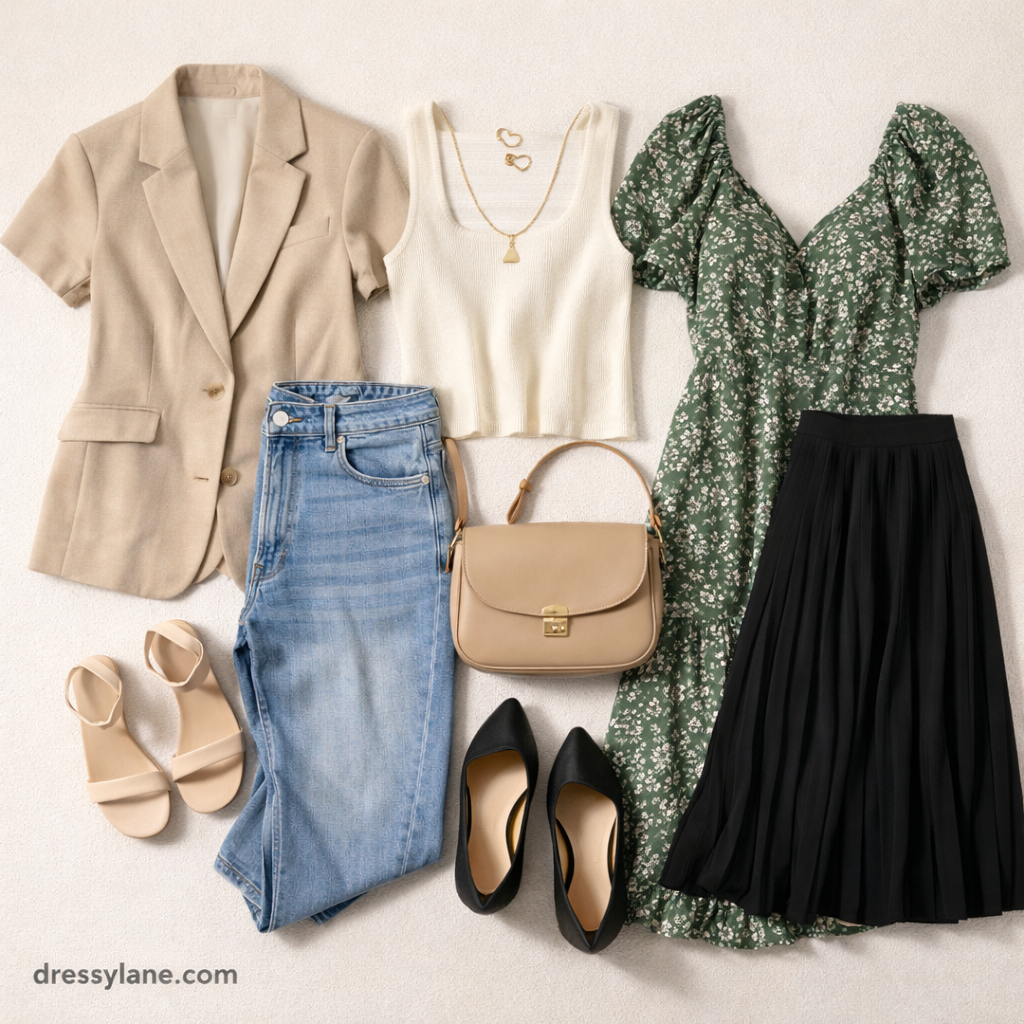
There is no single silhouette that makes women look confident.
The better approach is to identify which shapes make you feel secure and allow you to move naturally.
Useful foundations might include:
- Straight or wide-leg trousers
- Dark jeans
- Soft knit tops
- Button-down shirts
- Midi dresses
- Cardigans
- Blazers
- Simple skirts
- Flats, loafers, boots, or sneakers
If a fitted dress makes you spend the evening pulling at the hem, it is probably not a confidence-building garment for you.
If a looser midi dress lets you forget about your clothing and focus on the people around you, that may be a much better choice.
The same applies in reverse. Some women feel better in defined, tailored silhouettes than loose clothing.
The objective is not to hide your body or display it. It is to find proportions in which you feel comfortable being seen.
How Men Can Dress More Confidently
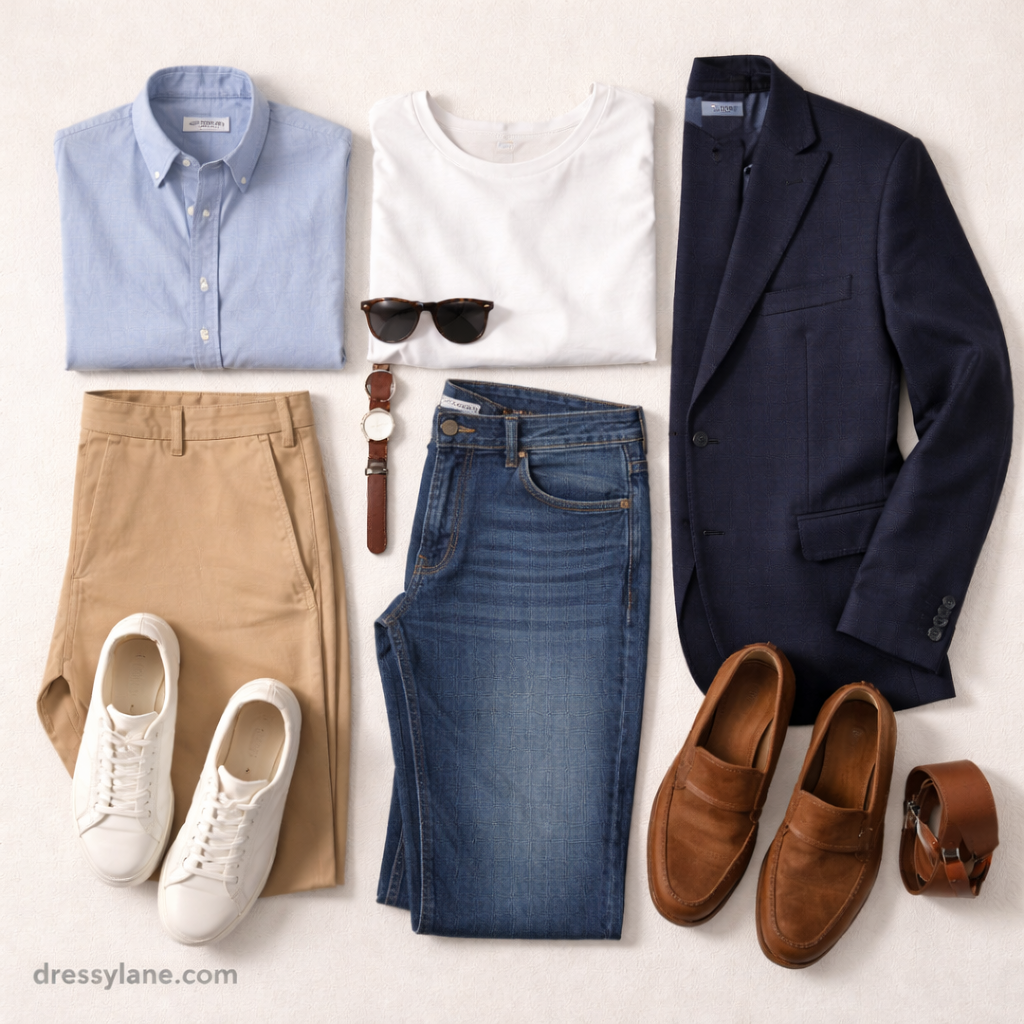
Men’s wardrobes can become unnecessarily complicated when confidence is confused with formality.
You do not need to wear a blazer everywhere.
Start with dependable basics:
- Well-fitting T-shirts
- Oxford or casual button-down shirts
- Knit polos
- Straight or tapered jeans
- Chinos
- Wool-blend trousers
- Crew-neck sweaters
- Overshirts
- Casual jackets
- Clean sneakers
- Loafers or simple leather shoes
Pay particular attention to trouser length, shoulder fit, and shoes.
These details affect an outfit considerably without requiring anything flashy.
Grooming also contributes to the overall impression. Clothing looks more intentional alongside clean shoes, tidy hair, maintained facial hair, and clothes that are clean and pressed where appropriate.
Dress With Confidence at Any Age
Personal style does not expire.
There is no birthday at which you suddenly have to stop wearing jeans, sneakers, bright colors, fitted clothing, leather jackets, dresses, or anything else you enjoy.
What often changes with age is not what you are allowed to wear but what you value from your clothing.
You may become more selective about:
- Fabric quality
- Shoe comfort
- Construction
- Fit
- Versatility
- Ease of care
- How long something will last
Those are useful changes.
Don’t dress younger or older—dress like yourself now
Trying deliberately to “dress younger” can create as much self-consciousness as following rigid age rules.
Instead, ask whether the garment works for:
- Your body now
- Your lifestyle now
- Your taste now
- The occasion
A 25-year-old and a 65-year-old can both wear jeans, a white shirt, and loafers. The individual cuts, colors, accessories, and styling may differ because they are different people—not simply because of their ages.
Update fit rather than abandoning categories
If an old favorite no longer feels right, you may not need to stop wearing that type of clothing.
Try another version.
Instead of abandoning jeans, experiment with a different rise or leg shape. Instead of deciding you can no longer wear dresses, try another length or fabric. If traditional tailoring feels stiff, look at softer, unstructured jackets.
Confidence at any age comes from adapting your wardrobe as you change rather than dressing according to arbitrary age limits.
Stop Chasing Trends That Don’t Suit You
Trends can be fun, but they are optional.
Before buying one, ask:
Would I still like this if I had never seen it on social media?
That question eliminates a surprising number of purchases.
If you enjoy a trend, incorporate it. If you don’t, skip it.
You can also experiment in small doses—a trending color in a sweater, an updated trouser shape, or a current accessory—without rebuilding your wardrobe around it.
A confident wardrobe usually contains more pieces you genuinely like than pieces you believe you are supposed to like.
Use Fabric and Comfort to Support Confidence
Physical discomfort quickly becomes self-consciousness.
Choose clothing that allows you to move and sit naturally.
Useful everyday fabrics include:
- Cotton
- Linen
- Cotton-linen blends
- Modal
- Lyocell
- Fine merino wool
- Jersey
- Stretch denim
- Wool blends with some stretch
Consider the situation too.
A linen shirt may be excellent for an outdoor summer lunch but less useful in a heavily air-conditioned office unless you bring a layer. Heavy raw denim may look great but feel unpleasant during a hot commute.
Comfort should be planned rather than treated as an afterthought.
How to Feel Confident Without Overdressing
Overdressing can create just as much self-consciousness as underdressing.
If you are unsure how formal an occasion will be, aim for pieces that can move slightly up or down in formality.
For example:
Women: tailored trousers + knit top + loafers + optional blazer
Men: chinos + Oxford shirt + loafers + optional casual jacket
You can remove the jacket if the environment is relaxed or keep it on if people are dressed more formally.
Our guide to what to wear when you don’t want to overdress covers this middle ground in more detail.
If an invitation itself is confusing, see how to dress when the invitation is vague.
Build Confidence for Unfamiliar Situations
A new restaurant, work event, conference, date, or social gathering can make even someone with a well-developed personal style second-guess an outfit.
Do a little preparation.
Check:
- The stated dress code
- Venue
- Time of day
- Weather
- Expected activities
- Whether you will be walking
- Whether the event moves indoors and outdoors
Then choose something slightly adaptable.
For example, a dinner at an upscale hotel does not necessarily require formalwear. Smart trousers, an appropriate shirt or top, polished shoes, and an optional jacket may be enough depending on the venue.
For that particular situation, see how to dress for hotel dining.
For broader situations, our complete guide to dressing for different occasions provides a useful starting point.
Use Clothing to Influence How You Feel—Within Reason
Clothing can help create a sense of readiness.
If you have been working from home in pajamas all morning, changing into trousers, a clean shirt, and shoes may make the start of your workday feel more definite.
If you have an important meeting, wearing an outfit you already know works can remove one uncertainty from the day.
Different clothing qualities can also support different moods:
- Soft knits can feel relaxed.
- Tailoring can feel structured.
- Familiar outfits can feel reassuring.
- Color can make an outfit feel more energetic.
- Simple neutrals can create visual calm.
But clothing does not need to transform your personality.
The point is to give yourself one less thing to worry about.
A Practical Confidence Test Before You Leave Home
Here is a useful habit: once you are dressed, stop looking at the outfit from two feet away.
Step back.
Better yet, walk around for a few minutes.
Sit down. Put on your coat. Pick up your bag. Put your phone and wallet in your pockets. Walk in the shoes.
Then ask:
Is there anything I am likely to spend the next four hours adjusting?
If the answer is yes, fix that problem before leaving.
Maybe you need a different belt. Maybe the shirt will not stay tucked. Maybe the shoes already hurt. Maybe the jacket restricts your shoulders.
In practice, removing one irritating element often improves confidence more than adding another stylish one.
Stop Checking Yourself Constantly
Once you have chosen an appropriate outfit and confirmed that it works, try to leave it alone.
Constantly checking mirrors, adjusting your clothes, comparing yourself with other people, or wondering whether you chose the “best” outfit keeps your attention on yourself.
That defeats much of the purpose.
You want clothes that let you participate in whatever you got dressed for.
That is why repeat outfits are so useful. Familiarity creates trust.
Frequently Asked Questions
How can I dress more confidently every day?
Start with reliable outfit formulas built around clothes that fit properly and suit your routine. Maintain your shoes and clothing, prepare for the day’s activities, and avoid pieces you know you will continually adjust.
How can I dress with calm confidence?
Keep the outfit intentional but restrained. Use clean silhouettes, coordinated colors, good fit, simple accessories, and one focal point at most. Do not add extra pieces simply because an outfit feels “too basic.”
How can I dress confidently at any age?
Focus on your current body, lifestyle, preferences, and activities rather than age-based fashion rules. If an old style no longer feels right, try an updated cut, fabric, or proportion before abandoning it entirely.
Do I need expensive clothes to look confident?
No. Fit, condition, coordination, and appropriateness generally matter more than price. A clean cotton shirt, properly fitting trousers, and maintained shoes can create a stronger outfit than expensive pieces that fit poorly.
What should I wear when I don’t know what everyone else will wear?
Choose an adaptable middle-ground outfit. Smart trousers or dark jeans, a simple shirt or knit, polished shoes, and an optional jacket or cardigan give you room to adjust once you arrive.
Can I dress confidently if I don’t know anything about fashion?
Absolutely. Build several repeatable combinations from simple pieces you already like. You do not need extensive fashion knowledge to recognize proper fit, clean clothing, comfortable shoes, and appropriate dress for an occasion.
What if I don’t feel confident about my body?
Avoid treating clothing as a punishment or waiting for your body to change before buying things that fit. Wear clothing that accommodates your body as it is now and experiment with silhouettes that let you move without constant adjustment or self-monitoring.
Is repeating outfits a bad thing?
No. Repeating successful outfits is one of the easiest ways to develop personal style. People with consistent style often repeat the same silhouettes, colors, and combinations because they already know they work.
Final Thoughts
Dressing confidently is not about becoming fearless, fashionable, or perfectly put-together.
It is about reducing uncertainty.
Wear clothes that fit your body now. Build around your real lifestyle. Learn which colors and silhouettes you enjoy. Create a few dependable outfit formulas. Choose fabrics and shoes you can comfortably wear for hours. Dress appropriately for the situation, but do not let other people’s expectations erase your personal style.
And as you get older, change jobs, move somewhere new, or enter a different stage of life, allow your wardrobe to change with you.
The most useful sign that an outfit is working is surprisingly simple: after you leave home, you stop thinking about it.
You are comfortable, you know you are appropriately dressed, and your attention can move to the reason you got dressed in the first place.
That is everyday confidence.